How AI Surpasses Human Doctors in Diagnostics
TL;DR
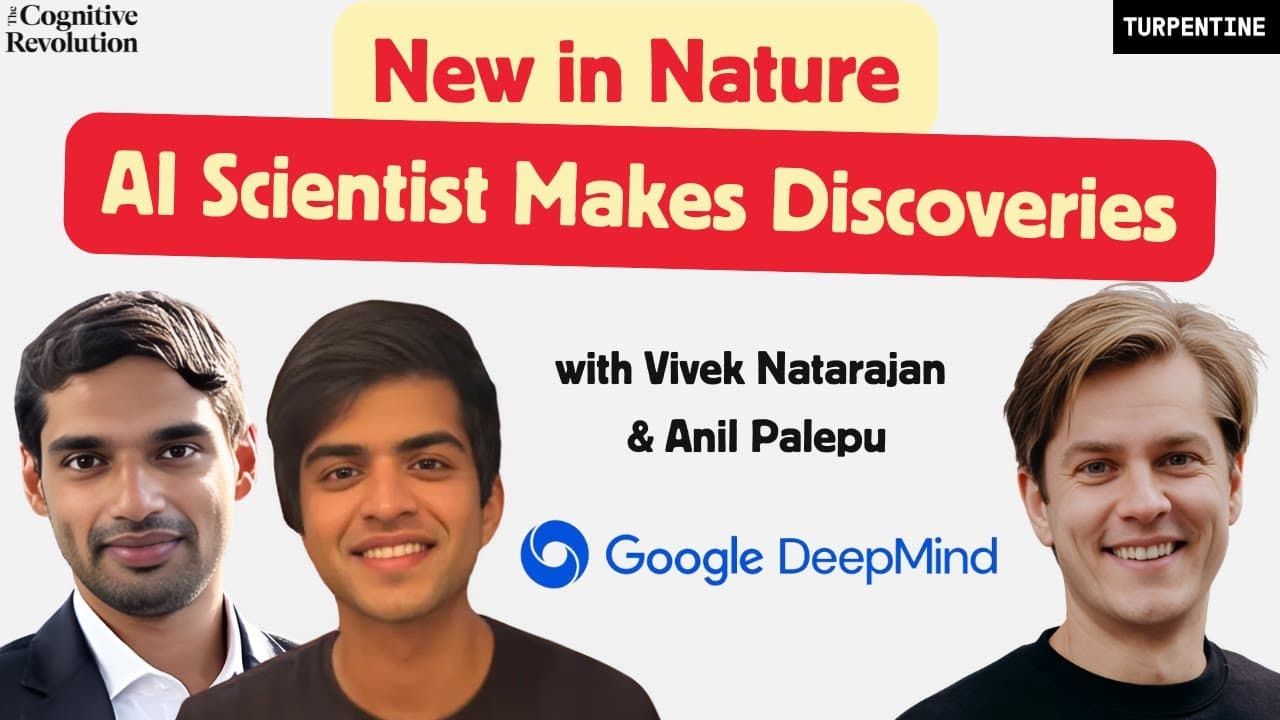
AI systems like AMIE and Co-Scientist are outperforming human doctors in diagnostic accuracy and treatment recommendations. AMIE has entered clinical trials at a Harvard Medical School hospital, while Co-Scientist has independently discovered mechanisms for bacterial drug resistance, paralleling human scientific findings. These developments signify a threshold moment in AI's role as a thought partner in complex intellectual tasks.
Transcript
Hello and welcome back to the cognitive revolution. Today's episode features an eye-opening conversation with Vav Natarajan and Anil Pelipu from Google Deep Mind. Their groundbreaking work on Amy, the articulate medical intelligence explorer and co-scientist represent what seems to me an important threshold moment in AI capabilities. I always say t... Read More
Key Insights
- AMIE is an AI system that surpasses human doctors in diagnostic accuracy and treatment recommendations.
- Co-Scientist is capable of scientific discovery, proposing mechanisms for bacterial drug resistance.
- These AI systems operate without extensive custom training, relying on commercially available models.
- AI systems can enhance healthcare access and improve reliability in specialized medicine.
- Structured reasoning in AI systems proves more effective than simple chain of thought approaches.
- Long context capabilities in AI models allow for processing and reasoning over vast amounts of information.
- Tournament-style evaluation surfaces the best hypotheses by comparing multiple AI-generated ideas.
- Real-world deployment of AI systems in healthcare is underway, with AMIE entering clinical trials.
Install to Summarize YouTube Videos and Get Transcripts
Explore YouTube Video Summarizer or Get YouTube Transcript Extractor
Questions & Answers
Q: How do AI systems like AMIE outperform human doctors?
AI systems like AMIE outperform human doctors by utilizing advanced models that analyze and synthesize vast amounts of medical data. They provide accurate diagnostic and treatment recommendations, often surpassing human primary care physicians in analysis. These systems are designed to reason through complex medical scenarios, enhancing healthcare access and reliability.
Q: What is Co-Scientist's role in scientific discovery?
Co-Scientist is an AI system designed to perform scientific discoveries by analyzing large datasets and proposing novel hypotheses. It successfully identified mechanisms for bacterial drug resistance, paralleling human scientific research. This capability highlights AI's potential as a thought partner in advancing scientific knowledge and solving complex problems.
Q: How does structured reasoning benefit AI systems?
Structured reasoning benefits AI systems by providing a clear framework for processing information and making decisions. Unlike simple chain of thought approaches, structured reasoning involves predefined steps that guide the AI through complex tasks, improving accuracy and reliability in generating insights and recommendations.
Q: What are the implications of AI systems in healthcare?
AI systems in healthcare have profound implications, including improved diagnostic accuracy, enhanced treatment recommendations, and increased access to quality care. They can support healthcare professionals by offering reliable insights, potentially reducing wait times for specialist consultations and improving patient outcomes globally.
Q: How do long context capabilities enhance AI models?
Long context capabilities enable AI models to process and reason over large amounts of information, allowing them to maintain coherence and accuracy in complex tasks. This capability is crucial for tasks requiring the integration of diverse data sources, leading to more informed and reliable decision-making processes.
Q: What is the significance of tournament-style evaluation in AI?
Tournament-style evaluation is significant in AI as it involves comparing multiple AI-generated hypotheses to surface the best ideas. This method enhances the reliability of AI systems by ensuring that the most promising solutions are identified and pursued, thereby improving the overall effectiveness of AI-driven insights.
Q: How are AI systems being tested in real-world healthcare settings?
AI systems like AMIE are being tested in real-world healthcare settings through clinical trials, such as those conducted at a Harvard Medical School hospital. These trials aim to validate the AI's performance in diagnosing and treating patients, ensuring that the systems can operate effectively and safely in actual medical environments.
Q: What challenges remain for AI systems in scientific discovery?
Challenges for AI systems in scientific discovery include ensuring the reliability of generated hypotheses, integrating diverse data sources, and overcoming the limitations of current models. Ongoing research focuses on enhancing AI's ability to autonomously identify and explore novel scientific questions, further advancing its role as a thought partner in research.
Summary & Key Takeaways
-
AI systems like AMIE and Co-Scientist are now outperforming human doctors in diagnostic tasks and treatment recommendations. AMIE's capabilities are being tested in clinical trials at a Harvard Medical School hospital, signaling a significant advancement in AI healthcare applications.
-
Co-Scientist, an AI system, demonstrated its ability to perform scientific discoveries by independently identifying mechanisms for bacterial drug resistance, aligning with unpublished human research. This marks a pivotal moment in AI's role as a thought partner in scientific endeavors.
-
The integration of structured reasoning and long context capabilities in AI models enhances their performance, allowing them to process vast amounts of information and generate reliable insights. These advancements are paving the way for AI systems to become integral in complex intellectual tasks.
Read in Other Languages (beta)
Share This Summary 📚
Summarize YouTube Videos and Get Video Transcripts with 1-Click
Try YouTube Summary with ChatGPT & Claude or YouTube Transcript Generator
Explore More Summaries from Cognitive Revolution "How AI Changes Everything" 📚




Summarize YouTube Videos and Get Video Transcripts with 1-Click
Try YouTube Summary with ChatGPT & Claude or YouTube Transcript Generator