How Gaia Changed Astronomy Forever
TL;DR
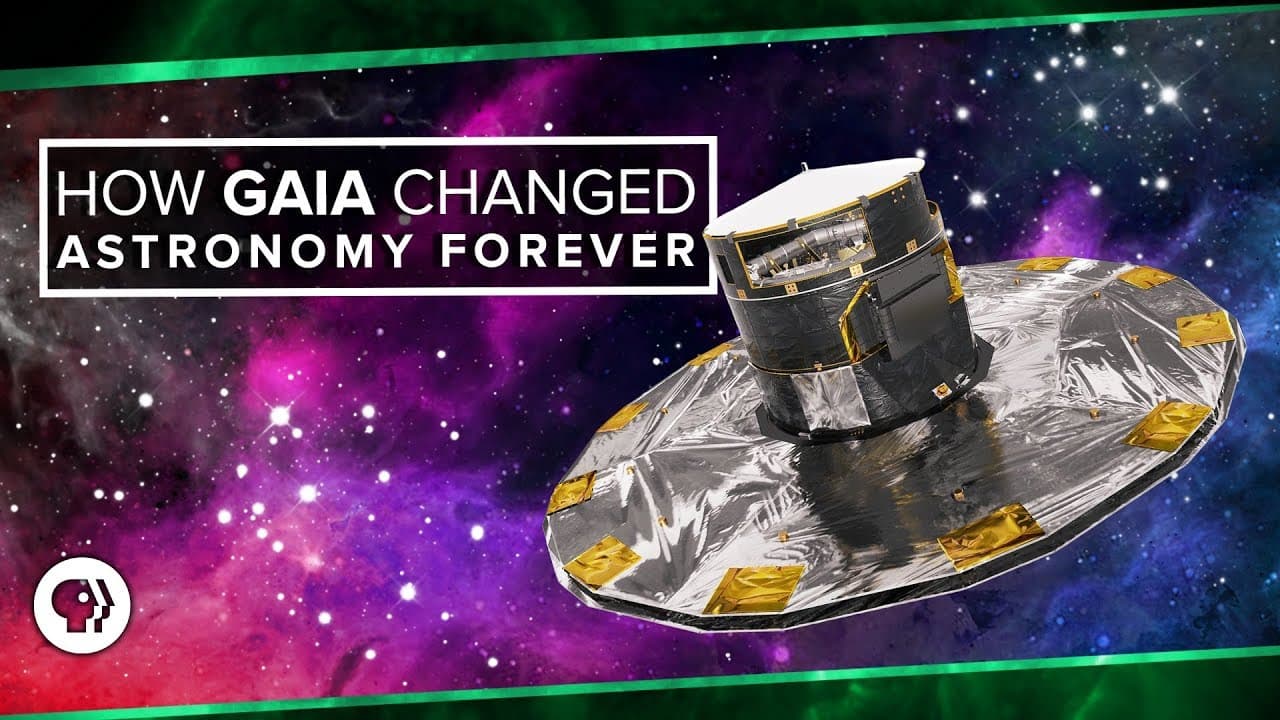
Gaia revolutionized our understanding of the Milky Way with precise star mapping.
Transcript
The great advances in any science tend to come in sudden leaps April 25th of 2018 marks the beginning of just such a leap for much of astronomy. In the early hours of the morning the Gaia mission second data release dropped. Our understanding of our own galaxy will never be the same again. The Gaia satellite was launched in late 2013 entirely built... Read More
Key Insights
- The Gaia satellite, launched by the European Space Agency, aims to map the Milky Way with unprecedented precision, surpassing its predecessor Hipparcos by cataloging nearly 1.7 billion stars.
- Gaia's astrometry allows it to measure star positions with incredible accuracy, enabling the creation of a 3D dynamic atlas of our galaxy and providing insights into stellar distances and velocities.
- The mission's data release in April 2018 marked a significant leap in astronomy, offering a detailed Hertzsprung–Russell diagram that reveals intricate details about stellar evolution and population.
- Gaia's ability to measure stellar velocities through Doppler shifts and position changes helps astronomers model the Milky Way's dynamics, uncovering its spiral structure and historical interactions with other galaxies.
- The mission has advanced our understanding of exoplanets by improving distance measurements, allowing for more accurate assessments of planetary sizes and potential new discoveries through radial velocity shifts.
- Gaia's data contributes to dark matter research by studying stellar streams, offering clues about sub-halos and dark matter distribution within the galaxy.
- Beyond stars, Gaia tracks solar system objects, including asteroids, aiding in future mining missions and identifying potential Earth threats, while also mapping distant quasars and supernovae.
- The mission enhances gravitational wave research by providing precise distance measurements to pulsars, contributing to a galactic-scale observatory for detecting these cosmic phenomena.
Install to Summarize YouTube Videos and Get Transcripts
Explore YouTube Video Summarizer or Get YouTube Transcript Extractor
Questions & Answers
Q: What is the primary goal of the Gaia satellite?
The primary goal of the Gaia satellite, launched by the European Space Agency, is to map the stars of the Milky Way with unprecedented precision. It aims to catalog nearly 1.7 billion stars, providing detailed information on their positions, colors, and brightness, far surpassing its predecessor Hipparcos.
Q: How does Gaia measure stellar distances?
Gaia measures stellar distances using a phenomenon called stellar parallax. As the satellite orbits the Sun at Lagrange point two, it detects tiny shifts in star positions relative to its motion. Coupled with its precise position measurements, Gaia determines distances to stars as far as the galactic center.
Q: What insights does Gaia provide about stellar evolution?
Gaia provides insights into stellar evolution by offering a detailed Hertzsprung–Russell diagram, revealing intricate details about star mass, size, fusion activity, and evolutionary paths. It extends the main sequence to include faint red dwarfs and shows the sequence of white dwarfs, enhancing our understanding of stellar life cycles.
Q: How does Gaia contribute to our understanding of the Milky Way's dynamics?
Gaia contributes to understanding the Milky Way's dynamics by measuring stellar velocities through Doppler shifts and position changes. This data allows astronomers to model the galaxy's spiral structure, uncover historical interactions, and trace the origins of stars, providing a detailed view of our galactic environment.
Q: What role does Gaia play in exoplanet research?
In exoplanet research, Gaia improves distance measurements to stars, allowing for more accurate assessments of planetary sizes. By analyzing radial velocity shifts, Gaia helps identify potential new exoplanets and enhances our understanding of existing ones, contributing significantly to the field of planetary science.
Q: How does Gaia aid in dark matter research?
Gaia aids in dark matter research by studying stellar streams, which are dynamically connected groups of stars. Disruptions in these streams may indicate the presence of dark matter sub-halos, offering clues about dark matter distribution and helping astronomers understand its nature and influence in the galaxy.
Q: What other celestial objects does Gaia track?
Besides stars, Gaia tracks over 14,000 asteroids and other solar system objects, aiding in future mining missions and identifying potential Earth threats. It also maps the positions and brightness of over half a million quasars and identifies supernovae, contributing to our understanding of the universe beyond our galaxy.
Q: How does Gaia support gravitational wave research?
Gaia supports gravitational wave research by providing precise distance measurements to pulsars, enhancing the pulsar timing array, a galactic-scale gravitational wave observatory. This data improves the detection of gravitational waves, contributing to our understanding of these cosmic phenomena and their sources.
Summary & Key Takeaways
-
The Gaia satellite, launched by the European Space Agency, has revolutionized our understanding of the Milky Way by mapping nearly 1.7 billion stars with unprecedented precision. Its astrometry capabilities allow for accurate measurements of stellar positions, distances, and velocities, creating a comprehensive 3D atlas of our galaxy.
-
Gaia's data release in April 2018 marked a significant advancement in astronomy, offering detailed insights into stellar evolution through a refined Hertzsprung–Russell diagram. The mission's ability to track stellar velocities and positions helps model the Milky Way's dynamics and uncover historical galactic interactions.
-
In addition to stellar mapping, Gaia contributes to exoplanet research, dark matter studies, and solar system object tracking. It provides crucial data for gravitational wave research by enhancing distance measurements to pulsars, supporting a galactic-scale observatory for detecting these cosmic phenomena.
Read in Other Languages (beta)
Share This Summary 📚
Summarize YouTube Videos and Get Video Transcripts with 1-Click
Try YouTube Summary with ChatGPT & Claude or YouTube Transcript Generator
Explore More Summaries from PBS Space Time 📚




Summarize YouTube Videos and Get Video Transcripts with 1-Click
Try YouTube Summary with ChatGPT & Claude or YouTube Transcript Generator