Percent Error Made Easy!
TL;DR
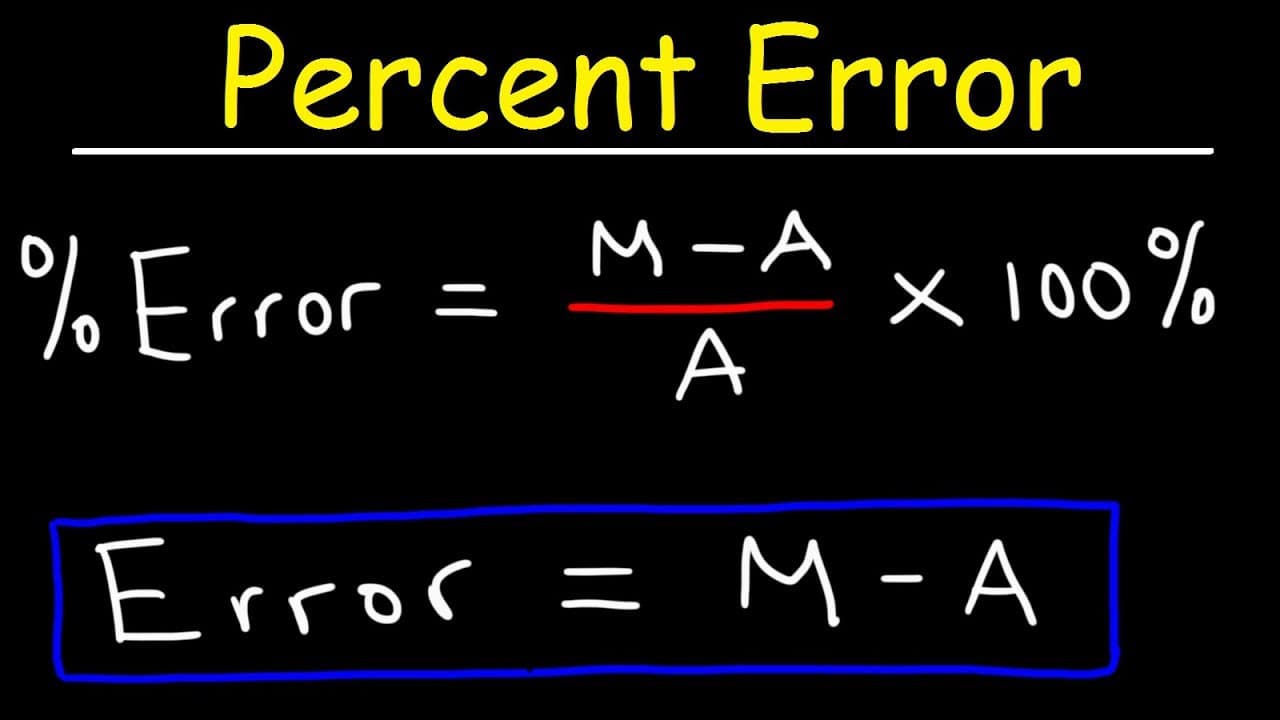
Learn how to calculate percent error in experimental measurements using the difference between the measured value and the actual value.
Transcript
in this video we're going to focus on calculating percent error so here's a problem let's say that you have an experiment and you're measuring the density of aluminum and let's say your measured value is 2.6 grams per cubic centimeter so this is how much you got in the experiment now the accepted value or the actual density of aluminum this is what... Read More
Key Insights
- 🔨 Percent error is a useful tool in evaluating the accuracy of experimental measurements.
- ❓ It can be calculated using the formula: |(measured value - actual value) / actual value| * 100.
- 💨 Percent error provides a standardized way to compare experimental results to accepted values.
- 🛩️ Negative errors indicate that the measured value is smaller than the actual value, while positive errors indicate the opposite.
- ℹ️ Percent error can help identify sources of error in experimental procedures.
- ❓ Calculating error (without percentage) involves simply finding the numerical difference between the measured and actual values.
- 👨🔬 Both percent error and error are important in scientific research and analysis.
Install to Summarize YouTube Videos and Get Transcripts
Explore YouTube Video Summarizer or Get YouTube Transcript Extractor
Questions & Answers
Q: How is percent error calculated in experimental measurements?
Percent error in experimental measurements is calculated by taking the absolute difference between the measured value and the actual value, dividing it by the absolute value of the actual value, and then multiplying by 100.
Q: What is the formula for calculating percent error?
The formula for calculating percent error is |(measured value - actual value) / actual value| * 100.
Q: Can percent error be negative?
Percent error is always positive, as it is the absolute difference between the measured and actual values. However, the error itself (without percentage) can be negative if the measured value is smaller than the actual value.
Q: What is the difference between percent error and error?
Percent error represents the relative difference between the measured and actual values, expressed as a percentage. Error, on the other hand, is the absolute numerical difference between the measured and actual values.
Summary & Key Takeaways
-
The video explains how to calculate percent error in experimental measurements using the formula: percent error = |(measured value - actual value) / actual value| * 100.
-
It provides an example of calculating percent error for the measured density of aluminum, with a measured value of 2.6 g/cm³ and an actual value of 2.7 g/cm³, resulting in a percent error of 3.7%.
-
The video also demonstrates calculating the error (without percentage) for an experimental measurement of iron metal density, with a measured value of 7.7 g/cm³ and an actual value of 7.86 g/cm³, resulting in an error of -0.16.
Read in Other Languages (beta)
Share This Summary 📚
Summarize YouTube Videos and Get Video Transcripts with 1-Click
Try YouTube Summary with ChatGPT & Claude or YouTube Transcript Generator
Explore More Summaries from The Organic Chemistry Tutor 📚
Summarize YouTube Videos and Get Video Transcripts with 1-Click
Try YouTube Summary with ChatGPT & Claude or YouTube Transcript Generator