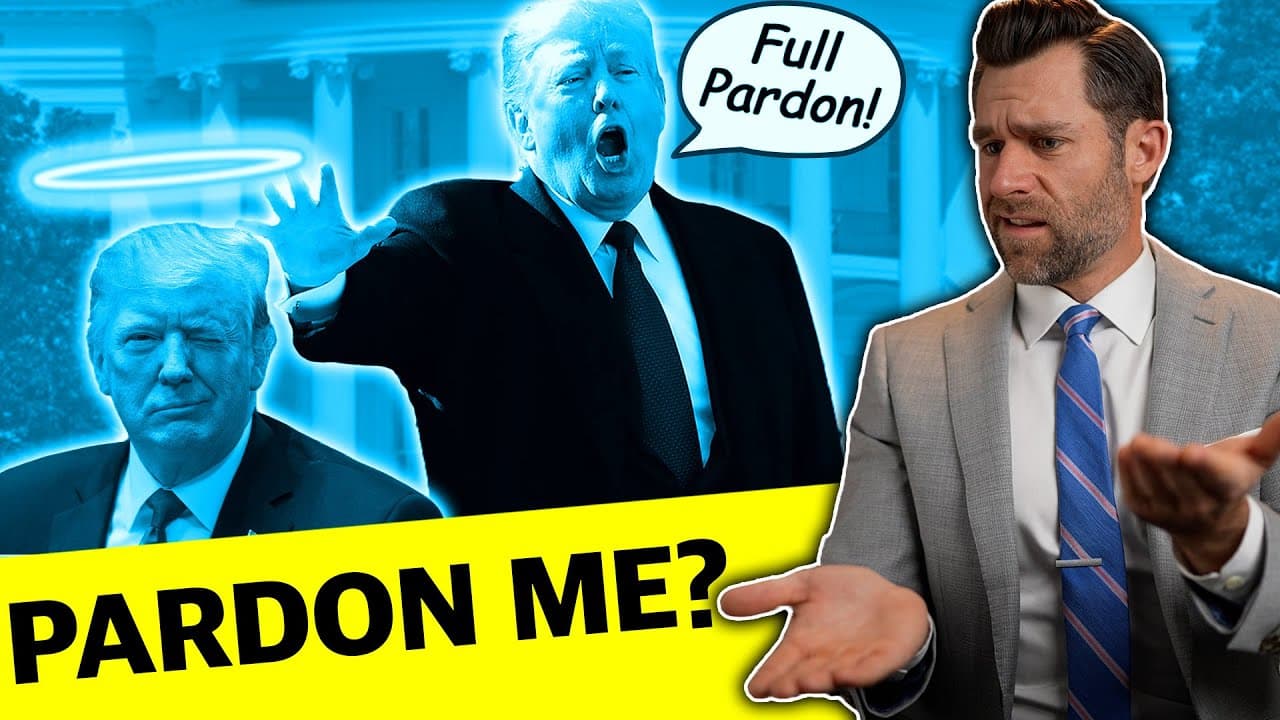
Can a President Pardon Himself or His Family?
TL;DR
A president can issue pardons for federal offenses, which may include pardoning themselves and their family. However, the legality of self-pardons is debated, with constitutional arguments suggesting it may violate the principle that one cannot be the judge in their own case. Congress can investigate pardons but lacks the authority to regulate them directly.
Transcript
- Thanks to Ting Mobile for keeping legal legal in the air. In the waning days of the Trump presidency, people are wondering if president Trump is going to exercise the pardon power to pardon himself and his family. Well, yeah, probably. Good night everyone. Oh, you want to know if there are any limits on the presidential pardon power, or if there'... Read More
Key Insights
- ✊ The presidential pardon power has limitations, including not applying to state crimes or impeachment cases.
- 🤳 The constitutionality of self-pardons is a debated topic, with arguments for and against.
- ✊ Congress can investigate presidential pardons but has limited authority to regulate the power.
- 🤳 The Supreme Court could potentially review cases involving self-pardons but has historically avoided political questions.
- 😖 The historical context of the presidential pardon power traces back to English traditions and American founding principles.
- 🤨 Possible scenarios, such as a president stepping down to receive a pardon from their successor, raise ethical and legal considerations.
- ✊ Legal interpretations and historical cases provide guidance on the scope and limitations of the presidential pardon power.
Install to Summarize YouTube Videos and Get Transcripts
Explore YouTube Video Summarizer or Get YouTube Transcript Extractor
Questions & Answers
Q: Are there any limits to the presidential pardon power?
Yes, the president cannot pardon state crimes or impeachment cases, and there is debate about self-pardons and potential constitutional limits.
Q: Can a president pardon themselves?
While the text of the constitution does not explicitly prohibit self-pardons, legal arguments exist against it, including the principle of no one being a judge in their own case.
Q: How can Congress regulate presidential pardon authority?
Congress can investigate the use of pardons through oversight powers, issuing subpoenas, and holding hearings, but lacks the direct legislative authority to limit the power.
Q: What role does the Supreme Court play in presidential pardons?
The Supreme Court has the power to interpret the scope of the pardon power and could potentially review cases involving self-pardons, although it has historically avoided political questions.
Summary & Key Takeaways
-
The presidential pardon power allows for the forgiveness of federal crimes, but it has limitations such as not applying to state crimes or impeachment cases.
-
There is ambiguity regarding whether a president can pardon themselves, with arguments for and against its constitutionality.
-
Congress can investigate the use of presidential pardons but lacks direct authority to limit the power.
Read in Other Languages (beta)
Share This Summary 📚
Summarize YouTube Videos and Get Video Transcripts with 1-Click
Try YouTube Summary with ChatGPT & Claude or YouTube Transcript Generator
Explore More Summaries from LegalEagle 📚





Summarize YouTube Videos and Get Video Transcripts with 1-Click
Try YouTube Summary with ChatGPT & Claude or YouTube Transcript Generator