How Long Is a Day on Earth in Hours and Minutes?
TL;DR
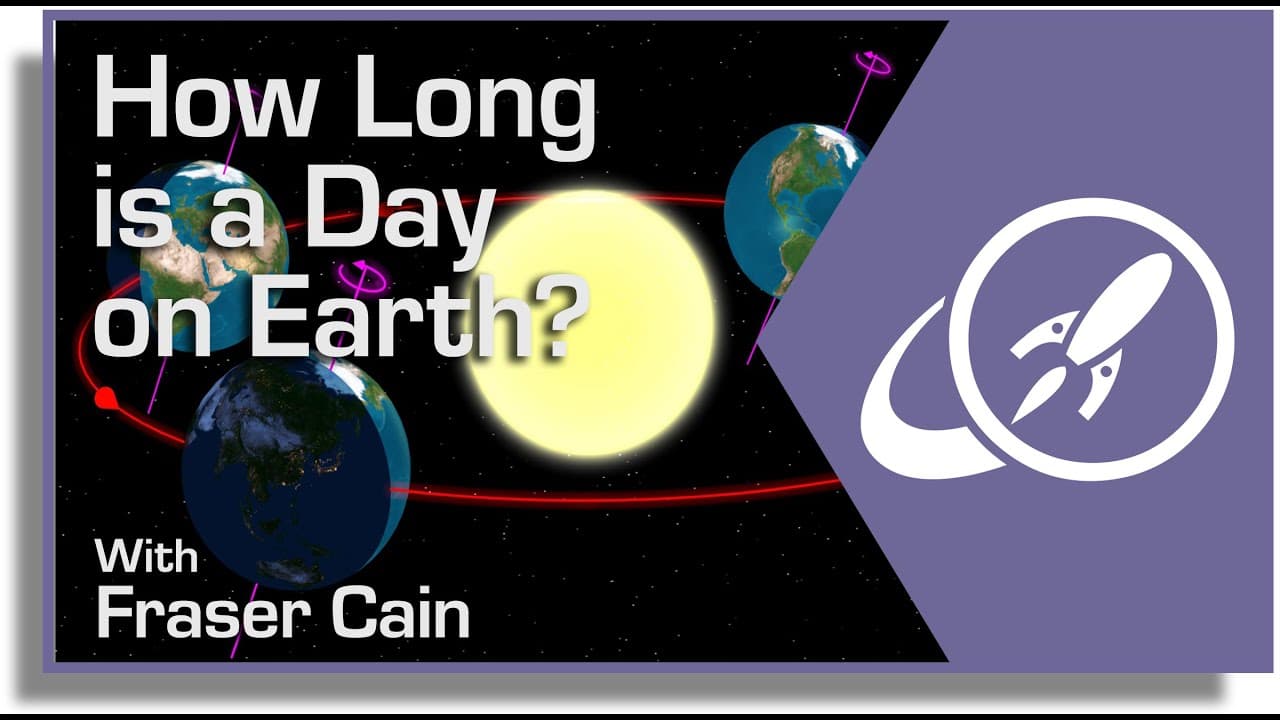
A day on Earth is approximately 23 hours, 56 minutes, and 4.09 seconds due to its rotation on its axis, differing from the 24-hour solar day. This discrepancy arises because, as the Earth orbits the Sun, it must rotate slightly more for the sun to appear in the same position in the sky each day. Additionally, factors like precession and tidal forces can further affect the length of a day.
Transcript
how long is a day on earth well more specifically how long does it take for the earth to turn once on its axis for all the stars to move through the sky and return to their original position go ahead and yell your answer at the screen 24 hours wrong it only takes 23 hours 56 minutes and 4.0 nine one six seconds for the earth to turn once on its axi... Read More
Key Insights
- 🥳 Earth's day length is 23 hours, 56 minutes, and 4.0916 seconds due to its rotation.
- 🥳 The difference between a solar day and a sidereal day is based on Earth's orbit.
- 🥳 Precession causes Earth's axis to shift, influencing the duration of a day.
- ⌛ Seismic events, like earthquakes, can impact the Earth's rotation time.
- 🙂 Tidal interactions with the moon contribute to slight changes in Earth's day length.
- 🫠 Glacial melting affects the Earth's rotation speed.
- 🥳 Earth's day length can be influenced by various external factors.
Install to Summarize YouTube Videos and Get Transcripts
Explore YouTube Video Summarizer or Get YouTube Transcript Extractor
Questions & Answers
Q: Why is Earth's day length not exactly 24 hours?
Earth's rotation on its axis takes 23 hours, 56 minutes, and 4.0916 seconds, making a sidereal day shorter than a solar day due to its orbit around the Sun.
Q: How does precession affect Earth's day length?
Earth's axis wobbles over a 26,000-year cycle, leading to a slight change in the Earth's day length by 0.0084 seconds as the North Star shifts.
Q: Can seismic events impact the duration of a day?
Yes, powerful earthquakes can alter the Earth's rotation time by a few microseconds, showcasing how external events can influence the length of a day.
Q: What role do tidal forces play in Earth's day length?
Tidal interactions with the moon cause the Earth's day to increase by approximately 1.7 milliseconds over a century, showcasing the dynamic nature of our planet's rotation.
Summary & Key Takeaways
-
Earth's day is not a standard 24 hours but rather 23 hours, 56 minutes, and 4.0916 seconds due to its rotation on its axis.
-
The difference between a solar day and a sidereal day lies in the Earth's orbit around the Sun.
-
Factors like precession, tidal forces, and seismic events can affect the exact length of a day on Earth.
Read in Other Languages (beta)
Share This Summary 📚
Summarize YouTube Videos and Get Video Transcripts with 1-Click
Try YouTube Summary with ChatGPT & Claude or YouTube Transcript Generator
Explore More Summaries from Fraser Cain 📚



Summarize YouTube Videos and Get Video Transcripts with 1-Click
Try YouTube Summary with ChatGPT & Claude or YouTube Transcript Generator