What Are Complex Numbers in Polar Form?
TL;DR
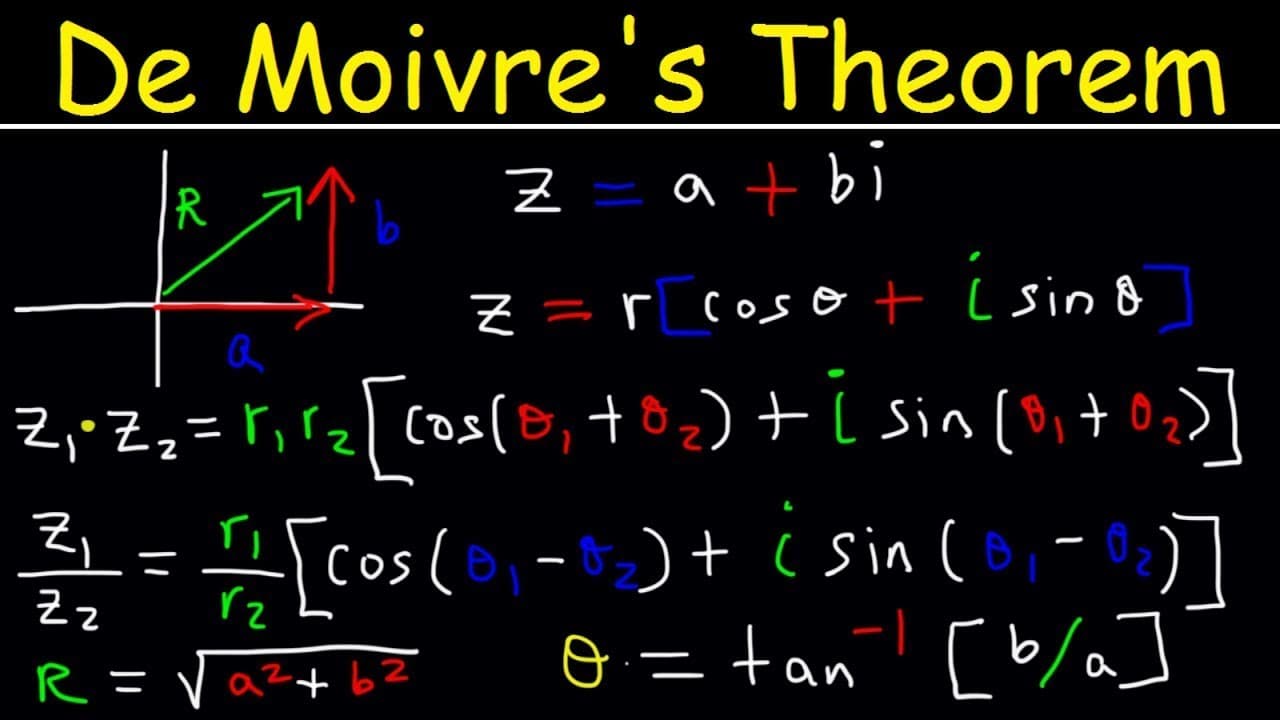
Complex numbers in polar form are expressed as z = r(cos(θ) + i sin(θ)), where r is the magnitude and θ is the angle. To convert from rectangular to polar form, use r = √(a² + b²) for the radius and θ = atan(b/a) for the angle. When multiplying, multiply the r values and add the angles; to divide, divide the r values and subtract the angles.
Transcript
in this video we're going to talk about complex numbers in polar form and we're also going to go over the more va's theorem so the complex number z in rectangular form is a plus bi in polar form z can be represented this way it's r times cosine theta plus i sine theta or sine theta times i now to graph a complex number in rectangular form you need ... Read More
Key Insights
- 🤪 Complex numbers can be represented in polar form as z = r(cos(θ) + i sin(θ)).
- ❣️ The x-axis and y-axis represent the real and imaginary axes, respectively, when graphing complex numbers in rectangular form.
- 💁 The radius value determines the size of the circle when graphing complex numbers in polar form.
- 💁 Converting from rectangular form to polar form requires calculating the radius using the formula r = √(a^2 + b^2) and the angle using θ = atan(b/a).
- ✖️ When multiplying complex numbers in polar form, multiply the radius values and add the angles.
- 🗂️ To divide complex numbers in polar form, divide the radius values and subtract the angles.
Install to Summarize YouTube Videos and Get Transcripts
Explore YouTube Video Summarizer or Get YouTube Transcript Extractor
Questions & Answers
Q: What is the formula for converting a complex number from rectangular form to polar form?
To convert a complex number from rectangular form to polar form, use the formulas r = √(a^2 + b^2) and θ = atan(b/a), where a and b are the real and imaginary parts of the complex number, respectively.
Q: How do you graph a complex number in polar form?
To graph a complex number in polar form, focus on circles where the radius value represents the size of the circle. The angle θ determines the position of the complex number on the circle.
Q: How do you multiply complex numbers in polar form?
To multiply complex numbers in polar form, multiply the radius values of the numbers and add their angles to find the resulting complex number.
Q: What is De Moivre's theorem?
De Moivre's theorem allows you to find the nth power of a complex number in polar form. It states that z^n = r^n(cos(nθ) + i sin(nθ)), where z is the complex number, r is the radius, and θ is the angle.
Summary & Key Takeaways
-
Complex numbers in polar form can be represented as z = r(cos(θ) + i sin(θ)).
-
When graphing complex numbers in rectangular form, the x-axis represents the real axis and the y-axis represents the imaginary axis.
-
Graphing complex numbers in polar form requires focusing on circles, where the radius value determines the size of the circle.
-
To convert from rectangular form to polar form, use the formulas: r = √(a^2 + b^2) and θ = atan(b/a).
-
When multiplying complex numbers in polar form, multiply the radius values and add the angles.
-
To divide complex numbers in polar form, divide the radius values and subtract the angles.
-
De Moivre's theorem can be used to find the nth power of a complex number in polar form.
Read in Other Languages (beta)
Share This Summary 📚
Summarize YouTube Videos and Get Video Transcripts with 1-Click
Try YouTube Summary with ChatGPT & Claude or YouTube Transcript Generator
Explore More Summaries from The Organic Chemistry Tutor 📚




Summarize YouTube Videos and Get Video Transcripts with 1-Click
Try YouTube Summary with ChatGPT & Claude or YouTube Transcript Generator