What Is a Random Forest and How Does It Work?
TL;DR
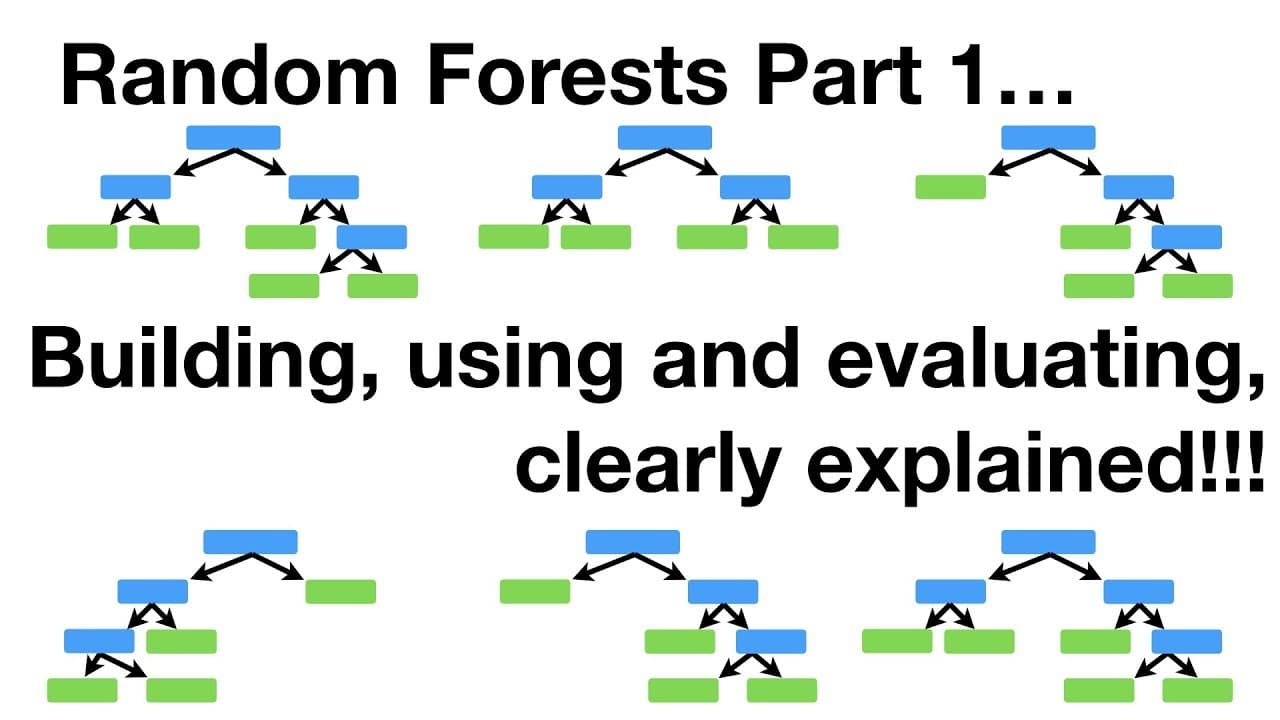
A random forest is an ensemble learning method that improves classification accuracy by combining multiple decision trees built from bootstrap samples. It uses a subset of variables at each step to increase diversity among the trees, and out-of-bag error helps assess its performance by evaluating how well it classifies data not used in training.
Transcript
Wandering around a random forest. I won't get lost because of stat quest Hello, I'm Josh Dharma and welcome to stat quest today We're gonna be starting part one of a series on random forests, and we're going to talk about building and evaluating random forests Note random forests are built from decision trees. So if you don't already know about tho... Read More
Key Insights
- 🌲 Random forests combine decision trees and bootstrapping for improved accuracy.
- 🌲 Bootstrapping involves creating duplicate samples to build diverse trees.
- 🥖 Out-of-bag error estimates the accuracy of a random forest model.
- 💱 Changing the number of variables per step can optimize the random forest's accuracy.
- ❓ Experimenting with different settings helps identify the most accurate random forest configuration.
- 👶 Random forests are effective in handling classification tasks with new data samples.
- ❓ Iterative testing and optimization are essential for enhancing the accuracy of random forest models.
Install to Summarize YouTube Videos and Get Transcripts
Explore YouTube Video Summarizer or Get YouTube Transcript Extractor
Questions & Answers
Q: How do random forests improve accuracy compared to individual decision trees?
Random forests combine decision trees and bootstrapping to create a flexible and accurate classification model. By utilizing the strength of multiple trees, random forests increase accuracy in handling new data samples.
Q: What is the significance of creating a bootstrap dataset in random forests?
Bootstrap datasets are crucial in random forests as they allow for duplicates and variability in tree creation. This diversity leads to improved accuracy and flexibility when classifying new data.
Q: How is the out-of-bag error used to estimate the accuracy of a random forest?
The out-of-bag error measures the proportion of correctly classified samples that were not included in the bootstrap dataset. By evaluating these samples, one can estimate the accuracy of the random forest model.
Q: How does changing the number of variables per step impact the accuracy of a random forest?
By experimenting with different settings, such as the number of variables considered at each step, one can optimize the random forest's accuracy. This iterative process helps identify the most accurate configuration for the model.
Summary & Key Takeaways
-
Random forests enhance accuracy by combining decision trees and bootstrapping datasets.
-
Bootstrapping involves creating duplicate samples to build multiple decision trees.
-
Out-of-bag error helps estimate the random forest's accuracy by testing unlabeled data.
Read in Other Languages (beta)
Share This Summary 📚
Summarize YouTube Videos and Get Video Transcripts with 1-Click
Try YouTube Summary with ChatGPT & Claude or YouTube Transcript Generator
Explore More Summaries from StatQuest with Josh Starmer 📚

Summarize YouTube Videos and Get Video Transcripts with 1-Click
Try YouTube Summary with ChatGPT & Claude or YouTube Transcript Generator