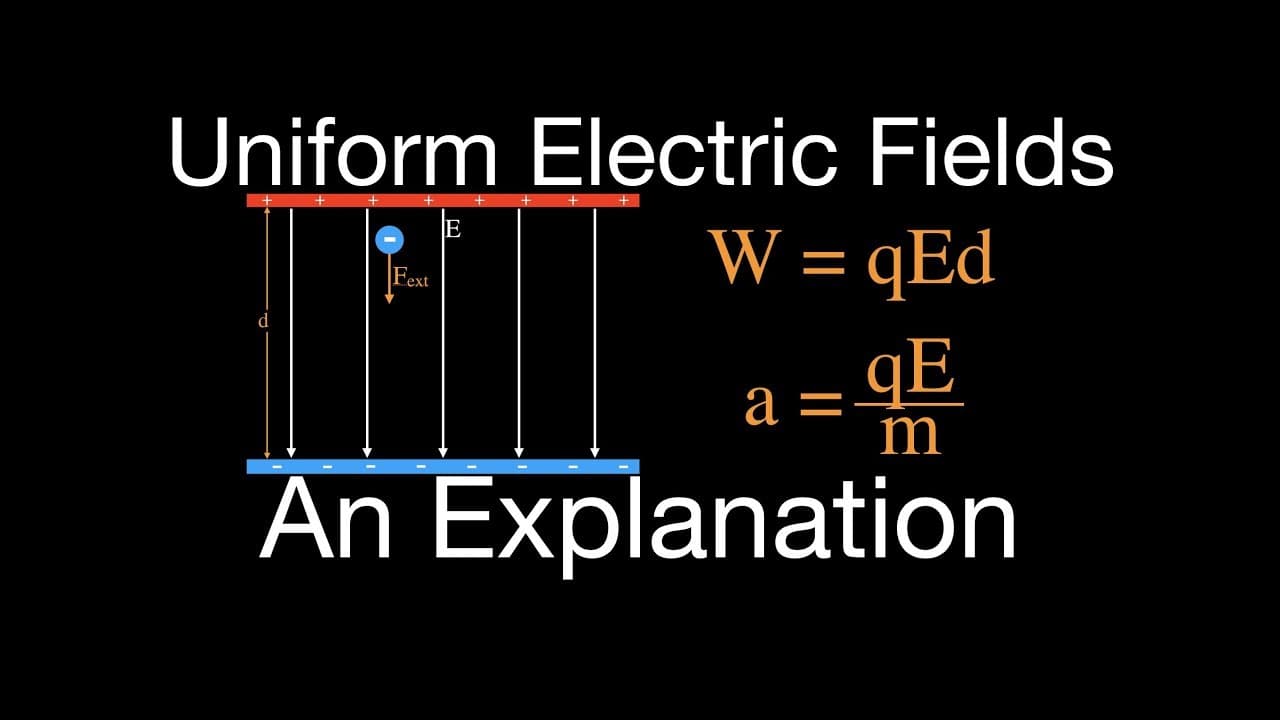
Uniform Electric Field (1 of 9 ) Motion of Charged Particles Parallel to the Field
TL;DR
Explains work, velocity, and acceleration of charged particles in electric fields with relevant equations and examples.
Transcript
okay in today's video I am going to be going over the motion of charged particles in electric fields and we're gonna be talking about particles that are moving along or parallel to electric field in this video in the next video which we can link to in the upper right hand corner this video will go over charged particles that are moving across or pe... Read More
Key Insights
- 🈂️ Work done on a charged particle is equal to the product of charge, electric field strength, and distance.
- 🏑 Potential energy is converted to kinetic energy as charged particles move in electric fields.
- 👮 Acceleration of charged particles in electric fields is determined by Newton's second law.
- 🏑 The velocity of a charged particle in an electric field is calculated using relevant equations.
- 🥡 Time taken for a charged particle to move in an electric field can be determined using kinematic equations.
Install to Summarize YouTube Videos and Get Transcripts
Explore YouTube Video Summarizer or Get YouTube Transcript Extractor
Questions & Answers
Q: How is work calculated for moving charged particles in an electric field?
Work done is the product of charge, electric field strength, and distance moved, given by the equation: Work = Q * E * D.
Q: How can we calculate the acceleration of a charged particle in an electric field?
Acceleration is derived using the equation A = (Q * E) / M, where Q is charge, E is electric field strength, and M is mass.
Q: What equation is used to determine the velocity of a charged particle moving in an electric field?
The velocity is found by the equation V = sqrt(2 * Q * E * D / M), where Q is charge, E is electric field strength, D is distance, and M is mass.
Q: How can we calculate the time taken for a charged particle to move in an electric field?
Time is calculated as T = sqrt(2 * A * X) / A, where A is acceleration and X is the distance moved.
Summary & Key Takeaways
-
Charged particles moving in an electric field experience work done due to an external force.
-
Potential energy is converted to kinetic energy as particles move in electric fields.
-
Acceleration of particles in electric fields is determined by Newton's second law.
Read in Other Languages (beta)
Share This Summary 📚
Summarize YouTube Videos and Get Video Transcripts with 1-Click
Try YouTube Summary with ChatGPT & Claude or YouTube Transcript Generator
Explore More Summaries from Step by Step Science 📚

Summarize YouTube Videos and Get Video Transcripts with 1-Click
Try YouTube Summary with ChatGPT & Claude or YouTube Transcript Generator