AI's Costly JWST Mistake // 33-Engine Super Heavy Test // Problems in Orbit
TL;DR
- SpaceX engines tested, space debris threat, kKilanova observed in the making, Google AI error, map of universe's matter, Sierra Space habitat testing.
Transcript
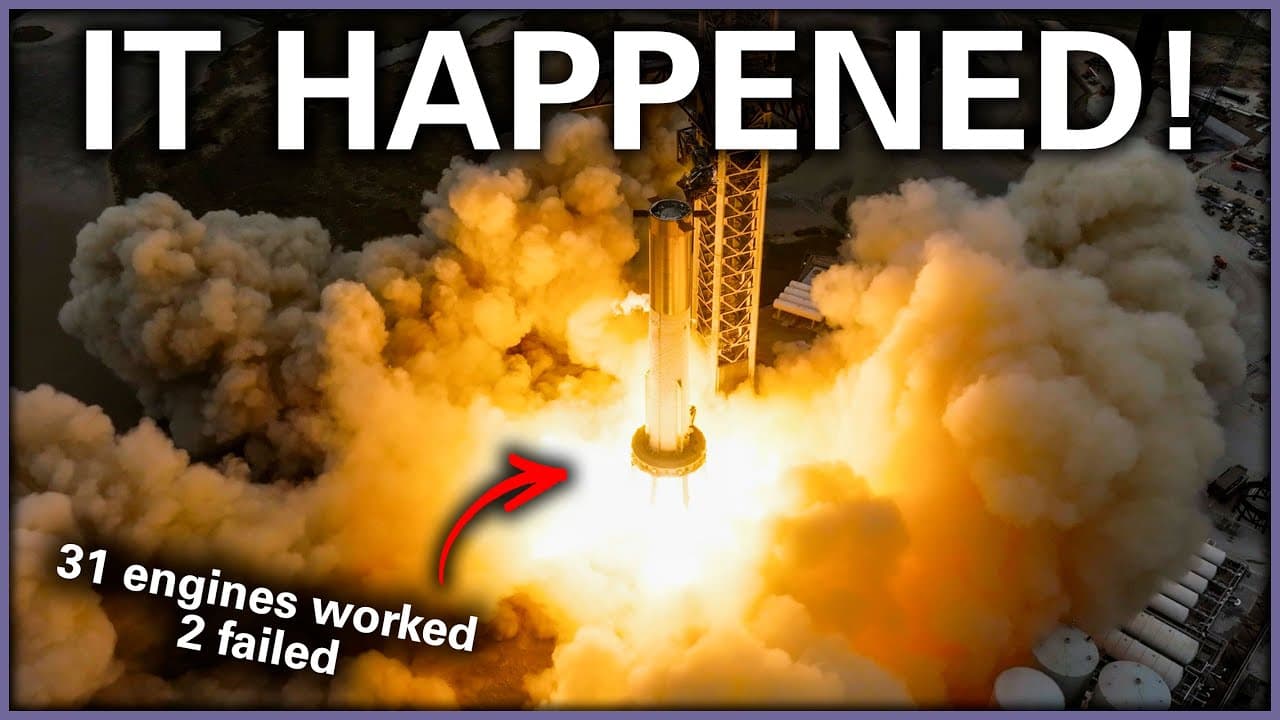
super heavy test almost all of us Raptors the worst case scenario for space debris actually happened kilanova is coming and a new map of all the matter and dark matter in the universe all this and more in this week's episode of space bites we almost got a full static fire test of all of the Raptor engines on the super heavy booster so on Thursday w... Read More
Key Insights
- 💨 SpaceX's successful Raptor engine test paves the way for an upcoming orbital launch.
- 🛰️ The breakup of a Russian satellite highlights the ongoing issue of space debris pollution.
- 🤩 Observations of kilanova events provide insights into neutron star collisions and heavy element formation.
- 💁 Google AI's error regarding JWST discoveries underscores the need for accurate information dissemination.
- 🦻 Mapping the universe's large-scale structure aids astronomers in refining cosmological theories.
- 👾 Sierra Space's inflatable habitat testing shows promise for future space habitats.
- ❓ Understanding the universe's history through mapping and observations enhances scientific knowledge.
Install to Summarize YouTube Videos and Get Transcripts
Explore YouTube Video Summarizer or Get YouTube Transcript Extractor
Questions & Answers
Q: What recent test did SpaceX conduct regarding the Raptor engines?
SpaceX recently conducted a test for all 33 Raptor engines on the super heavy booster, successfully testing 31 engines to kick Starship into orbit.
Q: How did a Russian satellite breakup contribute to the space debris issue?
A Russian satellite breakup at high altitude resulted in 85 debris pieces in orbit, highlighting the long-lasting pollution problem in space.
Q: What error did Google's AI make regarding the James Webb Space Telescope discoveries?
Google's AI erroneously claimed that JWST was the first to capture an exoplanet image, which astronomers corrected, attributing the first image to the Very Large Telescope in 2004.
Q: How did astronomers map the large-scale structure of the universe?
By utilizing gravitational lensing and data from telescopes like the Dark Energy Survey, Planck Observatory, and South Pole Telescope, they mapped matter and dark matter across the universe.
Summary & Key Takeaways
-
SpaceX tested Raptor engines for super heavy booster successfully, aiming for an orbital launch soon.
-
Space debris threat highlighted by Russian satellite breakup, raising concerns about pollution in orbit.
-
Kilanova event observed in the making, shedding light on neutron star collisions.
Read in Other Languages (beta)
Share This Summary 📚
Summarize YouTube Videos and Get Video Transcripts with 1-Click
Try YouTube Summary with ChatGPT & Claude or YouTube Transcript Generator
Explore More Summaries from Fraser Cain / Universe Today Podcast 📚
Summarize YouTube Videos and Get Video Transcripts with 1-Click
Try YouTube Summary with ChatGPT & Claude or YouTube Transcript Generator