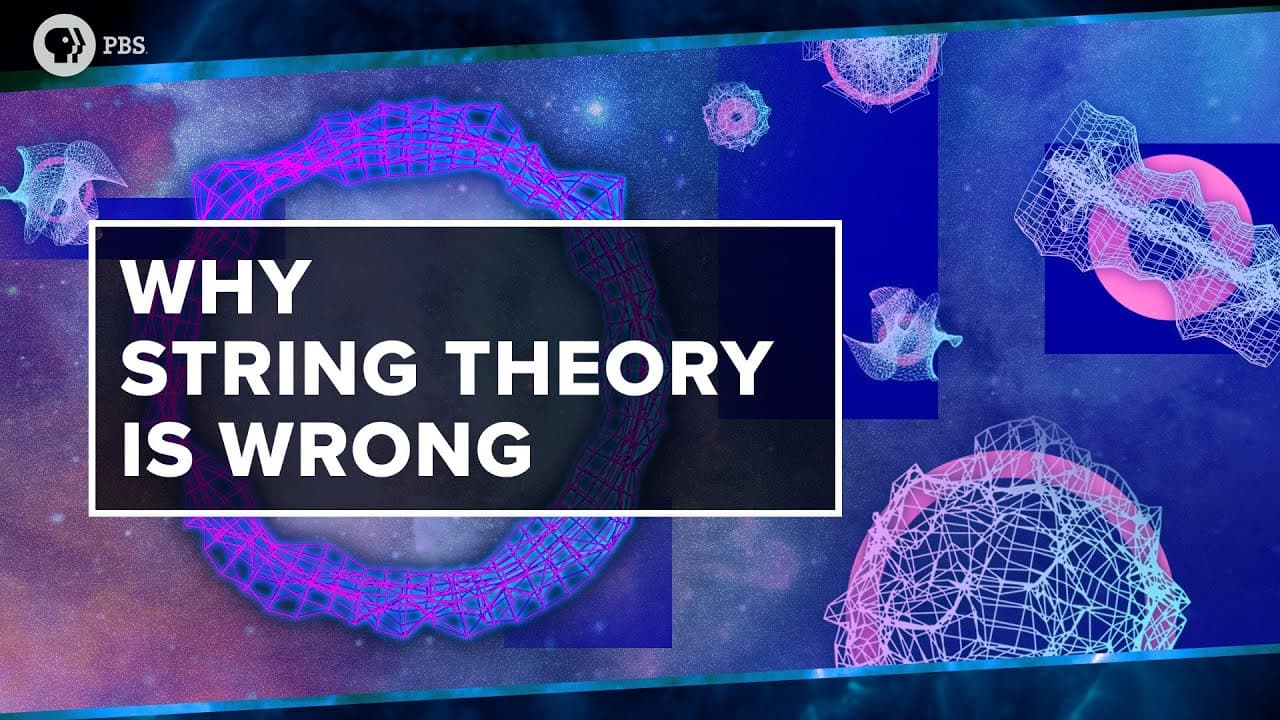
Why String Theory is Wrong
TL;DR
String theory's beauty may not equate to truth.
Transcript
Thanks to brilliant.org for supporting PBS Digital Studios. There's this idea that beauty is a powerful guide to truth in the mathematics of physical theory. String theory is certainly beautiful in the eyes of many physicists, but is it beautiful enough to pursue even if it's wrong? [intro music] Hermann Weyl once said, "If I have to choose between... Read More
Key Insights
- String theory is a beautiful mathematical framework but may not be the ultimate truth in physics.
- Hermann Weyl valued beauty over truth, sparking debates on the validity of beautiful theories.
- The Kaluza-Klein theory inspired string theory by introducing extra dimensions to explain electromagnetism.
- String theory converges multiple theories into one but faces challenges due to its complexity and lack of empirical evidence.
- Dualities in string theory suggest different mathematical expressions can describe the same physical phenomena.
- M-theory attempts to unify string theories into a single framework but remains undefined and speculative.
- The string landscape problem highlights the difficulty in pinpointing the correct geometry for our universe.
- Lack of evidence for supersymmetry at the LHC raises doubts about string theory's validity.
Install to Summarize YouTube Videos and Get Transcripts
Explore YouTube Video Summarizer or Get YouTube Transcript Extractor
Questions & Answers
Q: What is the main argument against string theory?
The main argument against string theory is its lack of empirical evidence and testable predictions. While it is a mathematically elegant framework, it remains speculative and unverified by experiments. The complexity of its extra dimensions and the unresolved nature of M-theory further challenge its validity as a true description of the universe.
Q: How does string theory attempt to unify physics?
String theory attempts to unify physics by proposing that all particles and forces are manifestations of vibrating strings in a higher-dimensional space. It incorporates quantum gravity and aims to unify the fundamental forces under a single theoretical framework. The theory's elegance lies in its ability to converge different versions into a coherent whole through dualities.
Q: What role do dualities play in string theory?
Dualities in string theory reveal that seemingly different mathematical theories can describe the same physical phenomena. They suggest that various versions of string theory are different expressions of the same underlying theory. This concept helps unify the divergent approaches within string theory, offering hope for a single, coherent framework.
Q: What is M-theory, and why is it significant?
M-theory is an extension of string theory that attempts to unify all five superstring theories into a single framework. It introduces an additional dimension, making it 11-dimensional. M-theory is significant because it offers a potential resolution to the discrepancies between different string theories, but it remains speculative and not fully understood.
Q: What challenges does the string landscape pose?
The string landscape refers to the vast number of possible geometries for the extra dimensions in string theory, each leading to different physical properties. This poses a challenge in identifying the correct geometry that corresponds to our universe. The sheer number of possibilities makes it difficult to make specific predictions or verify the theory experimentally.
Q: Why is the lack of supersymmetry evidence concerning for string theory?
Supersymmetry is a key component of string theory, providing a symmetry between bosons and fermions. The lack of evidence for supersymmetric particles at the Large Hadron Collider raises concerns about the validity of string theory. Without experimental confirmation, the theory's predictions remain speculative and unverified.
Q: How did Kaluza-Klein theory influence string theory?
Kaluza-Klein theory introduced the idea of extra dimensions to explain electromagnetism, inspiring the development of string theory. It demonstrated that higher-dimensional space could unify different forces, laying the groundwork for string theory's attempt to unify all particles and forces within a single framework using extra dimensions.
Q: What is the significance of beauty in theoretical physics?
Beauty in theoretical physics often guides the development of mathematical frameworks, as seen in string theory. However, beauty does not guarantee truth. The debate around string theory highlights the tension between pursuing elegant theories and the need for empirical validation. Hermann Weyl's preference for beauty over truth exemplifies this philosophical dilemma.
Summary & Key Takeaways
-
String theory, while mathematically elegant, may not represent the ultimate truth in physics. The theory aims to unify all particles and forces within a single framework using extra dimensions. However, its complexity and the lack of empirical evidence challenge its validity.
-
Hermann Weyl's preference for beauty over truth in theoretical physics raises questions about the pursuit of elegant theories like string theory. Despite its promise, string theory faces criticism for its speculative nature and inability to make testable predictions beyond the standard model.
-
Dualities in string theory suggest that different mathematical expressions can describe the same physical phenomena, leading to the convergence of various string theories. However, the unresolved nature of M-theory and the absence of supersymmetry evidence at the LHC cast doubt on string theory's correctness.
Read in Other Languages (beta)
Share This Summary 📚
Summarize YouTube Videos and Get Video Transcripts with 1-Click
Try YouTube Summary with ChatGPT & Claude or YouTube Transcript Generator
Explore More Summaries from PBS Space Time 📚




Summarize YouTube Videos and Get Video Transcripts with 1-Click
Try YouTube Summary with ChatGPT & Claude or YouTube Transcript Generator