Finding All Zeros of a Polynomial Function Using The Rational Zero Theorem
TL;DR
The Rational Zero Theorem helps list all possible rational zeros of a polynomial function, allowing us to solve polynomial equations efficiently.
Transcript
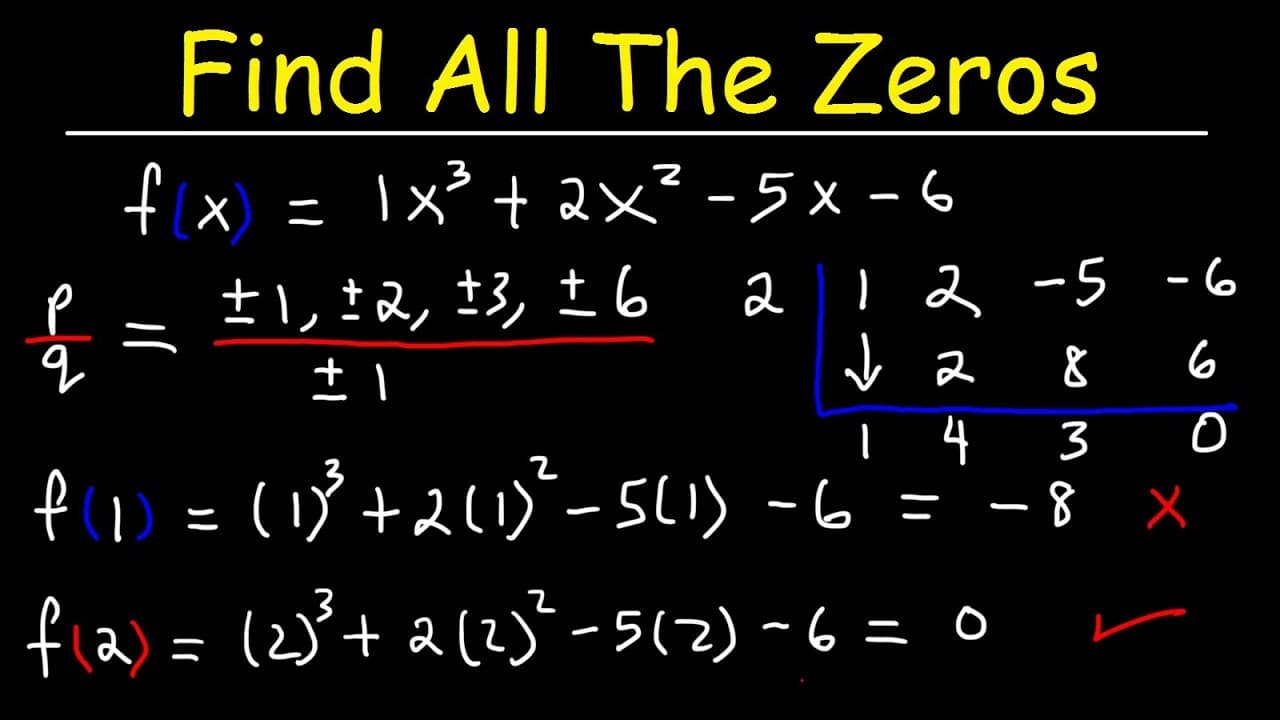
in this lesson we're going to focus on the rational zero theorem this theorem helps us to list all of the possible rational zeros of a polynomial function so it's very useful when solving polynomial equations so here's an example let's say that f of x is equal to one x cubed plus two x squared minus five x minus six and let's list all of the possib... Read More
Key Insights
- 0️⃣ The Rational Zero Theorem simplifies the process of finding rational zeros of polynomial functions.
- 0️⃣ Checking potential zeros by substituting them into the function helps identify actual zeros.
- ➗ Synthetic division is an efficient method for dividing polynomials to find other zeros.
- ✋ Factoring is used to simplify higher degree polynomials into quadratic equations.
- 0️⃣ The quadratic equation can then be solved using the quadratic formula to find any remaining zeros.
- 0️⃣ The Rational Zero Theorem is applicable for both real and complex zeros.
- 0️⃣ Selecting the correct zeros is crucial in solving polynomial equations accurately.
Install to Summarize YouTube Videos and Get Transcripts
Explore YouTube Video Summarizer or Get YouTube Transcript Extractor
Questions & Answers
Q: What is the purpose of the Rational Zero Theorem?
The Rational Zero Theorem helps in listing all possible rational zeros of a polynomial function, making it easier to solve polynomial equations.
Q: How do you determine the possible rational zeros using the theorem?
To find the possible rational zeros, we divide the constant term by the leading coefficient and list the factors, considering both positive and negative options.
Q: What is the next step after identifying the possible rational zeros?
We check each possible zero by substituting it into the function. If the result is zero, it is an actual zero of the function.
Q: How do you find the other zeros once you have one zero?
Synthetic division is used to divide the polynomial by the selected zero, reducing it to a lower degree polynomial. This process is repeated until we obtain a quadratic equation that can be factored.
Summary & Key Takeaways
-
The Rational Zero Theorem is used to identify all potential rational zeros of a polynomial function.
-
It involves dividing the constant term by the leading coefficient to determine possible factors.
-
Synthetic division and factoring are then used to find the actual roots of the polynomial equation.
Read in Other Languages (beta)
Share This Summary 📚
Summarize YouTube Videos and Get Video Transcripts with 1-Click
Try YouTube Summary with ChatGPT & Claude or YouTube Transcript Generator
Explore More Summaries from The Organic Chemistry Tutor 📚



Summarize YouTube Videos and Get Video Transcripts with 1-Click
Try YouTube Summary with ChatGPT & Claude or YouTube Transcript Generator