How Difficult Should Practice Be for Skill Learning?
TL;DR
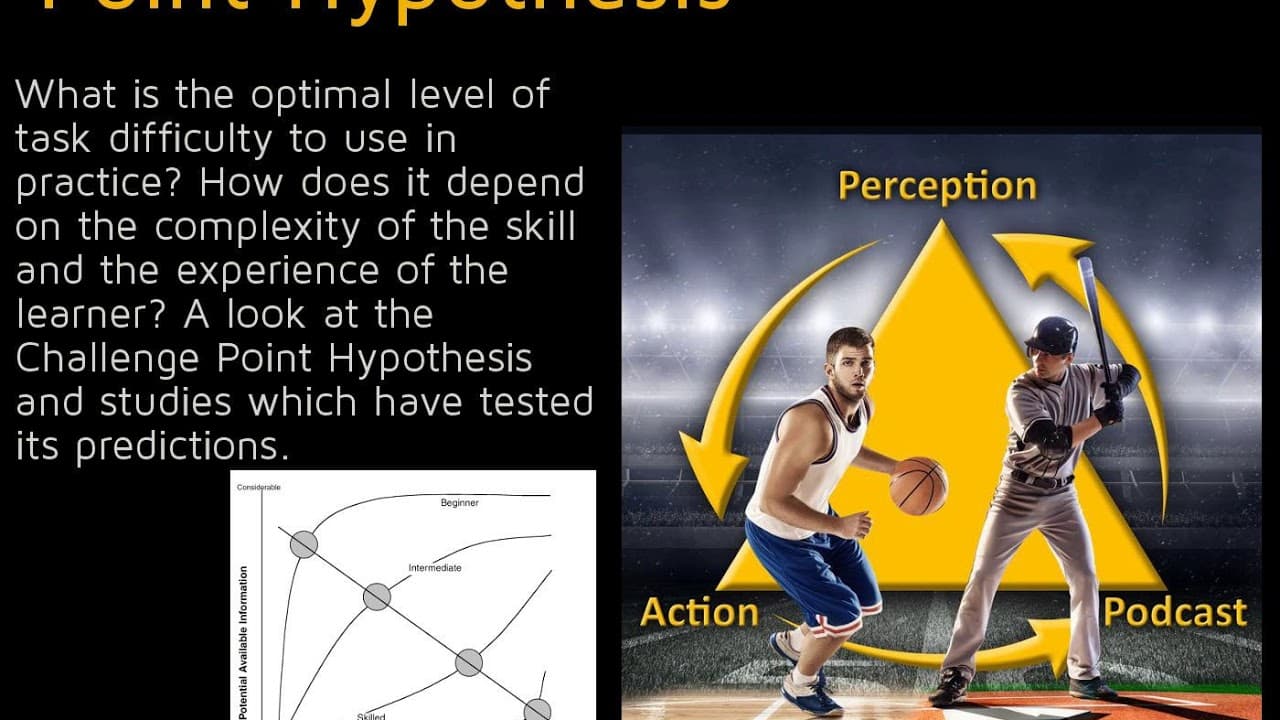
The optimal difficulty for practice in skill acquisition varies with the individual's skill level and the complexity of the task. Learning is most effective when the task demands provide just the right amount of information, avoiding extremes of too little or too much difficulty. Coaches should tailor practice conditions by balancing challenge with motivation to enhance performance.
Transcript
today on the perception and action podcast what is the optimal level of task difficulty to use in practice how does it depend on the complexity of the skill and the experience of the learner a look at the challenge point hypothesis and studies which have tested its predictions so it's time for a call to action hi everyone this is Rob gray from Ariz... Read More
Key Insights
- The Challenge Point Hypothesis suggests that optimal learning occurs at a moderate level of task difficulty, tailored to individual skill levels.
- Nominal difficulty is the inherent challenge of a task, while functional difficulty considers the performer's skill and conditions.
- Effective learning requires the right amount of information; too much or too little can hinder progress.
- Variability in practice conditions can increase functional difficulty, beneficial for low nominal tasks but overwhelming for complex tasks.
- Feedback frequency and timing are crucial, with more frequent feedback aiding high-difficulty tasks and less frequent benefiting simpler tasks.
- Research shows mixed results on the hypothesis, indicating complexities beyond the model's predictions.
- Motivation and frustration levels should be considered, balancing challenging tasks with achievable ones to maintain engagement.
- Practical application of the hypothesis is limited by difficulties in measuring functional task variability and the complexity of real-world tasks.
Install to Summarize YouTube Videos and Get Transcripts
Explore YouTube Video Summarizer or Get YouTube Transcript Extractor
Questions & Answers
Q: What is the Challenge Point Hypothesis?
The Challenge Point Hypothesis is a framework suggesting that optimal learning occurs when the task difficulty is moderate, providing the right amount of information for skill acquisition. It distinguishes between nominal difficulty, the inherent challenge of a task, and functional difficulty, which considers the performer's skill level and practice conditions.
Q: How does task difficulty affect learning according to the hypothesis?
According to the hypothesis, task difficulty affects learning by influencing the amount of information available. Too little difficulty results in insufficient information for learning, while too much overwhelms the learner, making the information uninterpretable. Optimal learning occurs at a moderate difficulty level, tailored to the individual's skill level.
Q: What role does feedback play in the Challenge Point Hypothesis?
Feedback plays a crucial role in the Challenge Point Hypothesis by modulating functional task difficulty. The frequency and timing of feedback can increase or decrease difficulty, with more frequent feedback aiding high-difficulty tasks and less frequent feedback benefiting simpler tasks. Feedback helps learners adjust their action plans for better skill acquisition.
Q: What are the limitations of the Challenge Point Hypothesis?
The limitations of the Challenge Point Hypothesis include its difficulty in accounting for individual differences, motivation, and frustration levels. Research shows mixed support for its predictions, indicating complexities beyond the model's scope. Measuring functional task variability and applying the hypothesis to real-world tasks also present challenges.
Q: How can coaches apply the Challenge Point Hypothesis in practice?
Coaches can apply the Challenge Point Hypothesis by designing practice sessions with moderate difficulty, tailored to individual skill levels. They should balance challenge with achievable tasks to maintain motivation and engagement. The hypothesis provides general guidelines but requires caution due to its limitations in predicting specific conditions and measuring functional difficulty.
Q: What is the difference between nominal and functional task difficulty?
Nominal task difficulty refers to the inherent challenge of a task, independent of the performer or conditions. Functional task difficulty, on the other hand, considers the performer's skill level and the conditions under which the task is performed. It reflects how challenging a task is for a specific individual in a given context.
Q: What insights have studies provided on the Challenge Point Hypothesis?
Studies on the Challenge Point Hypothesis provide mixed insights. Some support its predictions, showing optimal learning at moderate difficulty levels, while others reveal complexities in task difficulty, skill levels, and learning relationships. The hypothesis struggles to account for real-world complexities, motivation, and individual differences, limiting its practical application.
Q: Why is motivation important in the context of the Challenge Point Hypothesis?
Motivation is important because it influences engagement and persistence in learning tasks. The Challenge Point Hypothesis focuses on task difficulty and information but overlooks motivation and frustration levels. Balancing challenging tasks with achievable ones helps maintain motivation, preventing demotivation and stress from constant high difficulty, which is crucial for effective learning.
Summary & Key Takeaways
-
The Challenge Point Hypothesis explores optimal practice difficulty for skill acquisition, emphasizing a balance between nominal and functional task difficulty. It suggests that learning is best when tasks provide the right amount of information, avoiding too much or too little. Variability and feedback play key roles in modulating difficulty.
-
Research testing the hypothesis reveals mixed support, with some studies confirming its predictions while others highlight complexities in the relationships between task difficulty, skill level, and learning. The hypothesis struggles to account for motivation and individual differences, limiting its practical application.
-
Coaches can use the hypothesis to guide practice design, ensuring moderate difficulty tailored to individual skills. However, the model's limitations in predicting specific conditions and measuring functional difficulty suggest caution in its application. Balancing challenge with motivation is crucial for effective learning.
Read in Other Languages (beta)
Share This Summary 📚
Summarize YouTube Videos and Get Video Transcripts with 1-Click
Try YouTube Summary with ChatGPT & Claude or YouTube Transcript Generator
Explore More Summaries from Rob Gray 📚
Summarize YouTube Videos and Get Video Transcripts with 1-Click
Try YouTube Summary with ChatGPT & Claude or YouTube Transcript Generator