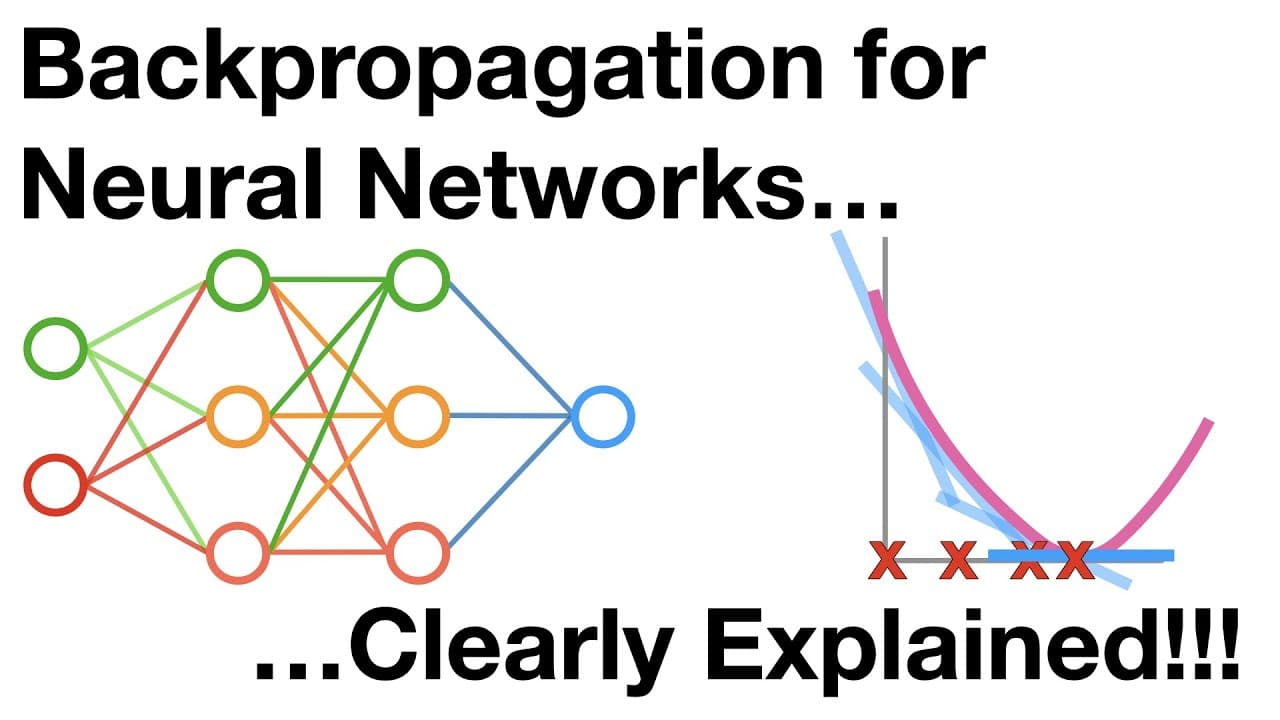
Neural Networks Pt. 2: Backpropagation Main Ideas
TL;DR
Backpropagation in neural networks involves optimizing weights and biases using the chain rule and gradient descent.
Transcript
Backpropagation is a really big word, but it's not a really big deal. StatQuest! Hello! I'm Josh Starmer and welcome to StatQuest! Today we're going to talk about Neural Networks, Part 2: Backpropagation Main Ideas. Note: this StatQuest assumes that you are already familiar with neural networks, the chain rule, and gradient descent. If not, check ... Read More
Key Insights
- 🏋️ Backpropagation in neural networks optimizes weights and biases by using the chain rule and gradient descent.
- 😘 The sum of squared residuals helps quantify the network's fit to the data, with lower values indicating better performance.
- 🍹 Gradient descent iteratively adjusts parameters to minimize the sum of squared residuals, improving the neural network's predictive accuracy.
- 💦 Parameters in neural networks are estimated starting from the last bias term and working backward to optimize all parameters efficiently.
- 🖐️ Derivatives calculated using the chain rule play a crucial role in backpropagation for updating network parameters.
- 🏋️ The process of optimizing weights and biases in a neural network involves adjusting them to reduce the difference between observed and predicted values.
- 😚 The calculated derivatives are used in gradient descent to determine the step size for updating parameters, bringing them closer to optimal values.
Install to Summarize YouTube Videos and Get Transcripts
Explore YouTube Video Summarizer or Get YouTube Transcript Extractor
Questions & Answers
Q: How does backpropagation optimize weights and biases in a neural network?
Backpropagation optimizes weights and biases by using the chain rule to calculate derivatives and gradient descent to find the optimal values that minimize the sum of squared residuals, improving the network's fit to the data.
Q: Why is the sum of squared residuals important in optimizing neural networks?
The sum of squared residuals quantifies the difference between observed and predicted values, helping to assess how well the neural network fits the data. Minimizing this sum through backpropagation improves the network's performance.
Q: What role does gradient descent play in the optimization process of neural networks?
Gradient descent is used in backpropagation to iteratively adjust weights and biases in the neural network to minimize the sum of squared residuals. It allows for finding optimal parameter values that improve the network's predictive accuracy.
Q: How are derivatives calculated for backpropagation in neural networks?
Derivatives are calculated using the chain rule, breaking down the relationship between the sum of squared residuals and parameters like weights and biases. This allows for efficient optimization of the network through gradient descent.
Summary & Key Takeaways
-
Backpropagation optimizes weights and biases in neural networks by using the chain rule to calculate derivatives and then plugging them into gradient descent.
-
Parameters are estimated starting from the last bias term and working backward to optimize all parameters.
-
Sum of squared residuals quantifies how well the neural network fits the data, and gradient descent is used to find the optimal values for parameters.
Read in Other Languages (beta)
Share This Summary 📚
Summarize YouTube Videos and Get Video Transcripts with 1-Click
Try YouTube Summary with ChatGPT & Claude or YouTube Transcript Generator
Explore More Summaries from StatQuest with Josh Starmer 📚


Summarize YouTube Videos and Get Video Transcripts with 1-Click
Try YouTube Summary with ChatGPT & Claude or YouTube Transcript Generator