Peaceable Queens - Numberphile
TL;DR
Placing non-attacking white and black Queens on a chessboard - a challenging problem with intriguing solutions.
Transcript
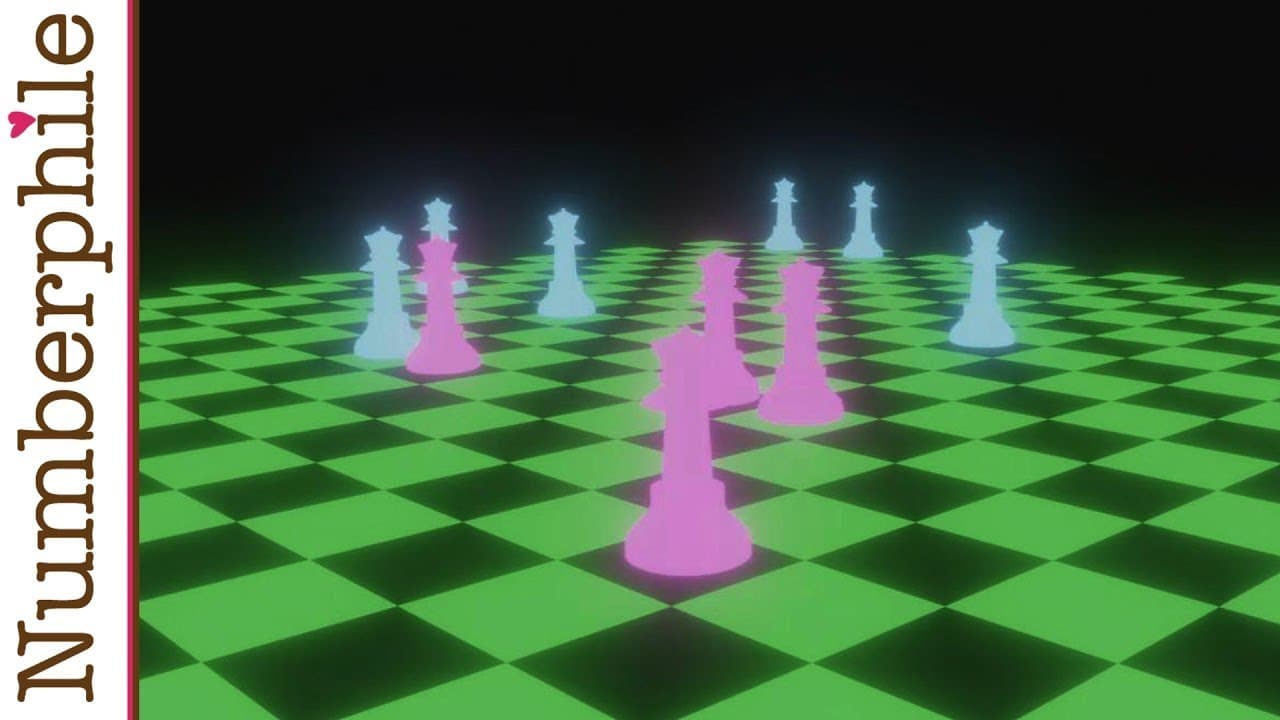
Chess Queens are trained to attack on sight. They see a piece of the other colour, they capture it. That's their job. Those are normal Queens. I want to tell you about peaceable Queens. The question is, you have a chess board of a certain size - could be 8x8 or it could be 4x4. You would like to put down as many Queens as you can. Some black Queens... Read More
Key Insights
- 🥇 Placing non-attacking Queens on a chessboard poses a complex optimization challenge.
- ❓ Problem-solving techniques like Simulated Annealing offer avenues for determining optimal Queen placements.
- ⛩️ The conjectures surrounding the Chess Queens problem hint at the potential for groundbreaking solutions.
- 🌥️ The quest for optimal Queen configurations continues, with larger chessboards presenting escalating challenges.
- ❓ Traditional strategies and innovative methods converge in solving the placement of peaceable Queens on a chessboard.
- 💖 The Chess Queens problem sparks curiosity and exploration in mathematical optimization and combinatorial configurations.
- 👑 Solutions like clumping Queens in specific patterns showcase creative approaches to maximizing non-attacking Queen counts.
Install to Summarize YouTube Videos and Get Transcripts
Explore YouTube Video Summarizer or Get YouTube Transcript Extractor
Questions & Answers
Q: What is the objective of the problem with placing black and white Queens on a chessboard?
The goal is to maximize the number of Queens of each color on the board without them attacking each other, following strict placement constraints.
Q: How do methods like Simulated Annealing and Integer Programming contribute to finding optimal solutions?
These methods help in generating lower and upper bounds to explore the range of possible configurations and optimize the placement of Queens on the chessboard.
Q: What pattern emerges in the optimal placement of multiple Queens on larger chessboards?
Clumping Queens together seems to be an effective strategy to achieve higher Queen counts without conflicts, as showcased in solutions like the 20x20 board setup.
Q: What conjectures and unresolved questions surround the Chess Queens problem?
The exact maximum Queen count for larger chessboards remains unknown, leading to intriguing speculations and the quest for more data to verify optimal solutions.
Summary & Key Takeaways
-
Chess Queens must be placed on a chessboard without attacking each other.
-
Solutions are optimized with methods like Simulated Annealing and Integer Programming.
-
Conjectures point to optimal placements with escalating Queen counts on larger chessboards.
Read in Other Languages (beta)
Share This Summary 📚
Summarize YouTube Videos and Get Video Transcripts with 1-Click
Try YouTube Summary with ChatGPT & Claude or YouTube Transcript Generator
Explore More Summaries from Numberphile 📚





Summarize YouTube Videos and Get Video Transcripts with 1-Click
Try YouTube Summary with ChatGPT & Claude or YouTube Transcript Generator