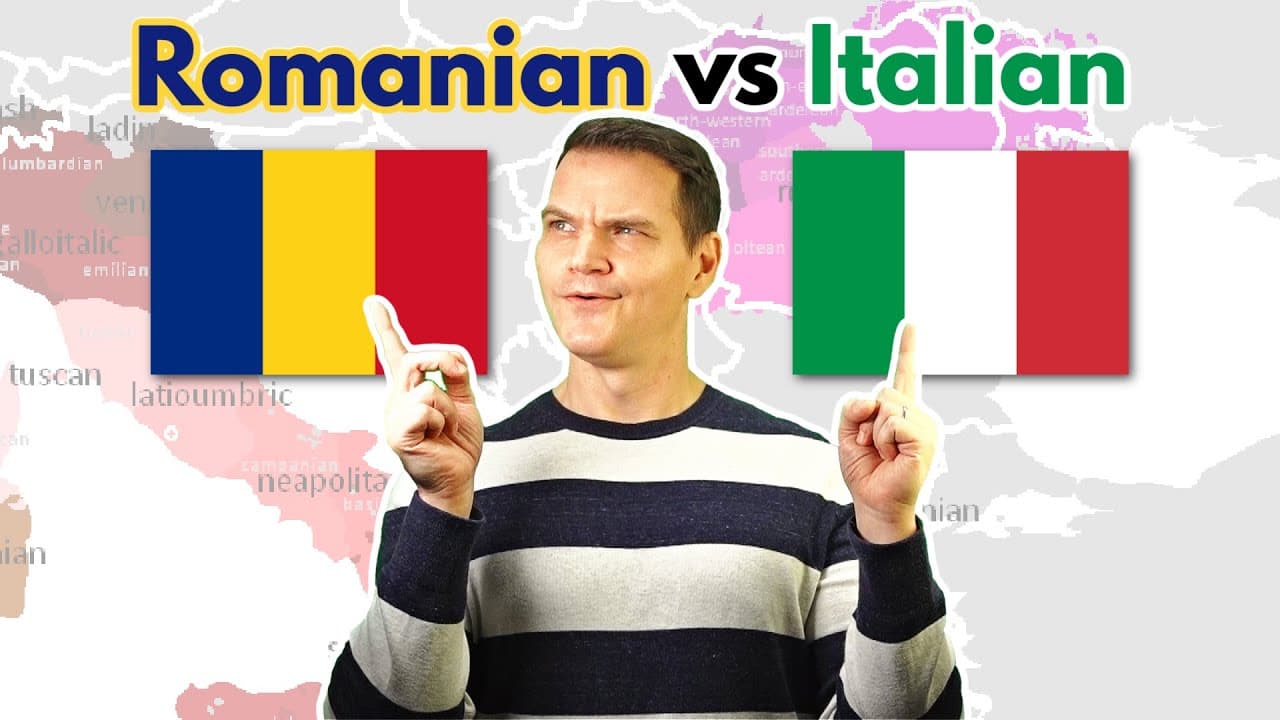
How Similar Are ROMANIAN and ITALIAN?
TL;DR
Romanian and Italian languages are similar yet distinct.
Transcript
this video was brought to you by Innovative language which produces two programs I recommend Romanian pod 101 and Italian pod 101 if you're learning either Romanian or Italian visit the link in the description to check them out as you probably know the romance languages all developed from varieties of Vulgar Latin that were spoken in different part... Read More
Key Insights
- Romanian and Italian share a 77% lexical similarity, meaning many words have common origins but have evolved differently.
- Romanian is considered the hardest Romance language to understand due to Slavic and Hungarian influences and geographical separation.
- Romanian uses more loanwords from Slavic and Hungarian languages, while Italian retains more Latin origins.
- Both languages are pro-drop, meaning subject pronouns are often omitted due to verb conjugation indicating the subject.
- Romanian retains three grammatical cases, unlike Italian, which has lost most case distinctions.
- Romanian has distinct diacritics to indicate pronunciation differences, whereas Italian uses fewer diacritical marks.
- Romanian includes neuter gender in its noun classification, unlike Italian, which only has masculine and feminine genders.
- Speakers of either language report being able to understand the other to some extent, especially in written form, with exposure aiding comprehension in spoken form.
Install to Summarize YouTube Videos and Get Transcripts
Explore YouTube Video Summarizer or Get YouTube Transcript Extractor
Questions & Answers
Q: Why is Romanian considered the hardest Romance language to understand?
Romanian is often considered the hardest Romance language to understand because it has been influenced by neighboring languages like Slavic and Hungarian. Additionally, Romania's geographical separation from other Romance-speaking countries has led to unique linguistic developments that make Romanian distinct from other major Romance languages.
Q: How do Romanian and Italian handle subject pronouns?
Both Romanian and Italian are pro-drop languages, meaning they often omit subject pronouns. The verb conjugation in each language provides enough information about the subject, making the pronoun unnecessary. This is a common feature in Romance languages, allowing for more concise sentences while maintaining clarity.
Q: What are the main grammatical differences between Romanian and Italian?
Romanian retains three grammatical cases, unlike Italian, which has lost most case distinctions. Romanian also includes neuter gender in its noun classification, whereas Italian only has masculine and feminine genders. Additionally, Romanian uses definite articles as suffixes on nouns, while Italian uses standalone definite articles preceding nouns.
Q: How do Romanian and Italian differ in their use of diacritics?
Romanian uses a variety of diacritics to indicate pronunciation differences, such as the circumflex and breve. These diacritics help distinguish vowel and consonant sounds. In contrast, Italian uses fewer diacritical marks, primarily the acute and grave accents, which are used in specific cases such as indicating stress on the final vowel.
Q: How do Romanian and Italian compare in terms of vocabulary origins?
While both languages share a common Latin origin, Romanian vocabulary includes more loanwords from Slavic and Hungarian languages, reflecting its geographical and historical influences. Italian vocabulary, on the other hand, retains more words with direct Latin origins, reflecting its closer cultural and linguistic ties to ancient Rome.
Q: Can speakers of Romanian and Italian understand each other?
Speakers of Romanian and Italian often report being able to understand the other language to some extent, particularly in written form. The level of understanding in spoken form depends on exposure, with many people stating that they can learn to converse comfortably in the other language with consistent practice and exposure.
Q: What role do loanwords play in Romanian vocabulary?
Loanwords play a significant role in Romanian vocabulary, especially from Slavic and Hungarian languages. These loanwords contribute to the distinctiveness of Romanian compared to other Romance languages. The influence of neighboring languages is a result of Romania's geographical and historical context, leading to a unique linguistic blend.
Q: How similar are Romanian and Italian in terms of grammar and syntax?
Romanian and Italian share some grammatical similarities due to their common Latin roots, such as being pro-drop languages. However, they differ in several aspects, including the retention of grammatical cases in Romanian and the use of neuter gender. Romanian syntax also incorporates more elements influenced by Slavic languages, adding to its complexity.
Summary & Key Takeaways
-
Romanian and Italian languages, both derived from Vulgar Latin, show significant similarities but also notable differences due to historical influences and geographical separation. Romanian's vocabulary is influenced by neighboring languages, whereas Italian maintains more Latin origins.
-
Romanian uses more loanwords and has retained grammatical cases, unlike Italian. Both languages are pro-drop, omitting subject pronouns due to verb conjugation. Romanian's use of diacritics is more extensive compared to Italian's limited use.
-
Despite lexical similarities, Romanian and Italian differ in pronunciation, vocabulary, and grammar. Speakers often find written comprehension easier, while spoken understanding improves with exposure. Romanian's unique features include neuter gender and diacritics, distinguishing it from Italian.
Read in Other Languages (beta)
Share This Summary 📚
Summarize YouTube Videos and Get Video Transcripts with 1-Click
Try YouTube Summary with ChatGPT & Claude or YouTube Transcript Generator
Explore More Summaries from Langfocus 📚




Summarize YouTube Videos and Get Video Transcripts with 1-Click
Try YouTube Summary with ChatGPT & Claude or YouTube Transcript Generator