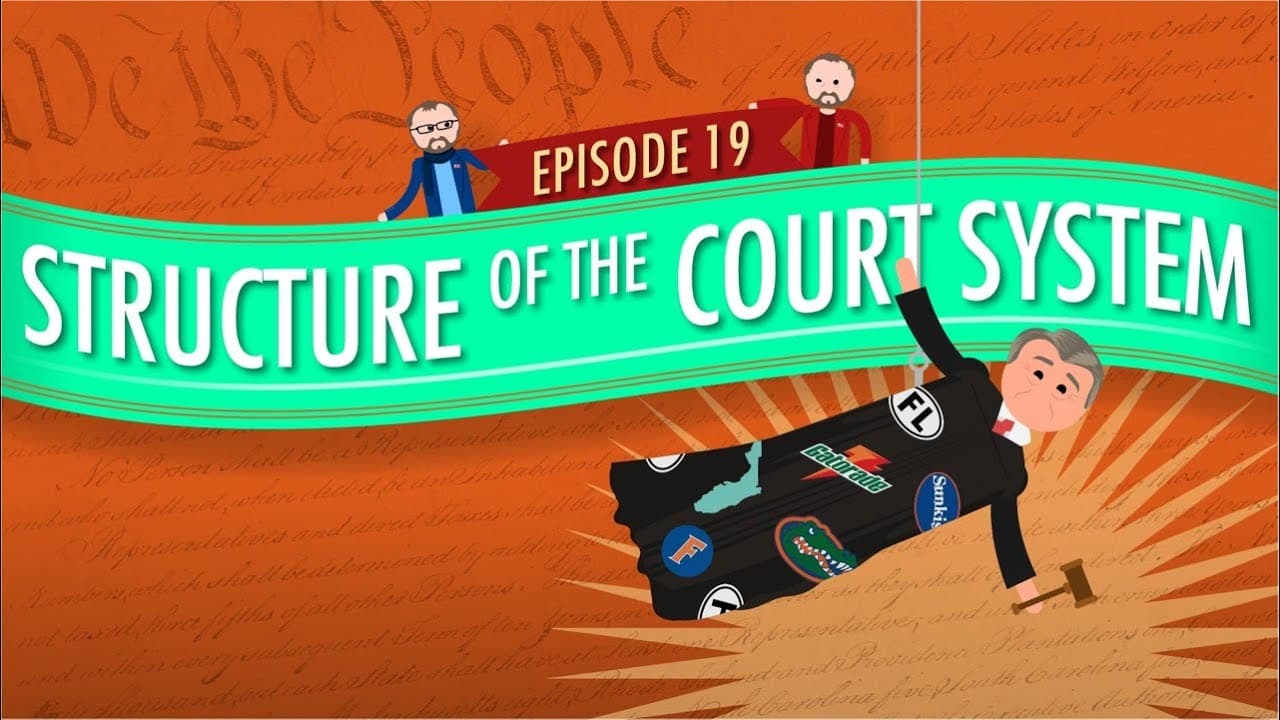
Structure of the Court System: Crash Course Government and Politics #19
TL;DR
The U.S. court system is hierarchical, with most cases settled outside court.
Transcript
Hi, I'm Craig and this is Crash Course Government and Politics. As fans of our series know, here at Crash Course we believe in hierarchy. First at the top you got me, then there's John Green, then Stan, then Brandon, then Zulaiha, then a bunch of independent contractors - wait I'm an independent contractor. But I'm still at the top! Anyway then the... Read More
Key Insights
- The U.S. court system operates in a hierarchical manner, with trial courts at the bottom and the Supreme Court at the top.
- Most legal disputes are settled outside of court, highlighting the efficiency of the U.S. legal system.
- Trial courts in the U.S. have original jurisdiction, and most cases start at the state level.
- Federal courts have original jurisdiction in specific cases, including those involving federal laws and constitutional issues.
- Appeals can be made if there is a procedural error or misapplication of the law, but appeals courts can refuse to hear cases.
- The Supreme Court primarily acts as an appellate court, reviewing cases that raise federal questions.
- The Supreme Court has stringent criteria for case selection, including the need for standing and the absence of mootness.
- Circuit splits and cases initiated by the federal government are more likely to be heard by the Supreme Court.
Install to Summarize YouTube Videos and Get Transcripts
Explore YouTube Video Summarizer or Get YouTube Transcript Extractor
Questions & Answers
Q: What is the hierarchical structure of the U.S. court system?
The U.S. court system is hierarchical, with trial courts at the bottom, followed by appellate courts, and the Supreme Court at the top. Trial courts handle the majority of cases, while appellate courts review decisions from lower courts. The Supreme Court acts as the final appellate authority for cases that raise federal questions.
Q: How are most legal disputes resolved in the U.S.?
Most legal disputes in the U.S. are resolved outside of court through settlements, highlighting the efficiency of the legal system. This means that the vast majority of cases never reach trial, as parties often reach agreements or settlements to avoid lengthy and costly court proceedings.
Q: What types of cases have original jurisdiction in federal courts?
Federal courts have original jurisdiction in cases involving federal laws, treaties, the U.S. Constitution, and disputes where the U.S. government is a party. Additionally, cases involving disputes between states or citizens from different states where the amount in controversy exceeds $70,000 are also heard in federal courts.
Q: What is the role of appeals courts in the U.S. legal system?
Appeals courts review decisions from lower courts to ensure that the law has been applied correctly and that procedural rules have been followed. They can refuse to hear cases, but if they do, they assess whether there were legal errors in the trial court's decision. Appeals courts help maintain legal consistency and fairness.
Q: How does a case reach the U.S. Supreme Court?
A case reaches the U.S. Supreme Court primarily through appellate jurisdiction, requiring the case to raise a federal question or involve an important federal statute. The Court reviews around 80 cases annually from approximately 8,000 requests, using criteria such as standing, mootness, and circuit splits to select cases.
Q: What criteria does the Supreme Court use to select cases?
The Supreme Court uses several criteria to select cases, including the presence of a federal question, standing, and the absence of mootness. The Court avoids advisory opinions and prefers cases with actual injuries. It also prioritizes cases with circuit splits or those initiated by the federal government.
Q: What is the significance of circuit splits in Supreme Court case selection?
Circuit splits occur when different appellate courts reach conflicting conclusions on the same legal issue. The Supreme Court often hears cases involving circuit splits to resolve these discrepancies, ensuring uniform interpretation and application of federal law across the United States.
Q: Why does the Supreme Court refuse some cases involving constitutional questions?
The Supreme Court may refuse cases involving constitutional questions if the issues are deemed settled or if the Court prefers not to address them at the time. For example, the Court historically avoided gun control cases and currently tends to avoid obscenity cases, reflecting its discretion in shaping its docket.
Summary & Key Takeaways
-
The U.S. court system is structured hierarchically, with trial courts handling the majority of cases and the Supreme Court acting as the final appellate court. Most disputes are resolved outside of court, underscoring the system's efficiency.
-
Federal courts have original jurisdiction in cases involving federal laws, treaties, the U.S. Constitution, and disputes between states. Appeals can be made if there is a procedural error, but not all appeals are heard.
-
The Supreme Court reviews cases that raise federal questions, but has strict criteria for case selection, such as standing and the absence of mootness. Circuit splits and federal government appeals are prioritized for review.
Read in Other Languages (beta)
Share This Summary 📚
Summarize YouTube Videos and Get Video Transcripts with 1-Click
Try YouTube Summary with ChatGPT & Claude or YouTube Transcript Generator
Explore More Summaries from CrashCourse 📚




Summarize YouTube Videos and Get Video Transcripts with 1-Click
Try YouTube Summary with ChatGPT & Claude or YouTube Transcript Generator