What Can JWST Discover About the Big Bang and Black Holes?
TL;DR
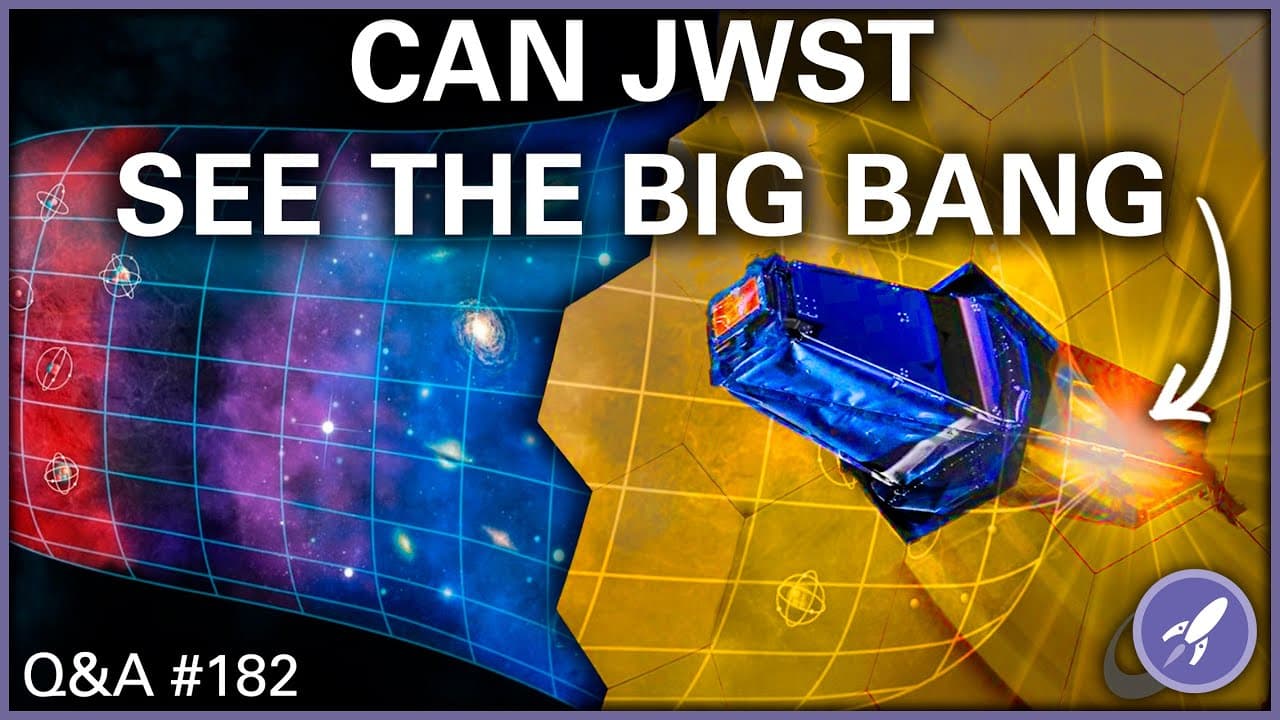
The James Webb Space Telescope (JWST) cannot see the Big Bang itself due to the universe's opacity in its first 380,000 years. However, JWST can use gravitational lensing to observe incredibly distant galaxies and potentially gather hints about the first stars formed after the Big Bang. Black holes gain mass when fed matter or antimatter, as they do not emit or lose mass through Hawking radiation.
Transcript
Hi, everyone, I'm Fraser Cain. I'm the publisher of Universe Today. I've been a space and astronomy journalist for over 20 years. And we generate a ton of news on Universe Today. And that turns to a ton of questions from you about the topics we cover and just general topics, mostly about Lagrangian points, but there'll be some non Lagrangian point ... Read More
Key Insights
- 😒 Hubble Space Telescope uses gravitational lensing to observe distant galaxies and cosmic structures in detail.
- 🤩 Gravitational lensing can magnify the capabilities of telescopes like James Webb to study early Universe phenomena like the first stars.
- 😚 Black holes absorb matter without losing mass, making them essentially impossible to destroy with antimatter or dark matter.
- 🥵 Advanced alien civilizations following the laws of physics would have observable effects, like waste heat and gravitational disturbances.
- ✊ Solar flares pose a threat to modern civilization, highlighting the importance of transitioning to microgrid power systems to protect against electrical grid disruptions.
- 😵💫 The trajectory of Earth's orbit around the Sun is stable and won't spiral into the Sun due to the balance of gravitational forces.
- 🫵 Planetary nebulae like the Snowball Nebula are visually appealing targets for astrophotography, offering unique and captivating views of stellar remnants.
Install to Summarize YouTube Videos and Get Transcripts
Explore YouTube Video Summarizer or Get YouTube Transcript Extractor
Questions & Answers
Q: Can the James Webb Space Telescope use gravitational lensing to see the first stars in the Universe?
Yes, gravitational lensing can magnify James Webb's capabilities by a factor of 10,000, allowing it to potentially see the first stars formed after the Big Bang.
Q: Can dark matter or antimatter reduce the mass of a black hole, leading to its disappearance?
Black holes consume any matter added to them, increasing their mass, and dark matter would simply contribute to the black hole's mass without causing disappearance.
Q: Would advanced alien civilizations have technology to hide from us and avoid detection?
While it's possible, alien civilizations adhering to the laws of physics would likely leave observable traces, such as waste heat and gravitational effects on the surrounding environment.
Q: Is it possible for humans to survive in low gravity on Mars?
Surviving low gravity on Mars presents challenges, such as muscle and bone loss, but potential solutions like exercise programs and artificial gravity could help mitigate these effects.
Summary & Key Takeaways
-
Fraser Cain, a space and astronomy journalist, answers viewer questions on various topics from Lagrangian points to first stars in the Universe.
-
He discusses the use of gravitational lensing for observing distant galaxies and the limitations of viewing the Big Bang itself.
-
Questions range from dropping antimatter into black holes to the possibility of hidden alien civilizations with advanced technology.
Read in Other Languages (beta)
Share This Summary 📚
Summarize YouTube Videos and Get Video Transcripts with 1-Click
Try YouTube Summary with ChatGPT & Claude or YouTube Transcript Generator
Explore More Summaries from Fraser Cain 📚
Summarize YouTube Videos and Get Video Transcripts with 1-Click
Try YouTube Summary with ChatGPT & Claude or YouTube Transcript Generator