Ozonolysis - Oxidative Cleavage of Alkenes
TL;DR
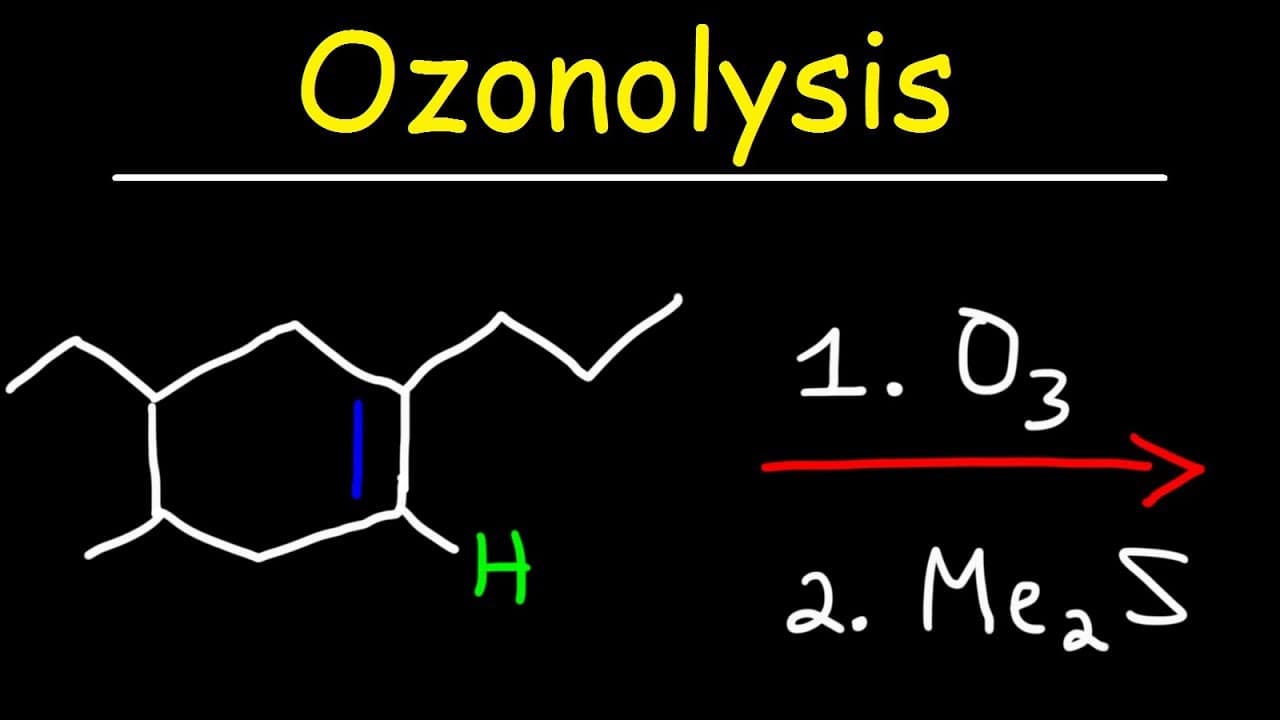
This video explains the ozonolysis reaction of alkanes, demonstrating how to predict the major products and determine the original alkene.
Transcript
in this video we're going to go over the ozonolysis reaction of alkanes so let's start with 3 hexing what's going to be the major product if we add ozone and dimethyl sulfide what do you think so ozone will cause this molecule to split in half and so what's going to happen is you're going to get two carbonyl groups so basically once you split it in... Read More
Key Insights
- 🪜 Ozonolysis reaction of alkanes involves splitting the molecule and adding oxygen to each side of the resulting double bond.
- 💁 The type of carbonyl group formed (aldehyde or ketone) depends on the primary or secondary nature of the carbon.
- ❓ Different reagents can be used in ozonolysis reactions to yield different products.
- 😋 Rigid structures like rings produce single-molecule products, while chains result in multiple molecules per double bond.
Install to Summarize YouTube Videos and Get Transcripts
Explore YouTube Video Summarizer or Get YouTube Transcript Extractor
Questions & Answers
Q: What are the major products obtained when ozone and dimethyl sulfide are added to 3-hexene?
The major product in this case is propanol, as the molecule splits into two halves, resulting in two carbonyl groups.
Q: When a similar structure with an additional carbon is used, what are the products obtained with ozone and zinc/acetic acid?
In this case, the products obtained are butanone and propanol, with the additional carbon determining whether the product is an aldehyde (if primary carbon) or a ketone (if secondary carbon).
Q: When a ring is used in the ozonolysis reaction, how many molecules are obtained compared to a chain?
A ring results in a single molecule product, while a chain will yield two or more molecules per double bond.
Q: How can the original alkene used to create a ketone and an aldehyde be determined?
By drawing the carbonyl groups facing each other and connecting them with an alkene, the original alkene can be determined. Inverting the process will give the starting material.
Summary & Key Takeaways
-
Ozonolysis of alkanes involves splitting the molecule in half and adding oxygen to each side of the resulting double bond, resulting in two carbonyl groups.
-
The type of carbonyl group (aldehyde or ketone) formed depends on the carbon's primary or secondary nature.
-
Different examples of ozonolysis reactions are demonstrated, highlighting the products obtained by using different reagents and starting with different molecules.
Read in Other Languages (beta)
Share This Summary 📚
Summarize YouTube Videos and Get Video Transcripts with 1-Click
Try YouTube Summary with ChatGPT & Claude or YouTube Transcript Generator
Explore More Summaries from The Organic Chemistry Tutor 📚





Summarize YouTube Videos and Get Video Transcripts with 1-Click
Try YouTube Summary with ChatGPT & Claude or YouTube Transcript Generator