Products
Features
YouTube Video Summarizer
Summarize YouTube videos
Web & PDF Highlighter
Highlight web pages & PDFs
Chat with PDF
Ask any PDF questions with AI
Ask AI Clone
Chat with your highlights & memories
Audio Transcriber
Transcribe audio files to text
Glasp Reader
Read and highlight articles
Kindle Highlight Export
Export your Kindle highlights
Idea Hatch
Hatch ideas from your highlights
Integrations
Obsidian Plugin
Notion Integration
Pocket Integration
Instapaper Integration
Medium Integration
Readwise Integration
Snipd Integration
Hypothesis Integration
Apps & Extensions
Chrome Extension
Safari Extension
Edge Add-ons
Firefox Add-ons
iOS App
Android App
Discover
Discover
Ideas
Discover new ideas and insights
Articles
Curated articles and insights
Books
Book recommendations by great minds
Posts
Essays and notes from readers
Quotes
Inspiring quotes collection
Videos
Curated videos and summaries
Explore Glasp
Glasp Newsletter
Weekly insights and updates
Glasp Talk
Interview series with great minds
Glasp Blog
Latest news and articles
Glasp Use Cases
Learn how others use Glasp
Build & Support
Glasp API
Access Glasp's API for developers
MCP Connector
Connect Glasp to Claude & ChatGPT
Community
Glasp Reddit Community
Students
Student discount and benefits
FAQs
Frequently Asked Questions
AboutPricing
DashboardLog inSign up

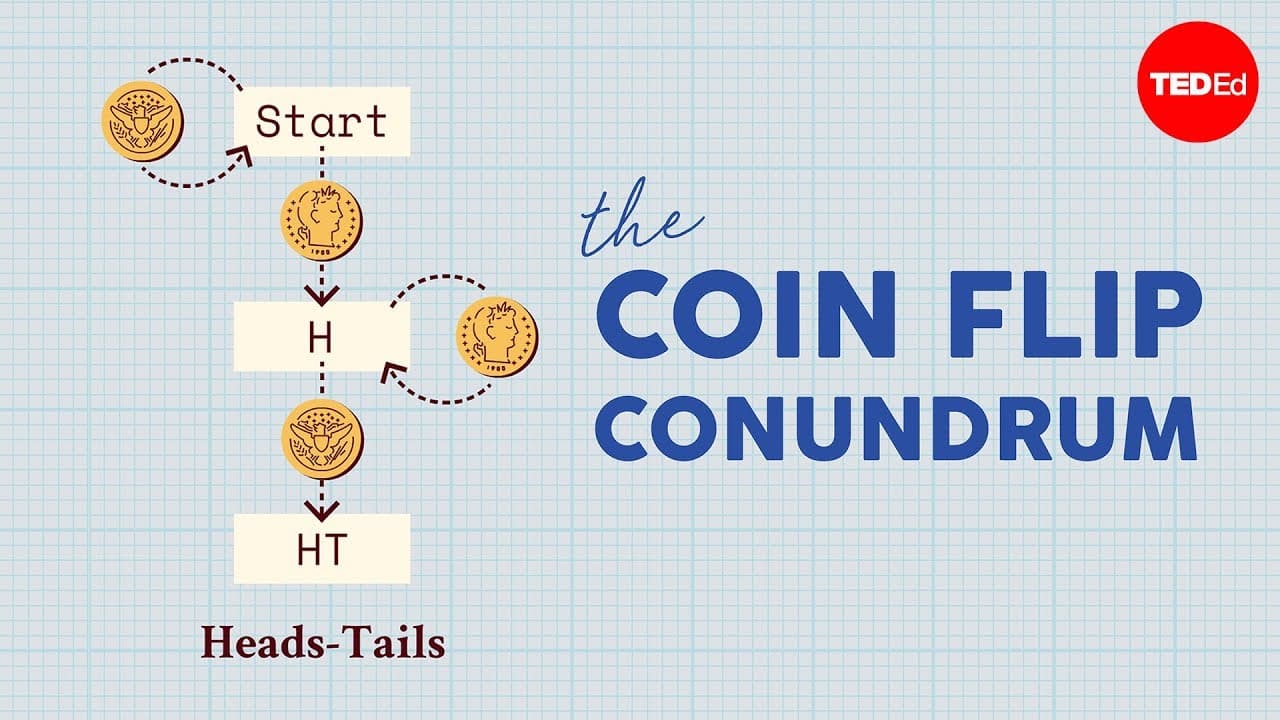
The coin flip conundrum - Po-Shen Loh
657.0K views
•
February 15, 2018
by
TED-Ed
YouTube video player
The coin flip conundrum - Po-Shen Loh

TL;DR

Different coin flip sequences have varying probabilities, affecting outcomes.

Transcript

When the Wright brothers had to decide who would be the first to fly their new airplane off a sand dune, they flipped a coin. That was fair: we all know there’s an equal chance of getting heads and tails. But what if they had a more complicated contest? What if they flipped coins repeatedly, so that Orville would win as soon as two heads showe... Read More

Key Insights

  • 🐬 Sequential outcomes in coin flips affect probabilities and average number of flips needed.
  • 🥺 More complex sequences can lead to longer average flip counts due to specific move structures.
  • 🐬 Probability and algebra can be used to calculate and analyze average flip requirements for various coin flip sequences.
  • 🐬 Wilbur had an advantage in the contested coin flip scenario due to the sequence of outcomes.
  • 🐬 The Wright brothers' historical coin flip for the first flight did not involve the complex dynamics studied here.
  • 👾 Understanding sequence structures is crucial in deciphering probabilities and outcomes in games or contests.
  • 👾 The concept of moving through a board game with different flip outcomes highlights the dynamics of various sequences.

Install to Summarize YouTube Videos and Get Transcripts

Explore YouTube Video Summarizer or Get YouTube Transcript Extractor

Questions & Answers

Q: What advantage did Wilbur have in the more complex coin flip contest?

Wilbur had an advantage in the contest where the goal was to get two heads in a row as his sequence had a move that could send back the player, requiring more flips on average before reaching the goal.

Q: How did the average number of flips differ for heads/heads and heads/tails sequences?

The average number of flips for heads/heads sequence was calculated to be six flips, while for heads/tails sequence, it was calculated to be four flips, showing a difference due to the sequence structure.

Q: How was probability and algebra used to calculate the average number of flips needed for different sequences?

By defining variables x and y for heads/tails and heads/heads sequences respectively, probabilities of different outcomes were considered along with the average number of flips needed for each step, resulting in calculated averages of four and six flips.

Summary & Key Takeaways

  • Coin flips with different sequences can lead to varied outcomes due to differing probabilities.

  • Wilbur had an advantage in a more complex coin flip contest due to the sequence of outcomes.

  • Probability and algebra can be used to calculate average number of flips needed for different sequences.


Read in Other Languages (beta)

English

Share This Summary 📚

Summarize YouTube Videos and Get Video Transcripts with 1-Click

Download browser extensions on:

Try YouTube Summary with ChatGPT & Claude or YouTube Transcript Generator

Explore More Summaries from TED-Ed 📚
What would happen if you didn’t drink water? - Mia Nacamulli thumbnail
What would happen if you didn’t drink water? - Mia Nacamulli
TED-Ed
Why do women have periods? thumbnail
Why do women have periods?
TED-Ed
How sugar affects the brain - Nicole Avena thumbnail
How sugar affects the brain - Nicole Avena
TED-Ed
The rise and fall of the Berlin Wall - Konrad H. Jarausch thumbnail
The rise and fall of the Berlin Wall - Konrad H. Jarausch
TED-Ed
How to build a fictional world - Kate Messner thumbnail
How to build a fictional world - Kate Messner
TED-Ed
A brief history of alcohol - Rod Phillips thumbnail
A brief history of alcohol - Rod Phillips
TED-Ed

Summarize YouTube Videos and Get Video Transcripts with 1-Click

Download browser extensions on:

Try YouTube Summary with ChatGPT & Claude or YouTube Transcript Generator

Apps & Extensions

  • Chrome Extension
  • Safari Extension
  • Edge Add-ons
  • Firefox Add-ons
  • iOS App
  • Android App

Key Features

  • YouTube Video Summarizer
  • Web & PDF Summarizer
  • Web & PDF Highlighter
  • Chat with PDF
  • Ask AI Clone
  • Audio Transcriber
  • Glasp Reader
  • Kindle Highlight Export
  • Idea Hatch

Integrations

  • Obsidian Plugin
  • Notion Integration
  • Pocket Integration
  • Instapaper Integration
  • Medium Integration
  • Readwise Integration
  • Snipd Integration
  • Hypothesis Integration

More Features

  • APIs
  • MCP Connector
  • Blog & Post
  • Embed Links
  • Image Highlight
  • Personality Test
  • Quote Shots

Company

  • About us
  • Blog
  • Community
  • FAQs
  • Job Board
  • Newsletter
  • Pricing
Terms

•

Privacy

•

Guidelines

© 2026 Glasp Inc. All rights reserved.