Microscopy: Darkfield and Phase Contrast Microscopy (Edward Salmon)
TL;DR
Explains principles and techniques of darkfield and phase contrast microscopy.
Transcript
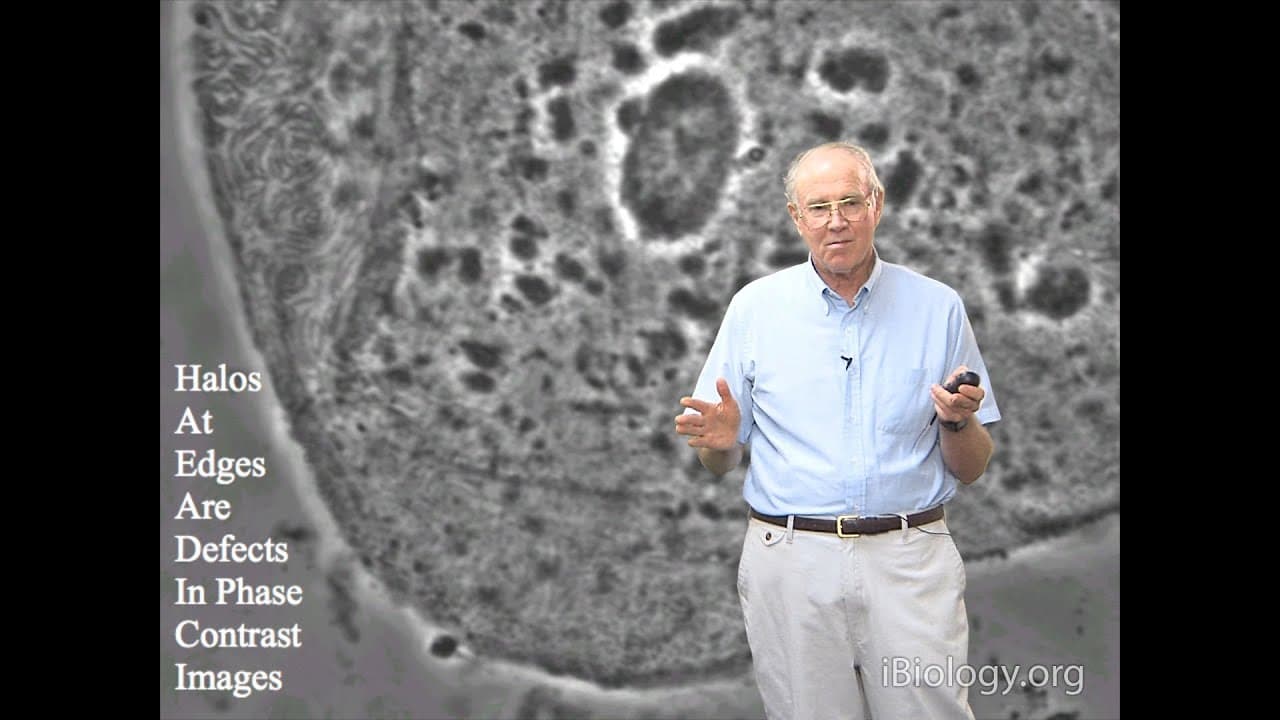
I’m here to talk today about the principles of darkfield and phase contrast microscopy. I want to begin by talking about some experiments that Frits Zernike described, that he did during the process of discovering phase contrast microscopy, for which he received a Nobel Prize. These are described in a Science article and also in a chapter in a book... Read More
Key Insights
- Frits Zernike's experiments led to the discovery of phase contrast microscopy, earning him a Nobel Prize.
- Darkfield microscopy is achieved by blocking undiffracted light, creating bright images against dark backgrounds.
- Phase contrast microscopy enhances contrast in transparent specimens by utilizing interference between diffracted and undiffracted light.
- Darkfield microscopy is sensitive to small objects but has limitations like poor depth of field and scattered light interference.
- Phase contrast microscopy allows high-resolution imaging without the need for intense lighting, making it suitable for live cell observation.
- Darkfield microscopy uses an annulus of illumination, while phase contrast employs a phase ring for image formation.
- Modern phase contrast microscopy improves resolution by using an annular cone of light and a phase ring in the objective.
- Phase contrast microscopy is widely used in cell biology for observing dynamic cellular processes and is often combined with fluorescence imaging.
Install to Summarize YouTube Videos and Get Transcripts
Explore YouTube Video Summarizer or Get YouTube Transcript Extractor
Questions & Answers
Q: What is the principle behind darkfield microscopy?
Darkfield microscopy operates by blocking the undiffracted light, allowing only the scattered light from the specimen to be collected by the objective lens. This creates an image where the specimen appears bright against a dark background. It is particularly useful for observing small particles and structures with high contrast.
Q: How did Frits Zernike contribute to microscopy?
Frits Zernike developed the phase contrast microscopy technique, which allows for the observation of transparent specimens without the need for staining. His work involved understanding how interference between diffracted and undiffracted light can enhance image contrast, a discovery that earned him the Nobel Prize in Physics.
Q: What are the advantages of phase contrast microscopy?
Phase contrast microscopy offers several advantages, including the ability to visualize transparent specimens with high contrast and resolution without the need for staining or intense lighting. It is particularly beneficial for observing live cells and dynamic processes, as it highlights fine structural details that are not visible in brightfield microscopy.
Q: What are the limitations of darkfield microscopy?
Darkfield microscopy has limitations such as poor depth of field and interference from scattered light, which can obscure fine structural details. Additionally, it requires special condensers and bright light sources, making it less suitable for thick specimens and certain applications compared to phase contrast microscopy.
Q: How does phase contrast microscopy enhance image contrast?
Phase contrast microscopy enhances image contrast by exploiting the interference between diffracted and undiffracted light. A phase ring in the objective lens introduces a phase shift, causing destructive interference that highlights differences in refractive index within the specimen, making transparent structures more visible.
Q: Why is phase contrast microscopy popular in cell biology?
Phase contrast microscopy is popular in cell biology because it allows researchers to observe live cells and dynamic processes with high contrast and resolution. It provides detailed images of cellular structures without the need for staining, making it ideal for studying cell behavior, division, and other biological functions.
Q: How is phase contrast microscopy combined with fluorescence imaging?
Phase contrast microscopy can be combined with fluorescence imaging by using shutters to alternate between phase contrast and fluorescence modes. This allows researchers to observe the structural dynamics of cells and the localization of specific proteins simultaneously, providing comprehensive insights into cellular functions and interactions.
Q: What is the role of the phase ring in phase contrast microscopy?
The phase ring in phase contrast microscopy is crucial for creating contrast by introducing a phase shift to the undiffracted light. This phase shift causes interference with the diffracted light, enhancing the visibility of transparent specimens. The phase ring also attenuates the intensity of the undiffracted light to balance the image brightness.
Summary & Key Takeaways
-
Darkfield and phase contrast microscopy are techniques that enhance visibility of specimens that are difficult to observe using brightfield microscopy. Darkfield microscopy involves blocking undiffracted light to create bright images against dark backgrounds, while phase contrast uses interference between diffracted and undiffracted light to enhance contrast.
-
Frits Zernike's pioneering work led to the development of phase contrast microscopy, allowing for high-resolution imaging of transparent specimens. This technique does not require intense lighting and is particularly useful for observing live cells, as it enhances visibility of fine structural details.
-
Modern phase contrast microscopy employs an annular cone of light and a phase ring to improve resolution. It is widely used in cell biology for studying dynamic cellular processes and is often combined with fluorescence imaging to provide comprehensive insights into cellular structures and functions.
Read in Other Languages (beta)
Share This Summary 📚
Summarize YouTube Videos and Get Video Transcripts with 1-Click
Try YouTube Summary with ChatGPT & Claude or YouTube Transcript Generator
Explore More Summaries from iBiology Techniques 📚
Summarize YouTube Videos and Get Video Transcripts with 1-Click
Try YouTube Summary with ChatGPT & Claude or YouTube Transcript Generator