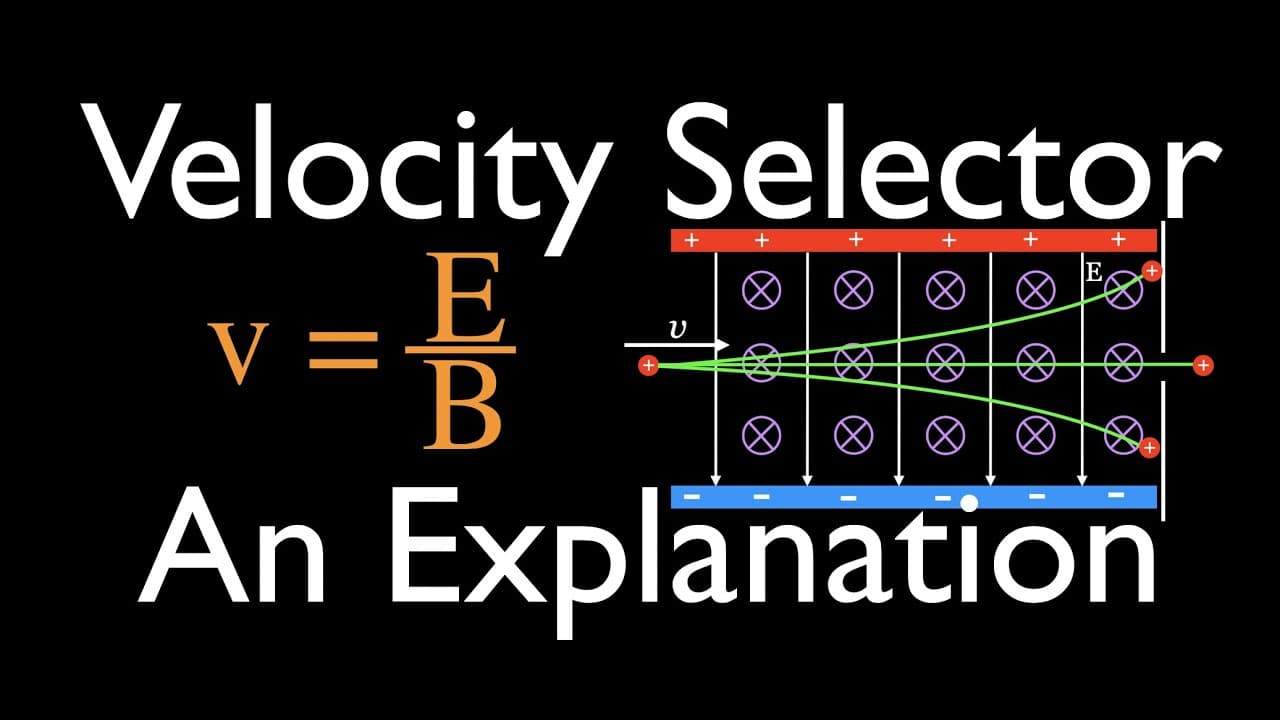
Velocity Selector: An Explanation
TL;DR
Velocity selectors filter charged particles based on speed; crucial for electron microscopes and spectrometers.
Transcript
in today's video i'm going to go over an explanation of what is a velocity selector we're going to have a little bit of a description and explanation and we'll also do a couple short example problems now before i get started please don't forget to subscribe to my channel step by step signs get all my excellent physics chemistry and math videos when... Read More
Key Insights
- 😒 Velocity selectors use electric and magnetic fields to filter charged particles by their velocity.
- 🧭 Proper orientation of magnetic fields ensures particles with the desired velocity pass through.
- 😘 Some particles are filtered out due to their velocity being too high or low.
- 🧭 Example problems illustrate how to calculate the velocity of particles passing through a velocity selector.
- 🖐️ Understanding the forces at play in a velocity selector is crucial for determining particle behavior.
- 🧭 Lorentz force and electric force balance determines which particles pass through a velocity selector.
- 🎮 Sharing knowledge from educational videos is encouraged to support the creator.
Install to Summarize YouTube Videos and Get Transcripts
Explore YouTube Video Summarizer or Get YouTube Transcript Extractor
Questions & Answers
Q: What is a velocity selector and how does it work?
A velocity selector is a device that filters charged particles based on their velocity using electric and magnetic fields. It allows particles with the desired velocity to pass through while filtering out others.
Q: Why are some particles filtered out in a velocity selector?
Some particles are filtered out because their velocity is either too high or too low, leading to the Lorentz force being greater or lesser than the electric force, causing deflection.
Q: How do electric and magnetic fields work together in a velocity selector?
Electric fields deflect charged particles while magnetic fields counteract this deflection, allowing particles with the desired velocity to travel straight through the selector.
Q: How are the velocity of particles calculated in a velocity selector?
The velocity of particles passing through a velocity selector is determined by the ratio of the electric field strength to the magnetic field strength, as demonstrated in example problems provided in the content.
Summary & Key Takeaways
-
Velocity selectors filter charged particles based on their velocity using electric and magnetic fields.
-
Particles with the right velocity pass through, while others are filtered out.
-
Simple example problems illustrate how to calculate the velocity of particles passing through a velocity selector.
Read in Other Languages (beta)
Share This Summary 📚
Summarize YouTube Videos and Get Video Transcripts with 1-Click
Try YouTube Summary with ChatGPT & Claude or YouTube Transcript Generator
Explore More Summaries from Step by Step Science 📚
Summarize YouTube Videos and Get Video Transcripts with 1-Click
Try YouTube Summary with ChatGPT & Claude or YouTube Transcript Generator