Rutherford's Experiment of Scattering of α Particles - Structure of Atom - Chemistry Class 11
TL;DR
The Ruther Ford experiment involved bombarding alpha particles on a thin gold foil to determine the structure of an atom.
Transcript
click the bell icon to get latest videos from akira hello friends in the previous topic we have discussed about the atomic model of GJ thompson in which we have got to know about the various and limitations of it so among that one of the limitation was the alpha particle scattering which was not been explained in JJ Thompson so here we are going to... Read More
Key Insights
- 🤔 The Ruther Ford experiment involved bombarding alpha particles on a thin gold foil to study their scattering behavior.
- 👾 Most alpha particles passed through the gold foil, indicating atoms have vacant spaces.
- 🫀 The scattering of particles at angles less than 90 degrees suggested the presence of electrons in atoms.
- 🥺 The bounce-back of alpha particles at 180 degrees led to the conclusion of a positively charged nucleus.
- 👾 The experiment provided insights into the structure of the atom, including the existence of empty space, electrons, and a nucleus.
- ⚾ Ruther Ford's conclusions were based on the observations made during the experiment.
- 🫀 The experiment helped refine the understanding of atomic models and led to the development of the nuclear model of the atom.
Install to Summarize YouTube Videos and Get Transcripts
Explore YouTube Video Summarizer or Get YouTube Transcript Extractor
Questions & Answers
Q: What was the main goal of the Ruther Ford experiment?
The main goal was to determine the scattering of alpha particles and use it to understand the structure of an atom.
Q: How did Ruther Ford set up the experiment?
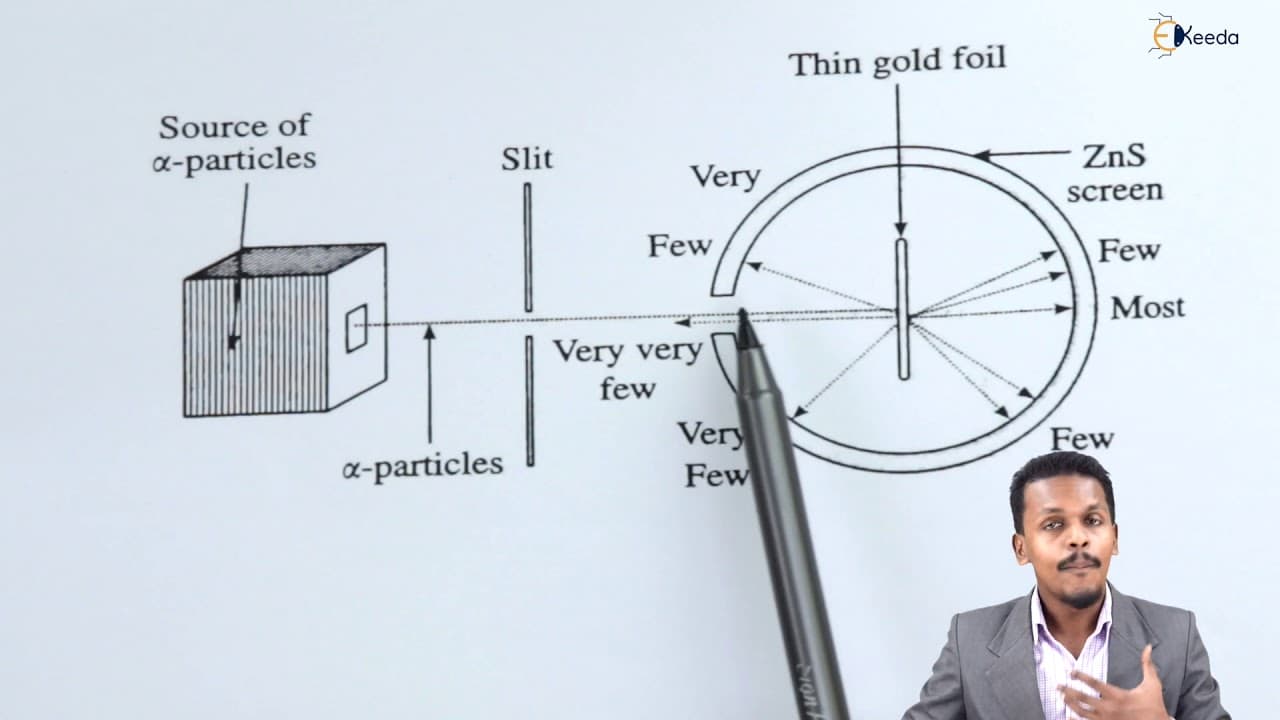
Ruther Ford used a source of alpha particles, a thin gold foil covered with a zinc sulfide screen, and a slit to control the intensity of the particles passing through.
Q: What were the observations made during the experiment?
Most alpha particles passed through the gold foil, some were scattered at angles less than 90 degrees, and a small fraction bounced back at 180 degrees.
Q: What conclusions did Ruther Ford draw from the experiment?
Ruther Ford concluded that atoms have vacant spaces, contain electrons, and have a positively charged nucleus.
Summary & Key Takeaways
-
The Ruther Ford experiment aimed to understand the scattering of alpha particles and its implications for the structure of an atom.
-
By bombarding alpha particles on a gold foil, Ruther Ford observed that most of the particles passed through, some were scattered at angles less than 90 degrees, and a small fraction bounced back.
-
Based on these observations, Ruther Ford concluded that atoms have vacant spaces, contain electrons, and have a positively charged nucleus.
Read in Other Languages (beta)
Share This Summary 📚
Summarize YouTube Videos and Get Video Transcripts with 1-Click
Try YouTube Summary with ChatGPT & Claude or YouTube Transcript Generator
Explore More Summaries from Ekeeda 📚






Summarize YouTube Videos and Get Video Transcripts with 1-Click
Try YouTube Summary with ChatGPT & Claude or YouTube Transcript Generator