How Can We Trust Information in an AI-Driven World?
TL;DR
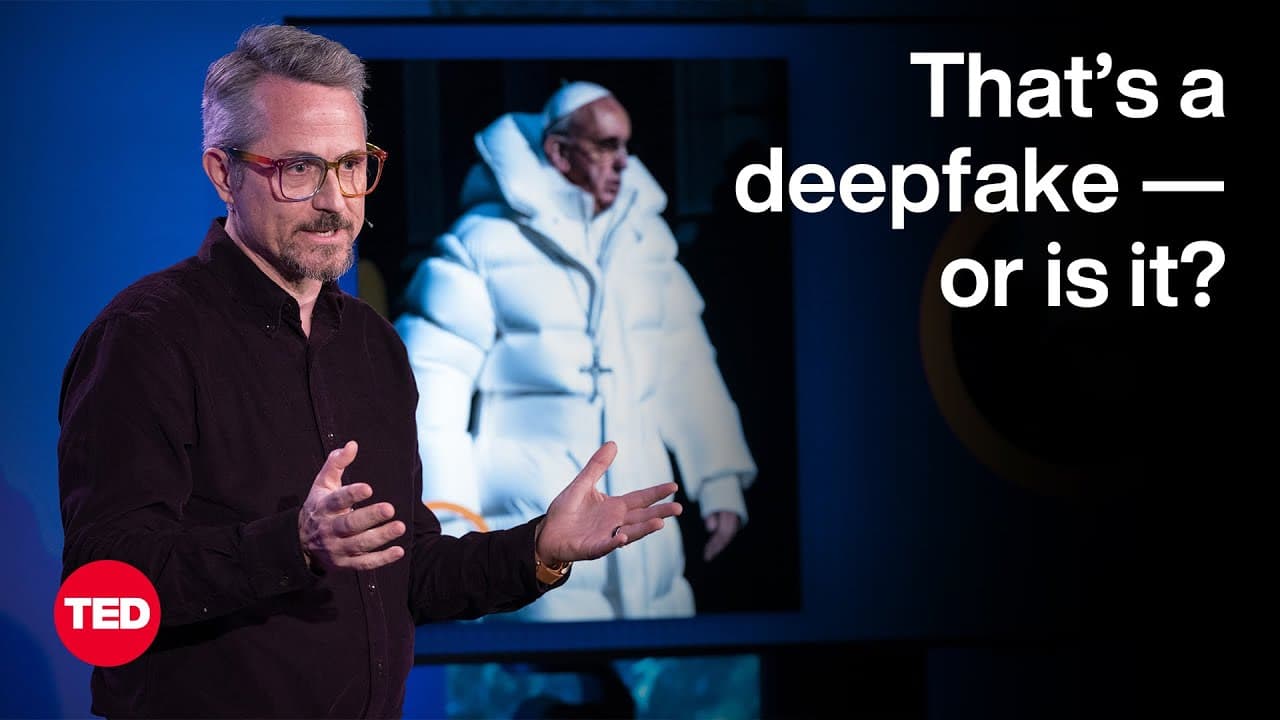
As AI technologies improve, distinguishing between real and fake content becomes increasingly difficult, undermining trust in information. Initiatives like 'Prepare, Don't Panic' aim to enhance detection tools for journalists and human rights defenders while advocating for transparency through content provenance and cryptographic metadata. Without robust oversight and accountability, society risks losing the ability to discern fact from fiction.
Transcript
It's getting harder, isn't it, to spot real from fake, AI-generated from human-generated. With generative AI, along with other advances in deep fakery, it doesn't take many seconds of your voice, many images of your face, to fake you, and the realism keeps increasing. I first started working on deepfakes in 2017, when the threat to our trust in inf... Read More
Key Insights
- Generative AI and deepfakes make it increasingly difficult to distinguish between real and fake content, posing significant challenges to information trust.
- The proliferation of deepfakes, particularly sexual deepfakes, continues to harm women and girls globally, highlighting the need for protective measures.
- WITNESS, a human-rights group, leads efforts to combat deepfake misinformation through initiatives like the 'Prepare, Don't Panic' campaign.
- A deepfakes rapid-response task force works with media-forensics experts to debunk false claims and verify authenticity in audio and video content.
- There is a pressing need for robust detection tools accessible to journalists and human rights defenders to effectively combat misinformation.
- Content provenance and cryptographic metadata are essential for transparency, allowing users to trace AI's role in creating or editing media.
- Ensuring privacy and anonymity for creators, especially in repressive contexts, is crucial while maintaining transparency in AI-generated content.
- Governments must enforce transparency, accountability, and liability in AI development to prevent misinformation and protect democratic processes.
Install to Summarize YouTube Videos and Get Transcripts
Explore YouTube Video Summarizer or Get YouTube Transcript Extractor
Questions & Answers
Q: What are the primary challenges posed by generative AI and deepfakes?
Generative AI and deepfakes pose significant challenges by making it difficult to distinguish between real and fake content. This impacts trust in information, as realistic fake content can be easily created and disseminated. It also exacerbates existing issues, such as the spread of misinformation and the targeting of individuals, particularly women, with harmful deepfakes.
Q: How does WITNESS contribute to combating deepfake misinformation?
WITNESS is a human-rights group that leads initiatives to combat deepfake misinformation. They coordinate global efforts like 'Prepare, Don't Panic' to empower journalists and human rights defenders with the tools and skills needed to detect and debunk deepfakes. Their rapid-response task force works with media-forensics experts to verify the authenticity of contested audio and video content.
Q: What role do detection tools play in addressing the deepfake challenge?
Detection tools are crucial in addressing the deepfake challenge, as they help identify and verify the authenticity of audio and video content. These tools must be accessible to journalists, human rights defenders, and other frontline individuals who combat misinformation. Effective detection tools can differentiate between real and fake content, reducing the spread of misinformation.
Q: Why is content provenance important in the context of AI-generated media?
Content provenance is important because it provides transparency about how AI-generated media is created or edited. By adding cryptographic metadata, users can trace the involvement of AI in content production, ensuring authenticity and trust. This transparency is crucial for understanding the origins and modifications of media, preventing the spread of misinformation.
Q: What are the privacy concerns associated with AI-generated content transparency?
Privacy concerns arise when transparency in AI-generated content requires disclosing creators' identities, especially in repressive contexts. It's important to balance transparency with the ability to maintain anonymity for citizen journalists and creators using AI tools. Ensuring that content provenance focuses on the 'how' rather than the 'who' can address these privacy concerns.
Q: How can governments ensure responsible AI development to prevent misinformation?
Governments can ensure responsible AI development by enforcing transparency, accountability, and liability throughout the AI production pipeline. This includes setting regulations that require clear disclosure of AI's role in content creation, holding developers accountable for misuse, and ensuring that detection tools are available to those combating misinformation, thereby protecting democratic processes.
Q: What are the limitations of current deepfake detection tools?
Current deepfake detection tools face limitations such as only working on specific types of deepfake creation methods and struggling with low-quality social media content. They may also produce unreliable results, with false positives or negatives, and are not widely accessible to those who need them most, such as journalists and human rights defenders.
Q: How does the spread of AI-generated misinformation impact democratic societies?
The spread of AI-generated misinformation undermines trust in information, which is essential for democratic societies. It creates confusion and doubt, allowing people to believe or dismiss information based on bias rather than truth. This diminishes the shared, trustworthy information baseline upon which democracies thrive, posing significant risks to informed decision-making and democratic processes.
Summary & Key Takeaways
-
AI's rapid advancement in generating realistic fake content challenges our ability to discern truth from deception, impacting trust in information. Efforts like WITNESS's 'Prepare, Don't Panic' aim to address these challenges by empowering journalists and human rights defenders with detection tools.
-
Deepfakes and AI-generated content pose risks to societal trust, especially in political contexts. The need for content provenance and cryptographic metadata is critical to ensure transparency and authenticity in media, allowing users to understand AI's involvement in content creation.
-
To combat misinformation effectively, governments must implement transparency, accountability, and liability in AI development. This includes providing detection tools to those who need them and ensuring creators' privacy in repressive environments, preventing misuse of AI technology.
Read in Other Languages (beta)
Share This Summary 📚
Summarize YouTube Videos and Get Video Transcripts with 1-Click
Try YouTube Summary with ChatGPT & Claude or YouTube Transcript Generator
Explore More Summaries from TED 📚





Summarize YouTube Videos and Get Video Transcripts with 1-Click
Try YouTube Summary with ChatGPT & Claude or YouTube Transcript Generator