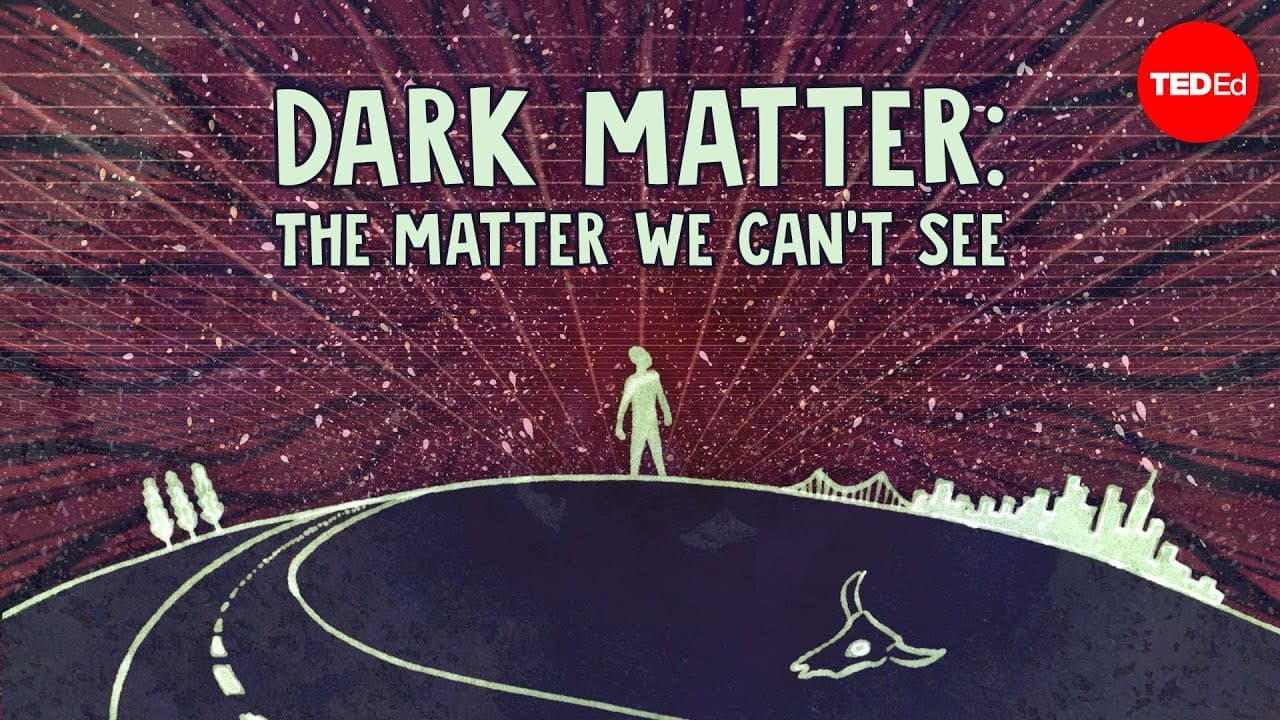
Dark matter: The matter we can't see - James Gillies
TL;DR
The universe is mostly made up of dark matter and dark energy, which accounts for 95% of the universe, while only 5% is made up of the visible matter we know.
Transcript
Translator: Andrea McDonough Reviewer: Jessica Ruby The ancient Greeks had a great idea: The universe is simple. In their minds, all you needed to make it were four elements: earth, air, fire, and water. As theories go, it's a beautiful one. It has simplicity and elegance. It says that by combining the four basic elements in different ways, you cou... Read More
Key Insights
- 🌍 The ancient Greeks believed in a simple universe composed of earth, air, fire, and water, but this theory lacked measurement and was ultimately proven wrong.
- 🔬 Leucippus of Miletus introduced the idea of atoms, which are tiny, indivisible particles that make up everything we see. However, atoms are actually divisible, and only 5% of the universe is made up of the atoms we know.
- ⚛️ The rest of the universe, 95% of it, is composed of dark matter and dark energy, which cannot be seen but can be inferred through observations of galaxy motion and the cosmic microwave background.
- ✨ Dark matter is necessary to explain the gravitational forces holding galaxies together, as there is not enough visible matter to account for it.
- 🔭 Dark energy, on the other hand, is believed to be driving the accelerated expansion of the universe, and most scientists think it's the result of some kind of energy.
- 🌌 Dark matter makes up around 27% of the universe, dark energy about 68%, leaving only 5% for visible matter, including us.
- 🔬 Supersymmetry is a theory that predicts new particles, some of which could make up dark matter. Confirmation of supersymmetry could increase our understanding of the universe from 5% to a third.
- 🪕 String theory suggests that the universe's diversity comes from a single vibrating string, with different particles being different harmonics. However, string theories are currently untestable.
Install to Summarize YouTube Videos and Get Transcripts
Explore YouTube Video Summarizer or Get YouTube Transcript Extractor
Questions & Answers
Q: What is dark matter and dark energy, and how do scientists know they exist?
Dark matter and dark energy are mysterious components of the universe that cannot be directly observed. Scientists infer their existence through measurements of galactic motion and the acceleration of the universe's expansion. These measurements indicate that there must be additional matter and energy that we cannot see, leading to the concepts of dark matter and dark energy.
Q: How does dark matter affect galaxies?
Dark matter plays a crucial role in galaxies by providing the necessary gravitational force to hold them together. Without dark matter, the visible matter in galaxies would not be sufficient to create enough gravity to prevent them from flying apart. Dark matter acts as the invisible glue that holds galaxies and galactic clusters intact.
Q: What is the current understanding of the composition of the universe?
According to current measurements, approximately 68% of the universe is believed to be made up of dark energy, which is driving the acceleration of the universe's expansion. Dark matter makes up about 27% of the universe, while only 5% is visible matter, including everything we can observe and interact with.
Q: How could supersymmetry help explain dark matter?
Supersymmetry, or SUSY, is a theoretical framework that predicts the existence of new particles, some of which could potentially make up dark matter. If experimental evidence for supersymmetry is found, our understanding of the universe could expand significantly, as it would explain a large portion of the elusive dark matter that currently remains a mystery.
Summary & Key Takeaways
-
Ancient Greeks believed the universe was made up of four elements, but Leucippus of Miletus introduced the theory of atoms, which is proven right but incomplete.
-
Dark matter, invisible to us, makes up a significant portion of the universe and is essential for holding galaxies together.
-
Dark energy, believed to be driving the universe's acceleration, makes up a large percentage of the universe, with only a small fraction being visible matter.
Read in Other Languages (beta)
Share This Summary 📚
Summarize YouTube Videos and Get Video Transcripts with 1-Click
Try YouTube Summary with ChatGPT & Claude or YouTube Transcript Generator
Explore More Summaries from TED-Ed 📚





Summarize YouTube Videos and Get Video Transcripts with 1-Click
Try YouTube Summary with ChatGPT & Claude or YouTube Transcript Generator