What Is the Wave-Particle Duality in Quantum Mechanics?
TL;DR
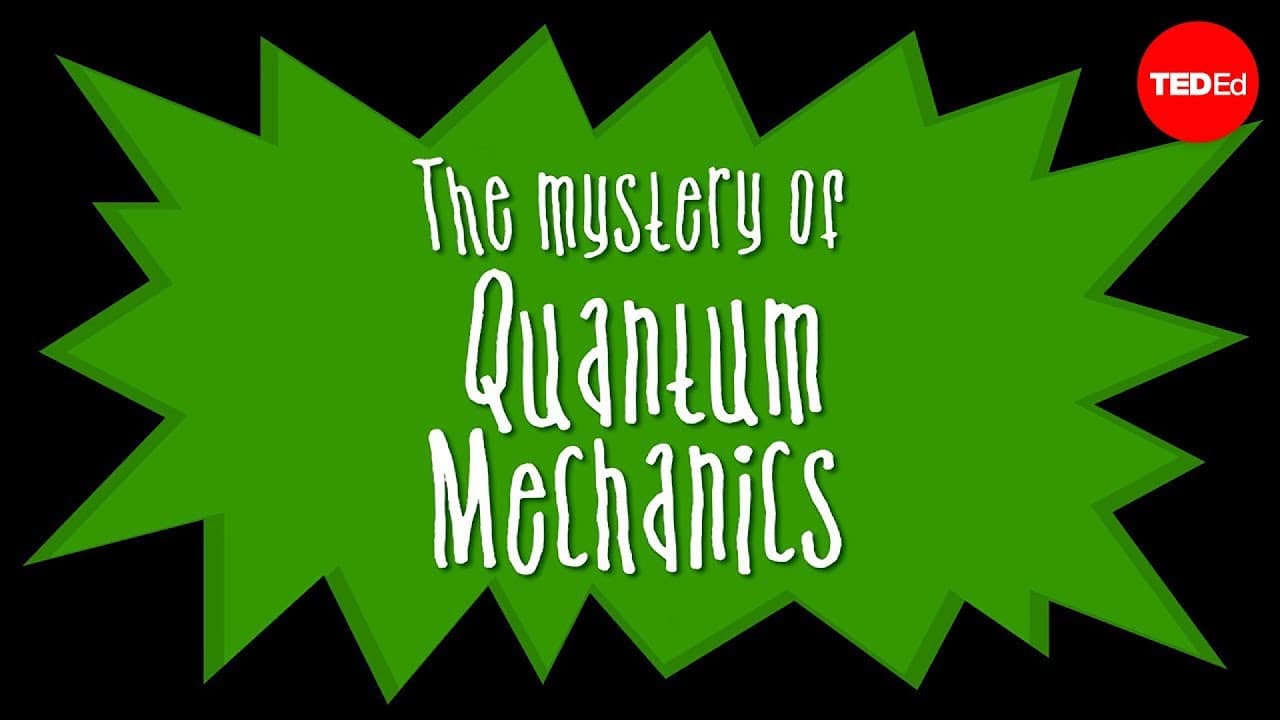
Wave-particle duality is the concept that everything in the universe, from light to electrons, exhibits both particle and wave characteristics simultaneously. This revolutionary idea, developed by scientists like Einstein, Bohr, and de Broglie, underpins quantum mechanics and explains various physical phenomena, highlighting that particles and waves are interchangeable.
Transcript
One of the most amazing facts in physics is this: everything in the universe, from light to electrons to atoms, behaves like both a particle and a wave at the same time. All of the other weird stuff you might have heard about quantum physics, Schrodinger's Cat, God playing dice, spooky action at a distance, all of it follows directly from the fact... Read More
Key Insights
- 👋 Quantum physics reveals that everything in the universe demonstrates both particle and wave properties simultaneously.
- 🙉 Understanding the wave-particle duality concept involved the contributions of key scientists such as Einstein, Planck, Rutherford, Bohr, and de Broglie.
- 🫀 The Bohr model of the atom provided a solution to the emission of specific colors of light and explained the stability of atomic structures.
- 👋 De Broglie's theory of matter waves revolutionized physics by suggesting that particles like electrons also exhibit wave-like behavior.
- 👋 Experimental verification of wave-particle duality involved observing electron behavior at barriers with slits, showcasing the dual nature of particles.
- 👋 The concept of wave-particle duality serves as the linchpin of quantum mechanics, offering explanations for various phenomena in the subatomic realm.
- 👋 Quantum physics challenges classical notions by demonstrating the interconnectedness of particles and waves in all aspects of the universe.
Install to Summarize YouTube Videos and Get Transcripts
Explore YouTube Video Summarizer or Get YouTube Transcript Extractor
Questions & Answers
Q: Who were the key scientists involved in uncovering the concept of wave-particle duality?
Key scientists include Albert Einstein, Max Planck, Ernest Rutherford, Niels Bohr, and Louis de Broglie, who each contributed crucial insights to understanding the dual nature of particles and waves.
Q: How did Niels Bohr resolve the inconsistency in Rutherford's atomic model?
Niels Bohr proposed that electrons in specific orbits do not emit light, only transitioning orbits cause light emission, aligning with Planck and Einstein's theories on energy quantization in light.
Q: Why did Louis de Broglie's wave-particle duality proposal revolutionize physics?
De Broglie's idea that electrons behave like waves provided an explanation for Bohr's special orbits, leading to experimental verification of wave behavior in electrons and transforming our understanding of matter at the microscopic level.
Q: What is the significance of the wave-particle duality concept in quantum physics?
The concept of particles exhibiting wave-like properties and vice versa is fundamental in quantum mechanics, serving as the central mystery from which various phenomena and principles in physics derive.
Summary & Key Takeaways
-
Physicists discovered that everything in the universe, from light to atoms, behaves as both a particle and a wave simultaneously.
-
The progression of understanding wave-particle duality involved contributions from famous scientists like Albert Einstein, Max Planck, Ernest Rutherford, Niels Bohr, and Louis de Broglie.
-
The idea that particles and waves are interchangeable concepts forms the basis of quantum mechanics, explaining various phenomena in physics.
Read in Other Languages (beta)
Share This Summary 📚
Summarize YouTube Videos and Get Video Transcripts with 1-Click
Try YouTube Summary with ChatGPT & Claude or YouTube Transcript Generator
Explore More Summaries from TED-Ed 📚


Summarize YouTube Videos and Get Video Transcripts with 1-Click
Try YouTube Summary with ChatGPT & Claude or YouTube Transcript Generator