Lenz's Law, Right Hand Rule, Induced Current, Electromagnetic Induction - Physics
TL;DR
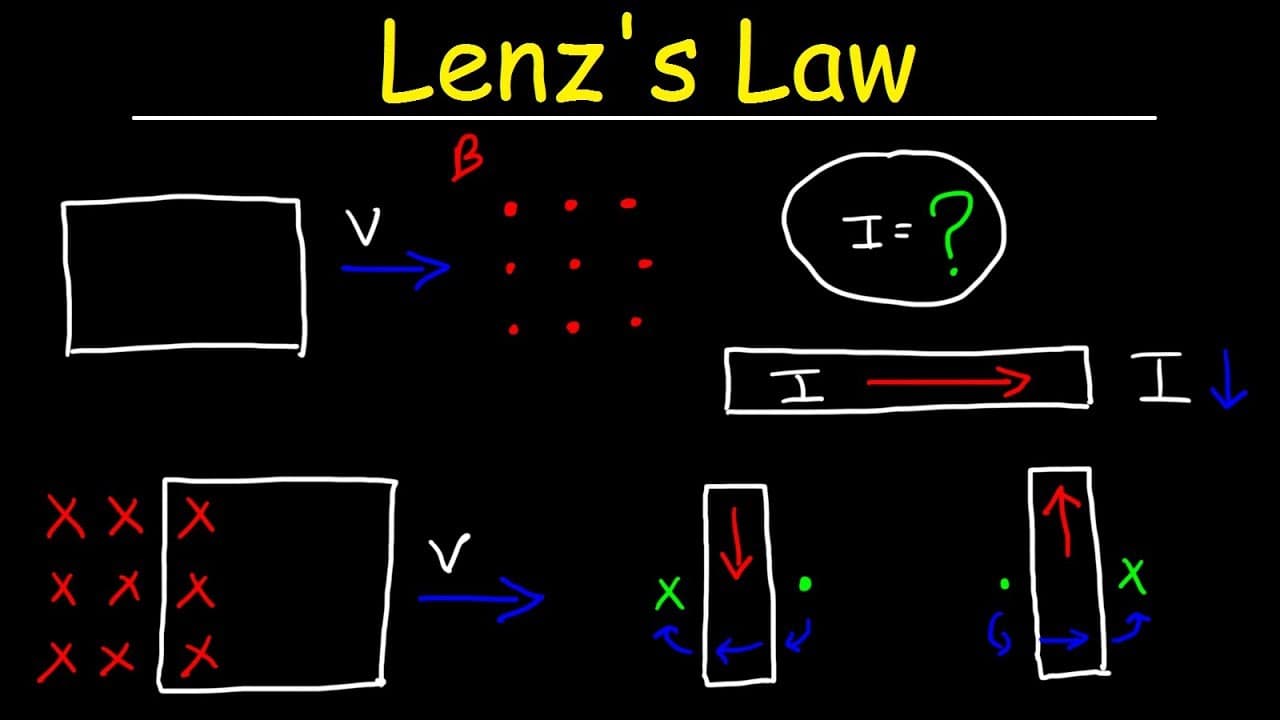
Lenz's Law states that an induced emf will always produce a current that opposes the change in magnetic flux that created it.
Transcript
in this video i want to focus on lenz's law and how we could use it to determine the direction of a current in the coil when an induced emf is present and the basic idea behind lenses law is that an induced emf will always give rise to a current whose magnetic field opposes the original change in flux that created it so let's start with an example ... Read More
Key Insights
- 💱 Lenz's Law states that an induced emf will always result in an induced current that opposes the change in magnetic flux.
- 🫰 The direction of the induced current can be determined using the right-hand rule, where your thumb points in the direction of the current and your fingers follow the magnetic field.
- 🏑 When the magnetic flux through a coil increases, the induced current generates a magnetic field in the opposite direction to counteract the change.
- 🏑 Conversely, when the magnetic flux through a coil decreases, the induced current generates a magnetic field in the same direction to support the change.
- ⚾ Lenz's Law is based on the principle of maintaining equilibrium and preventing drastic changes in magnetic flux.
- 🏑 By understanding Lenz's Law, one can predict the direction of current in a coil exposed to a changing magnetic field.
- 🏑 The process of determining the direction of induced current involves analyzing the interaction between the external and induced magnetic fields.
Install to Summarize YouTube Videos and Get Transcripts
Explore YouTube Video Summarizer or Get YouTube Transcript Extractor
Questions & Answers
Q: What is Lenz's Law and how does it relate to the direction of induced current?
Lenz's Law states that an induced emf will always give rise to a current whose magnetic field opposes the original change in flux that created it. This means that the direction of the induced current is such that it counteracts the change in magnetic flux.
Q: How can the direction of the induced current be determined?
The direction of the induced current can be determined using the right-hand rule. By wrapping your hand around a pen and pointing your thumb in the direction of the current, your fingers will follow the direction of the magnetic field generated by the current in the wire.
Q: What happens when the magnetic flux through a coil increases?
If the magnetic flux through a coil increases, the induced current will create a magnetic field in the opposite direction to oppose the change. This is done to try and maintain a state of equilibrium.
Q: How does Lenz's Law apply when the magnetic flux through a coil decreases?
When the magnetic flux through a coil decreases, the induced current will create a magnetic field in the same direction as the change to support it. This helps to restore equilibrium and increase the flux.
Summary & Key Takeaways
-
Lenz's Law explains that when a coil of wire is exposed to a changing magnetic field, an induced current is created that opposes the change in flux.
-
The direction of the induced current can be determined using the right-hand rule, where the magnetic field generated by the current in the wire corresponds to the direction of the current.
-
If the magnetic flux through a coil increases, the induced current creates a magnetic field in the opposite direction to counteract the change. If the flux decreases, the induced current creates a magnetic field in the same direction to support the change.
Read in Other Languages (beta)
Share This Summary 📚
Summarize YouTube Videos and Get Video Transcripts with 1-Click
Try YouTube Summary with ChatGPT & Claude or YouTube Transcript Generator
Explore More Summaries from The Organic Chemistry Tutor 📚



Summarize YouTube Videos and Get Video Transcripts with 1-Click
Try YouTube Summary with ChatGPT & Claude or YouTube Transcript Generator