Products
Features
YouTube Video Summarizer
Summarize YouTube videos
Web & PDF Highlighter
Highlight web pages & PDFs
Chat with PDF
Ask any PDF questions with AI
Ask AI Clone
Chat with your highlights & memories
Audio Transcriber
Transcribe audio files to text
Glasp Reader
Read and highlight articles
Kindle Highlight Export
Export your Kindle highlights
Idea Hatch
Hatch ideas from your highlights
Integrations
Obsidian Plugin
Notion Integration
Pocket Integration
Instapaper Integration
Medium Integration
Readwise Integration
Snipd Integration
Hypothesis Integration
Apps & Extensions
Chrome Extension
Safari Extension
Edge Add-ons
Firefox Add-ons
iOS App
Android App
Discover
Discover
Ideas
Discover new ideas and insights
Articles
Curated articles and insights
Books
Book recommendations by great minds
Posts
Essays and notes from readers
Quotes
Inspiring quotes collection
Videos
Curated videos and summaries
Explore Glasp
Glasp Newsletter
Weekly insights and updates
Glasp Talk
Interview series with great minds
Glasp Blog
Latest news and articles
Glasp Use Cases
Learn how others use Glasp
Build & Support
Glasp API
Access Glasp's API for developers
MCP Connector
Connect Glasp to Claude & ChatGPT
Community
Glasp Reddit Community
Students
Student discount and benefits
FAQs
Frequently Asked Questions
AboutPricing
DashboardLog inSign up

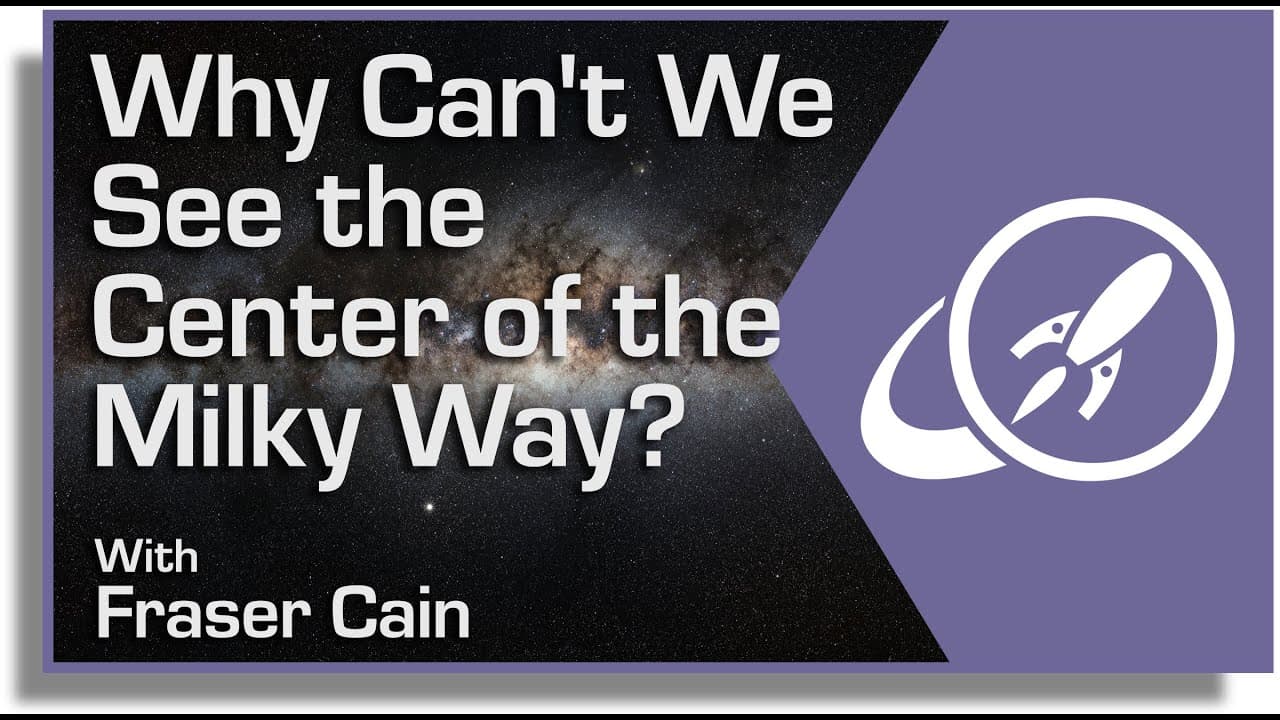
Why Can’t We See the Center of the Milky Way?
72.7K views
•
April 29, 2015
by
Fraser Cain
YouTube video player
Why Can’t We See the Center of the Milky Way?

TL;DR

An artist's illustration helps understand the Milky Way's complexities due to interstellar dust blockage.

Transcript

admire the majesty that is the Milky Way it's our celestial home see all the detail in this gorgeous photo look at all those stars gasps and beautiful glowing space dust you imagine what went into taking this photo what Marvel's of human engineering to get a camera to photograph the whole Milky Way all at once of course you can you're smart let's w... Read More

Key Insights

  • ✴️ The Milky Way's core houses a supermassive black hole, influencing star distribution.
  • 🫵 Interstellar dust obstructs views of the Milky Way, creating challenges for astronomers.
  • 🧑‍🔬 Different wavelengths, like infrared, help scientists see through dust and study obscured regions.
  • 🛟 NGC 6744 serves as a reference galaxy for understanding the Milky Way's structure.
  • ❓ The zone of avoidance restricts astronomers' visibility due to the Milky Way's dust.
  • ❓ Diverse observations across wavelengths reveal hidden aspects of the Milky Way.
  • 🦻 Understanding interstellar dust formations aids in deciphering galactic structures.

Install to Summarize YouTube Videos and Get Transcripts

Explore YouTube Video Summarizer or Get YouTube Transcript Extractor

Questions & Answers

Q: Why is the Milky Way's core so densely packed with stars?

The core of the Milky Way hosts a supermassive black hole, exerting immense gravitational forces that draw stars close together, creating a dense cluster.

Q: How do astronomers see through the interstellar dust in the Milky Way?

Astronomers utilize infrared and other wavelengths to penetrate the dust obstructing their view, allowing them to study regions like the galaxy's core and the supermassive black hole.

Q: What is the significance of the zone of avoidance in astronomy?

The zone of avoidance refers to the area obscured by the Milky Way, limiting astronomers' visibility. By exploring other wavelengths, astronomers can uncover more of the sky's mysteries.

Q: How do astronomers differentiate between an artist's illustration and actual photos of the Milky Way?

Astronomers study actual photos like NGC 6744 to understand similarities with the Milky Way, highlighting the challenges and beauty of observing our galaxy.

Summary & Key Takeaways

  • The Milky Way's core contains a supermassive black hole, surrounded by densely packed stars.

  • Interstellar dust obscures our view of the Milky Way, making it challenging to observe certain areas.

  • Astronomers use different wavelengths, like infrared, to penetrate the dust and study the galaxy more thoroughly.


Read in Other Languages (beta)

English

Share This Summary 📚

Summarize YouTube Videos and Get Video Transcripts with 1-Click

Download browser extensions on:

Try YouTube Summary with ChatGPT & Claude or YouTube Transcript Generator

Explore More Summaries from Fraser Cain 📚
Why Isn't the Asteroid Belt a Planet? thumbnail
Why Isn't the Asteroid Belt a Planet?
Fraser Cain
Are We Living in a Simulation? Understanding the Simulation Hypothesis thumbnail
Are We Living in a Simulation? Understanding the Simulation Hypothesis
Fraser Cain
Why Did Mars Lose Its Atmosphere? And How Can We Get It Back? thumbnail
Why Did Mars Lose Its Atmosphere? And How Can We Get It Back?
Fraser Cain
Exploring Space Lava Tubes: How To Prepare For It thumbnail
Exploring Space Lava Tubes: How To Prepare For It
Fraser Cain / Universe Today Podcast
What's On The Far Side Of The Moon? thumbnail
What's On The Far Side Of The Moon?
Fraser Cain

Summarize YouTube Videos and Get Video Transcripts with 1-Click

Download browser extensions on:

Try YouTube Summary with ChatGPT & Claude or YouTube Transcript Generator

Apps & Extensions

  • Chrome Extension
  • Safari Extension
  • Edge Add-ons
  • Firefox Add-ons
  • iOS App
  • Android App

Key Features

  • YouTube Video Summarizer
  • Web & PDF Summarizer
  • Web & PDF Highlighter
  • Chat with PDF
  • Ask AI Clone
  • Audio Transcriber
  • Glasp Reader
  • Kindle Highlight Export
  • Idea Hatch

Integrations

  • Obsidian Plugin
  • Notion Integration
  • Pocket Integration
  • Instapaper Integration
  • Medium Integration
  • Readwise Integration
  • Snipd Integration
  • Hypothesis Integration

More Features

  • APIs
  • MCP Connector
  • Blog & Post
  • Embed Links
  • Image Highlight
  • Personality Test
  • Quote Shots

Company

  • About us
  • Blog
  • Community
  • FAQs
  • Job Board
  • Newsletter
  • Pricing
Terms

•

Privacy

•

Guidelines

© 2026 Glasp Inc. All rights reserved.