Does Practice Representativeness Effect Perceptual-Motor Calibration?
TL;DR
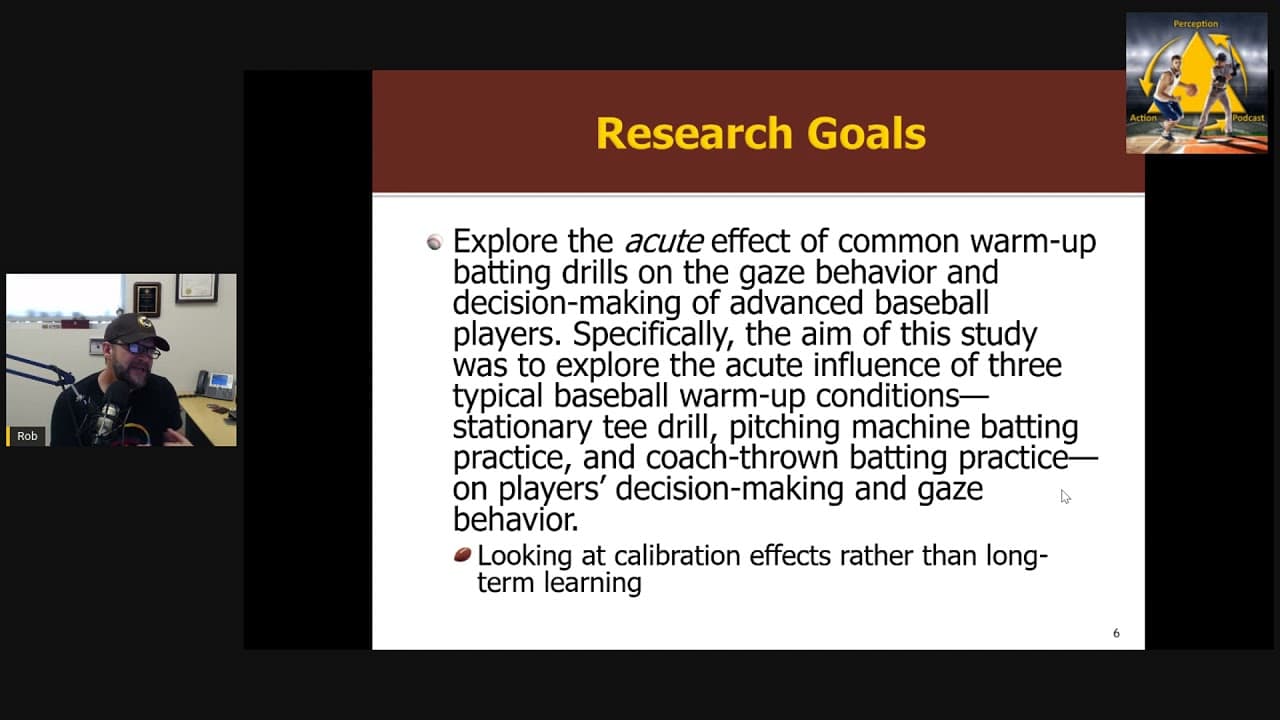
Study explores practice representativeness effects on baseball players' performance.
Transcript
hi everyone it's rob gray from asu in the perception action podcast again back with another article review today i want to look at the topic of representative design and kind of what are the effects of having you know different degrees of representativeness is having a really low representative practice going to hurt right how much is having a high... Read More
Key Insights
- Representative design in practice refers to how closely training mimics real game conditions, affecting transfer of skills to actual performance.
- The study examined short-term effects of practice representativeness on baseball players' decision-making and gaze behavior.
- Different practice methods, such as hitting off a tee or a pitching machine, vary in representativeness and can impact performance calibration.
- Findings suggest that more representative practice, like hitting off a live pitcher, may improve gaze behavior, though results were not statistically significant.
- Low representativeness in practice can lead to learning strategies that do not transfer well to real game conditions.
- The study highlighted the importance of action fidelity, where the movement dynamics in practice should closely match those in competition.
- Despite a lack of significant findings, trends indicated potential benefits of representative practice in quicker gaze calibration.
- The study's design and small sample size limited its ability to find significant results, yet it raised important questions about practice representativeness.
Install to Summarize YouTube Videos and Get Transcripts
Explore YouTube Video Summarizer or Get YouTube Transcript Extractor
Questions & Answers
Q: What is representative design in practice?
Representative design in practice refers to the degree to which training conditions mimic actual game scenarios. The idea is that the closer practice conditions are to real competition, the better the transfer of skills will be. Key elements include perception-action coupling, specifying information, and action fidelity, which ensure that practice movements and information align with those in competition.
Q: How does practice representativeness affect baseball players' performance?
Practice representativeness affects baseball players' performance by influencing their decision-making and gaze behavior. More representative practice, such as hitting off a live pitcher, can lead to better calibration of gaze behavior and potentially improve performance. Low representativeness, like hitting off a tee, may result in learning strategies that do not transfer effectively to actual games, affecting players' performance.
Q: What were the main findings of the study on practice representativeness?
The study found no significant effects of practice representativeness on baseball players' decision-making and gaze behavior, likely due to its small sample size and between-subjects design. However, trends indicated that more representative practice methods, such as hitting off a live pitcher, might aid in quicker gaze calibration, suggesting potential benefits for performance improvement.
Q: Why is action fidelity important in practice design?
Action fidelity is crucial in practice design because it ensures that the movement dynamics in practice closely match those in actual competition. High action fidelity helps players develop movement patterns that are directly applicable to real game situations, enhancing skill transfer and performance. Low action fidelity, where practice movements differ significantly from competition, can lead to ineffective learning and poor performance.
Q: What limitations did the study on practice representativeness face?
The study faced limitations such as a small sample size and a between-subjects design, which increased variability and reduced the likelihood of finding significant results. These factors limited the study's ability to draw definitive conclusions about the effects of practice representativeness on performance, though it did highlight important trends and questions for future research.
Q: How does representative practice influence skill transfer in sports?
Representative practice influences skill transfer by aligning practice conditions with those of actual competition. When practice closely mimics game scenarios, players are more likely to develop skills that transfer effectively to real situations, improving performance. Conversely, low representativeness can lead to learning ineffective strategies that do not work well in actual games, hindering skill transfer.
Q: What role does gaze behavior play in baseball performance?
Gaze behavior plays a critical role in baseball performance by affecting how players track and respond to pitches. Successful hitting requires players to quickly focus their gaze on the pitcher's release point to accurately track the ball. Proper gaze behavior allows players to make better decisions and execute more effective swings, directly impacting their performance in games.
Q: What are the potential consequences of low representativeness in practice?
Low representativeness in practice can lead to learning strategies and movement patterns that do not transfer well to actual game conditions. This misalignment can result in players developing ineffective skills and strategies, ultimately impacting their performance. Over time, practicing with low representativeness may hinder skill development and reduce players' ability to perform effectively in competition.
Summary & Key Takeaways
-
This study explored the impact of practice representativeness on baseball players' performance, focusing on decision-making and gaze behavior. Different levels of representativeness in practice, such as using a tee versus a pitching machine, were examined for their short-term effects on players' calibration.
-
Results showed no significant differences in performance based on practice method, likely due to the study's small sample size and between-subjects design. However, trends suggested that more representative practice might aid in quicker gaze calibration, potentially improving performance.
-
The study emphasized the importance of representative design in sports training, highlighting how closely practice mimics real game conditions can influence skill transfer. Despite limitations, the research raised critical questions about optimizing practice methods for better performance outcomes.
Read in Other Languages (beta)
Share This Summary 📚
Summarize YouTube Videos and Get Video Transcripts with 1-Click
Try YouTube Summary with ChatGPT & Claude or YouTube Transcript Generator
Explore More Summaries from Rob Gray 📚
Summarize YouTube Videos and Get Video Transcripts with 1-Click
Try YouTube Summary with ChatGPT & Claude or YouTube Transcript Generator