Classification of Lime
TL;DR
This lesson provides an overview of the classification of lime in construction, including lean/poor lime, hydraulic lime, and fat lime.
Transcript
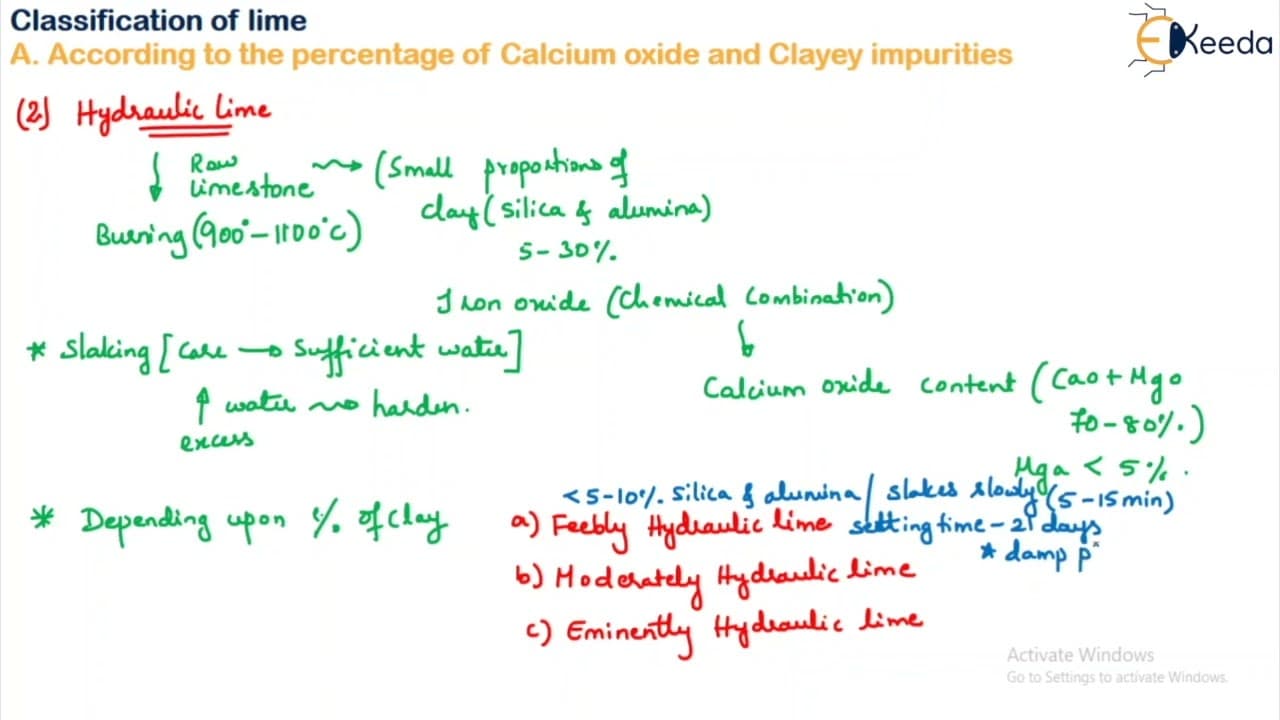
hello students in this lesson let us study about the classification of line so the line have been classified based on two categories the first category is based on how much of percentage of calcium oxide and clay impurities are present in this we have three categories the lean or poor lime hydraulic lime and the pore rich or fat line so that we wil... Read More
Key Insights
- 👨 Lime is classified into lean/poor lime, hydraulic lime, and fat lime based on calcium oxide and clay impurity percentages.
- 🥶 Hydraulic lime is obtained through the burning of raw limestone and can be further classified into free hydraulic lime, moderately hydraulic lime, and eminently hydraulic lime.
- ✋ Fat lime, also known as whitewashing lime, is a soft type of lime with high calcium oxide content.
- 😫 Lean/poor lime hydrates slowly, while hydraulic lime sets and hardens differently based on clay percentages.
- 👨 Fat lime is used for finishing coats, whitewashing, and in the manufacturing of cement.
- 👨 According to the IS classification, lime is categorized into eminently hydraulic lime, semi-hydraulic lime, fat lime, class D lime, class E lime, and silicaceous dolomite lime.
- 👷 Each classification has specific characteristics and applications in construction.
Install to Summarize YouTube Videos and Get Transcripts
Explore YouTube Video Summarizer or Get YouTube Transcript Extractor
Questions & Answers
Q: What are the three categories of lime classification?
The three categories of lime classification are lean/poor lime, hydraulic lime, and fat lime. Lean/poor lime has a lower percentage of calcium oxide and higher clay impurities, while fat lime has a high calcium oxide content.
Q: How is hydraulic lime obtained?
Hydraulic lime is obtained through the burning of raw limestone at temperatures between 900 to 1000 degrees Celsius. It contains small proportions of clay impurities.
Q: What are the characteristics of fat lime?
Fat lime slakes vigorously and increases in volume after slaking. It is often used for finishing coats in plastering and whitewashing.
Q: Where can lean/poor lime be used?
Lean/poor lime is suitable for making inferior mortars for less important structures. It should not be used for important or load-bearing structures.
Summary & Key Takeaways
-
Lime is classified based on the percentage of calcium oxide and clay impurities present, with three categories: lean/poor lime, hydraulic lime, and fat lime.
-
Hydraulic lime is obtained through the burning of raw limestone and further classified based on clay impurity percentages.
-
Fat lime, also known as whitewashing lime, is a soft type of lime with high calcium oxide content.
Read in Other Languages (beta)
Share This Summary 📚
Summarize YouTube Videos and Get Video Transcripts with 1-Click
Try YouTube Summary with ChatGPT & Claude or YouTube Transcript Generator
Explore More Summaries from Ekeeda 📚





Summarize YouTube Videos and Get Video Transcripts with 1-Click
Try YouTube Summary with ChatGPT & Claude or YouTube Transcript Generator