What If The Universe DID NOT Start With The Big Bang?
TL;DR
Explores if the universe began with the Big Bang or not.
Transcript
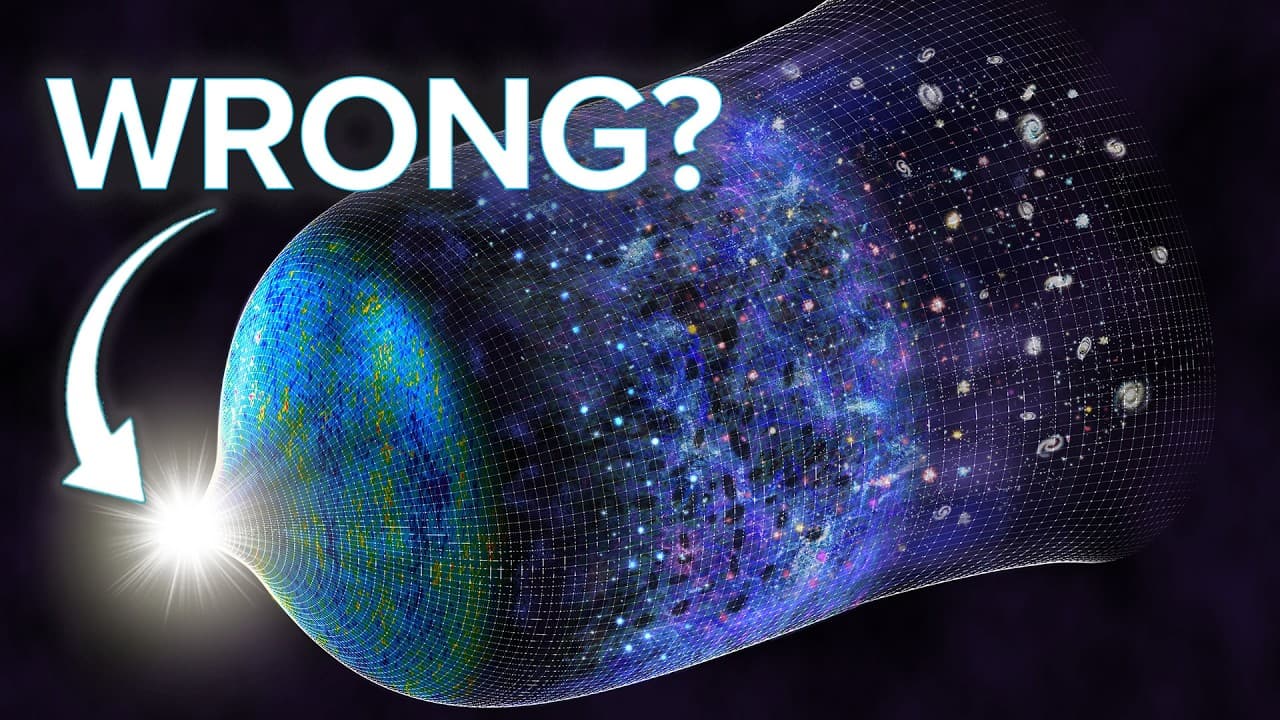
Thank you to Brilliant for supporting PBS. Here’s the story we like to tell about the beginning of the universe. Space is expanding evenly everywhere, but if you rewind that expansion you find that all of space was once compacted in an infinitesimal point of infinite density—the singularity at the beginning of time. The expansion of the universe... Read More
Key Insights
- The traditional Big Bang theory posits that the universe started from a singularity, an infinitesimal point of infinite density.
- Einstein's general theory of relativity led to the idea of an expanding universe, but recent studies suggest alternative possibilities.
- Cosmic inflation theory proposes that the universe underwent rapid expansion, potentially leading to multiple bubble universes.
- The concept of eternal inflation raises the question of whether the universe could have existed infinitely into the past.
- Geodesic incompleteness is a tool used to determine whether the universe had a beginning, suggesting a past boundary.
- The Borde-Guth-Vilenkin theorem argues that any universe with positive average expansion must have a past boundary.
- Recent research suggests that certain expansion histories of the universe might not require a singularity at the beginning.
- The debate over the universe's beginning remains unresolved, highlighting the limits of current physics and the need for quantum gravity theories.
Install to Summarize YouTube Videos and Get Transcripts
Explore YouTube Video Summarizer or Get YouTube Transcript Extractor
Questions & Answers
Q: What is the traditional view of the universe's beginning?
The traditional view, known as the Big Bang theory, suggests that the universe began from a singularity—an infinitesimal point of infinite density. This idea stems from the observation of an expanding universe, as predicted by Einstein's general theory of relativity. According to this view, all of space was once compacted into this singular point, marking the beginning of time and space.
Q: How does cosmic inflation challenge the Big Bang theory?
Cosmic inflation introduces the idea that the universe underwent a period of rapid exponential expansion shortly after the Big Bang. This theory helps explain the uniformity of the universe we observe today. It suggests that small smooth patches in the early universe were stretched to create the vast, smooth universe we see now. This challenges the notion of a singular beginning by proposing that the universe could have multiple bubble universes and might not have originated from a single point.
Q: What is eternal inflation and how does it affect our understanding of the universe?
Eternal inflation is a theory suggesting that the inflationary period of the universe might not have stopped everywhere, potentially creating an ever-growing spacetime with multiple bubble universes like ours. This raises the possibility that the universe could have existed infinitely into the past, challenging the idea of a singular beginning. If eternal inflation is true, it suggests that the universe might not have a definite starting point, complicating our understanding of its origins.
Q: What is geodesic incompleteness and its significance in cosmology?
Geodesic incompleteness refers to the idea that certain paths through spacetime, known as geodesics, cannot be extended indefinitely into the past or future. In cosmology, this concept is used to argue that the universe had a beginning. If all geodesics in the universe lead back to a single point, it suggests a past boundary, indicating that spacetime might have started at a particular moment. This concept is crucial for understanding whether the universe had a singular beginning.
Q: What does the Borde-Guth-Vilenkin theorem state about the universe's beginning?
The Borde-Guth-Vilenkin (BGV) theorem states that any universe that has been, on average, expanding throughout its history cannot have been doing so forever. It must have a past boundary, suggesting a beginning to spacetime. This theorem is significant because it provides a mathematical basis for the idea that the universe had a starting point, challenging theories that propose an infinite past.
Q: How do recent studies challenge the idea of a singular beginning?
Recent studies suggest that certain expansion histories of the universe might not require a singularity at the beginning. For example, a universe that expanded after a phase of contraction or from a static phase might avoid a singularity. These studies indicate that breaking certain energy conditions in general relativity could allow for a universe without a singular beginning, challenging traditional views and highlighting the complexity of cosmological models.
Q: What role does quantum gravity play in understanding the universe's origins?
Quantum gravity is essential for understanding the universe's origins because current physics, particularly general relativity, breaks down when approaching a point of infinite density, such as a singularity. A theory of quantum gravity would provide insights into the behavior of spacetime at extremely small scales, potentially resolving questions about the universe's beginning and whether it had a singular origin. The development of quantum gravity theories is crucial for advancing our understanding of cosmology.
Q: What is the significance of the debate over the universe's beginning?
The debate over the universe's beginning is significant because it challenges our understanding of cosmology and the fundamental nature of spacetime. It highlights the limitations of current physics and the need for new theories, such as quantum gravity, to fully comprehend the universe's origins. The discussion also underscores the remarkable ability of human reason to tackle profound questions about the cosmos, pushing the boundaries of scientific knowledge and exploration.
Summary & Key Takeaways
-
The video challenges the traditional Big Bang theory by exploring whether the universe had a singular beginning. It discusses cosmic inflation and eternal inflation, suggesting the universe might not have started with a singularity.
-
Geodesic incompleteness and the Borde-Guth-Vilenkin theorem are used to argue for a past boundary of the universe, but recent research indicates some expansion histories might not require a singularity.
-
The discussion emphasizes the complexity of cosmology and the limitations of current physics, highlighting the need for further exploration in quantum gravity to understand the universe's true origins.
Read in Other Languages (beta)
Share This Summary 📚
Summarize YouTube Videos and Get Video Transcripts with 1-Click
Try YouTube Summary with ChatGPT & Claude or YouTube Transcript Generator
Explore More Summaries from PBS Space Time 📚
Summarize YouTube Videos and Get Video Transcripts with 1-Click
Try YouTube Summary with ChatGPT & Claude or YouTube Transcript Generator