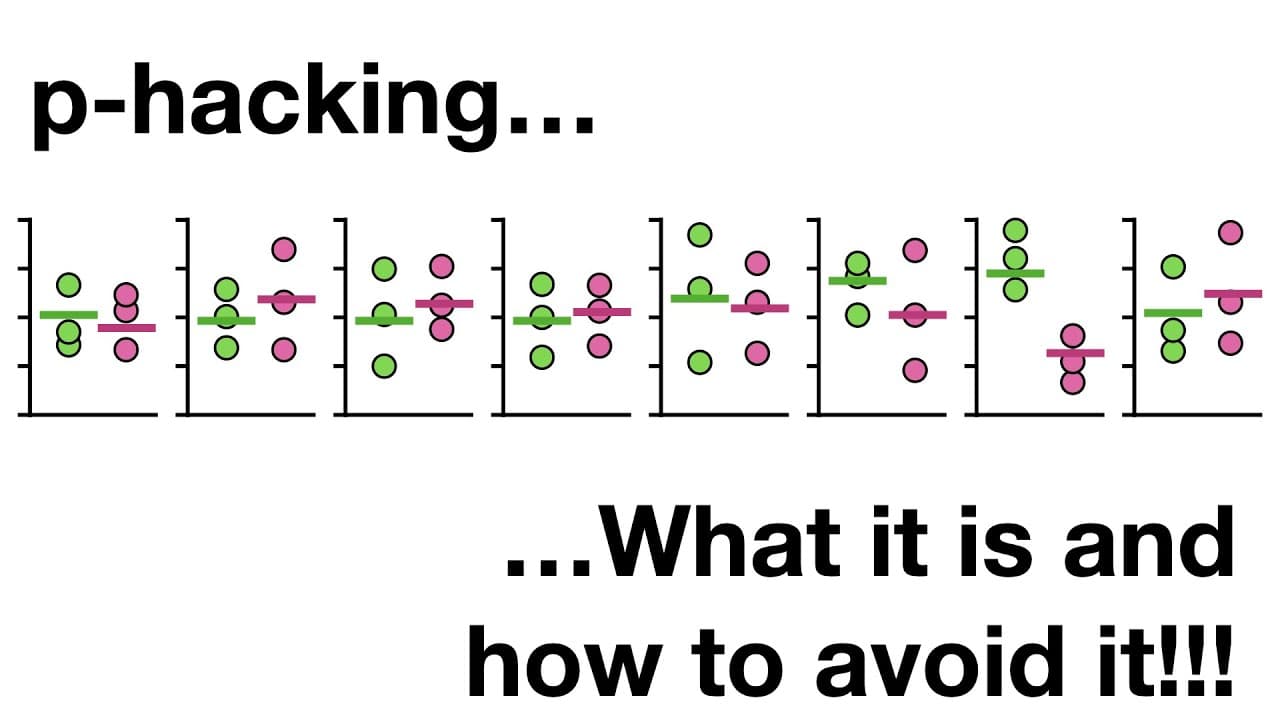
p-hacking: What it is and how to avoid it!
TL;DR
P-hacking is manipulating data analysis to achieve false positives; avoid it by using proper statistical methods.
Transcript
P hackin don't do it if you do it it's a shame skin quest yeah hello I'm Josh stormer and welcome to stat quest today we're gonna talk about P hacking what it is and how to avoid it note this stack quest assumes that you are already familiar with p-values if not check out the quests imagine there was a virus and we wanted to develop a drug to reduc... Read More
Key Insights
- 🥺 P-hacking involves manipulating data analysis to create false positives, leading to inaccurate conclusions.
- ☠️ Proper statistical practices, such as using the false discovery rate and conducting power analyses, help prevent P-hacking.
- 💉 The multiple testing problem is exacerbated by P-hacking, emphasizing the need for rigorous statistical methods.
- 🌸 Researchers must calculate p-values for all tests and avoid cherry-picking data to ensure the validity of their findings.
- ✊ Conducting power analyses before experiments helps in determining the appropriate sample size, reducing the risk of false positives.
- 🥺 P-hacking can have detrimental effects on scientific research, leading to wasted resources and compromised integrity.
- 😀 Awareness of the pitfalls of P-hacking and adherence to ethical statistical practices are crucial for ensuring the reliability of research outcomes.
Install to Summarize YouTube Videos and Get Transcripts
Explore YouTube Video Summarizer or Get YouTube Transcript Extractor
Questions & Answers
Q: What is P-hacking and why is it problematic?
P-hacking involves manipulating data analysis to achieve statistically significant results, leading to false positives. It undermines the integrity of research by presenting inaccurate conclusions based on flawed statistical practices.
Q: How can researchers avoid falling into the trap of P-hacking?
Researchers can avoid P-hacking by conducting proper statistical methods, such as calculating p-values for all tests, using techniques like the false discovery rate, and performing power analyses to determine correct sample sizes before experiments.
Q: What are the consequences of P-hacking in scientific research?
P-hacking can result in misleading findings that have real-world implications, leading to wasted resources, skewed understandings of phenomena, and compromised scientific integrity. It erodes trust in research outcomes and undermines the credibility of scientific endeavors.
Q: How does P-hacking relate to the multiple testing problem?
P-hacking exacerbates the multiple testing problem by increasing the likelihood of false positives when conducting numerous statistical tests. Researchers must be aware of this issue and employ corrective measures like the false discovery rate to mitigate the risk.
Summary & Key Takeaways
-
P-hacking involves manipulating data analysis to produce false positives, leading to incorrect conclusions.
-
To avoid p-hacking, calculate p-values for all tests, use methods like the false discovery rate, and conduct power analyses for proper sample sizes.
-
Proper statistical practices help in reducing the likelihood of reporting false positives and ensuring accurate results.
Read in Other Languages (beta)
Share This Summary 📚
Summarize YouTube Videos and Get Video Transcripts with 1-Click
Try YouTube Summary with ChatGPT & Claude or YouTube Transcript Generator
Explore More Summaries from StatQuest with Josh Starmer 📚

Summarize YouTube Videos and Get Video Transcripts with 1-Click
Try YouTube Summary with ChatGPT & Claude or YouTube Transcript Generator