What Are Simple, Body-Centered, and Face-Centered Cubic Structures?
TL;DR
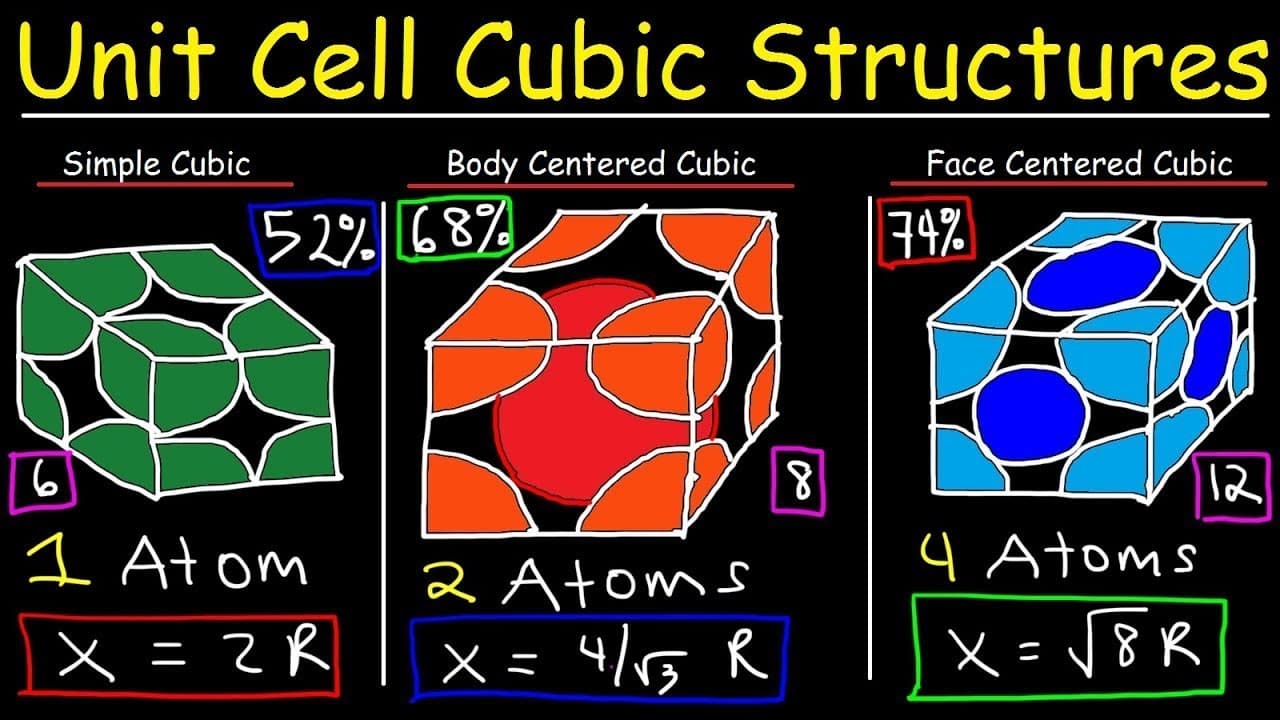
There are three main cubic crystal structures: simple cubic, body-centered cubic, and face-centered cubic. The simple cubic structure has 1 atom and 52% volume occupancy, the body-centered has 2 atoms and 68%, while the face-centered structure has 4 atoms and the highest efficiency at 74%. Each structure has specific formulas relating edge length to atomic radius: x = 2r for simple cubic, x = 4/√3 r for body-centered, and x = √8 r for face-centered.
Transcript
in this video i'm going to give you a basic introduction into unit cells now there's three structures you need to be familiar with the first one on the left is the simple cubic structure the second one in the middle is the body centered cubic structure and the last one is the face centered cubic structure so each of these cubes represent a single u... Read More
Key Insights
- 😀 There are three types of unit cell structures: simple cubic, body centered cubic, and face centered cubic.
- 🫀 The coordination number represents the number of atoms attached to a single atom in a cubic structure.
- 😀 The volume occupancy of the cube by atoms varies for each structure, with the face centered cubic structure being the most efficient.
Install to Summarize YouTube Videos and Get Transcripts
Explore YouTube Video Summarizer or Get YouTube Transcript Extractor
Questions & Answers
Q: What are the three types of unit cell structures discussed in the video?
The three types of unit cell structures discussed in the video are simple cubic, body centered cubic, and face centered cubic.
Q: How many atoms are there per unit cell in the body centered cubic structure?
There are two atoms per unit cell in the body centered cubic structure. Each atom at the corner of the cube is one-eighth of an atom, and there is also one atom in the center.
Q: What is the coordination number of the face centered cubic structure?
The coordination number of the face centered cubic structure is 12. Each atom is attached or adjacent to 12 other atoms in this structure.
Q: How does the volume occupancy of the face centered cubic structure compare to the other structures?
The face centered cubic structure has the highest volume occupancy among the three structures, with 74% of the volume of the cube occupied by atoms. It is the most efficient in terms of space utilization.
Summary & Key Takeaways
-
The video explains three types of unit cell structures: simple cubic, body centered cubic, and face centered cubic, and discusses the number of atoms and coordination numbers in each.
-
It highlights the volume occupancy of each structure, with the face centered cubic structure being the most efficient, and the simple cubic structure having 52% volume occupancy.
-
The relationship between the edge length (x) and atomic radius (r) is explained for each structure, with the edge length being equal to 2r for simple cubic, 4/√3 times r for body centered cubic, and √8 times r for face centered cubic.
Read in Other Languages (beta)
Share This Summary 📚
Summarize YouTube Videos and Get Video Transcripts with 1-Click
Try YouTube Summary with ChatGPT & Claude or YouTube Transcript Generator
Explore More Summaries from The Organic Chemistry Tutor 📚


Summarize YouTube Videos and Get Video Transcripts with 1-Click
Try YouTube Summary with ChatGPT & Claude or YouTube Transcript Generator