What Are Hubs, Bridges, Switches, and Routers in Networking?
TL;DR
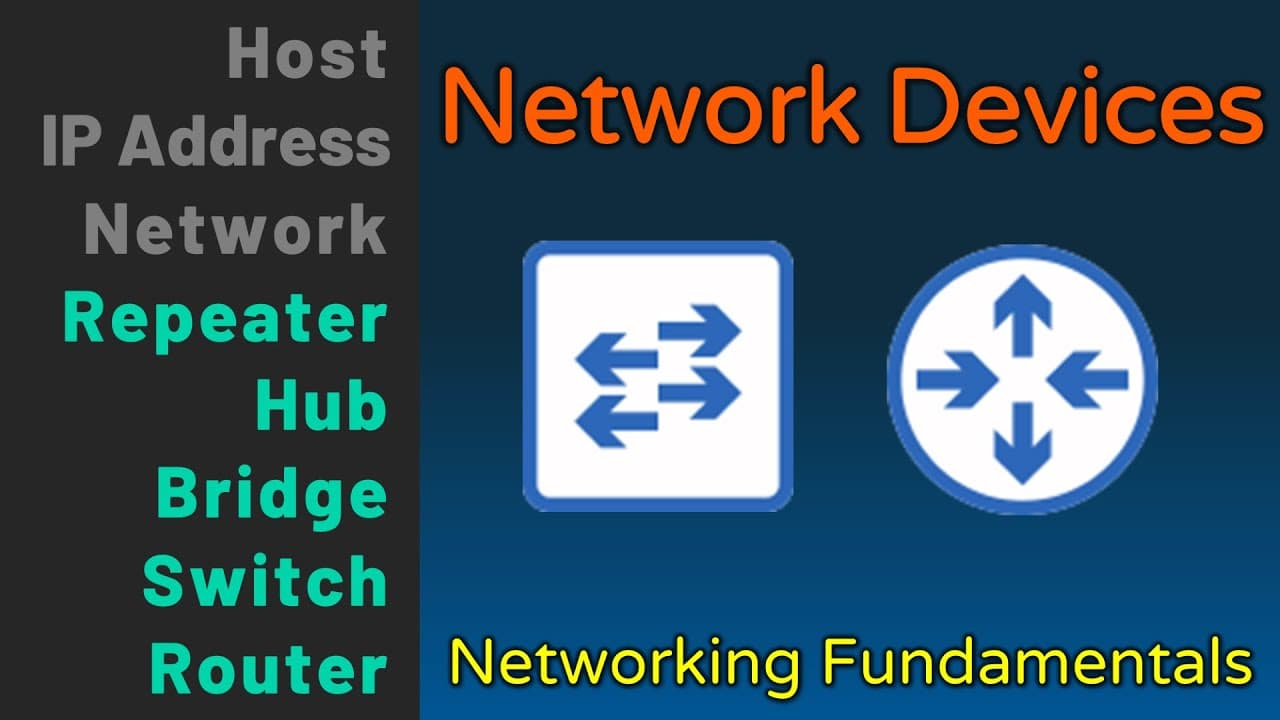
Hubs, bridges, switches, and routers are essential networking devices. Hubs connect multiple devices but broadcast all data to each; bridges filter traffic between hubs to specific networks; switches learn which devices are connected to manage communication effectively; and routers facilitate communication across different networks, applying traffic control and security measures.
Transcript
hello welcome to the second part of our lesson on network devices this is the first lesson from the first module of my new course on networking fundamentals the purpose of this module is to teach you how data flows through the internet in part one of this lesson we discussed the concepts of a host an ip address and a network if you haven't watched ... Read More
Key Insights
- 📡 The purpose of the module is to teach about how data flows through the internet, starting with the concepts of hosts, IP addresses, and networks.
- 🔁 Repeaters are devices used to regenerate signals and maintain connectivity between hosts when data travels over greater distances.
- ☑️ Hubs are multi-port repeaters that allow multiple devices to connect to a network, but they have the disadvantage of broadcasting all data to all devices connected to them.
- 🌉 Bridges are devices that sit between hub-connected hosts and learn which hosts are on each side. They help contain communication to specific networks and prevent unnecessary data duplication.
- 🔀 Switches combine the capabilities of hubs and bridges, allowing multiple devices to connect while also learning which devices are connected to each port. They enable communication within a network on a per-port basis.
- 🌐 Routers facilitate communication between multiple networks and can impose traffic control points, apply security policies, and redirect traffic. They create the hierarchy in networks and IP addresses.
- 👥 Networks consist of a logical grouping of hosts with similar connectivity requirements. Switches facilitate communication within a network, while routers enable communication between networks.
- 🔄 Routing is the process of moving data between networks, while switching is the process of moving data within networks. Various network devices perform routing, switching, or both functions.
Install to Summarize YouTube Videos and Get Transcripts
Explore YouTube Video Summarizer or Get YouTube Transcript Extractor
Questions & Answers
Q: How do repeaters enable connectivity between hosts spanning greater distances?
Repeater devices regenerate signals, allowing them to connect devices that are physically far apart by countering signal decay and preserving connectivity. By simply regenerating signals received on one end, repeaters ensure that the signal reaches the other side and maintains connectivity between the hosts.
Q: How do switches differ from hubs and bridges in facilitating communication within a network?
Unlike hubs, switches can determine which hosts are connected to each port and only send traffic to the relevant ports. This means that switches do not broadcast data to every connected device, providing efficient communication within a network. Additionally, switches can handle communication on a per-port basis, which makes them more versatile than bridges.
Q: What is the main purpose of a router in a network?
Routers primarily facilitate communication between different networks. They connect networks together and use routing tables to determine the appropriate path for data to travel between networks. Routers are also responsible for connecting networks to the internet, acting as gateways for traffic going in and out of a network.
Q: How do routers handle traffic control and security policies in a network?
Routers provide traffic control points between networks, making them ideal for implementing security policies and traffic filtering. By sitting on the boundary between networks, routers can control the flow of traffic, limit access to specific networks, and enforce security measures. They act as gateways for hosts to communicate with devices on other networks while maintaining security and control.
Summary & Key Takeaways
-
Connecting multiple hosts directly to each other is not scalable, leading to the creation of devices like switches and routers.
-
A hub is a multi-port repeater that allows multiple devices to connect to a network, but it broadcasts all data to every connected device.
-
Bridges sit between hub-connected hosts and learn which hosts are on either side, allowing communication to be contained within their respective networks.
Read in Other Languages (beta)
Share This Summary 📚
Summarize YouTube Videos and Get Video Transcripts with 1-Click
Try YouTube Summary with ChatGPT & Claude or YouTube Transcript Generator
Explore More Summaries from Practical Networking 📚


Summarize YouTube Videos and Get Video Transcripts with 1-Click
Try YouTube Summary with ChatGPT & Claude or YouTube Transcript Generator