Do We Need a New Dark Matter Model to Explain the Universe?
TL;DR
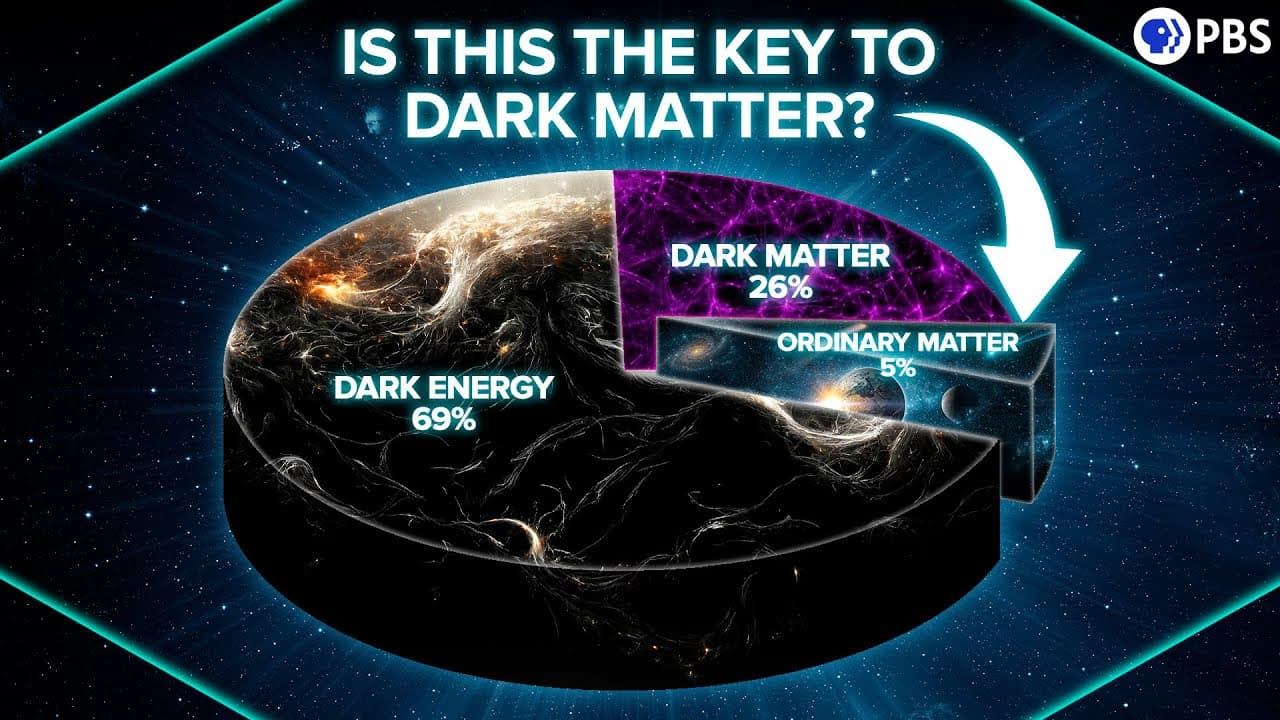
Yes, a new dark matter model may be necessary as the cold dark matter (CDM) model faces challenges like the 'missing satellites' and 'cusp-core' problems. Recent simulations incorporating ordinary matter suggest that while CDM could still explain some observations, issues like 'density-diversity' and 'too-big-to-fail' highlight its complexity and the ongoing need for better understanding of both dark and ordinary matter in shaping cosmic structures.
Transcript
The stuff of the visible universe - stars, planets, people - are a cosmic afterthought. Just luminous sprinkling on top of the vast oceans of dark matter that dominate the gravitational universe. Although we don't know what dark matter actually is, for a long time we thought we at least had it's behavior nailed. The so-called cold dark matter m... Read More
Key Insights
- Dark matter constitutes about 80% of the universe's mass, profoundly influencing cosmic structure despite its invisibility.
- The cold dark matter (CDM) model, which assumes slow-moving, non-interacting particles, initially matched observed cosmic structures.
- Discrepancies between CDM predictions and observations led to the 'missing satellites' and 'cusp-core' problems.
- Warm dark matter (WDM) and self-interacting dark matter (SIDM) are proposed alternatives to address CDM's shortcomings.
- Recent simulations incorporating ordinary matter suggest CDM may still be viable, resolving some previous discrepancies.
- Ordinary matter, though less massive, significantly impacts cosmic structure through processes like star formation and supernovae.
- The 'density-diversity' and 'too-big-to-fail' problems present new challenges to the CDM model's validity.
- Advancements in observational technology continue to refine our understanding of dark matter's role in the universe.
Install to Summarize YouTube Videos and Get Transcripts
Explore YouTube Video Summarizer or Get YouTube Transcript Extractor
Questions & Answers
Q: What is the cold dark matter model?
The cold dark matter (CDM) model posits that dark matter consists of slow-moving particles that do not interact with each other or ordinary matter, except through gravity. This model has been successful in explaining the large-scale structure of the universe, such as the formation of galaxies and galaxy clusters.
Q: What challenges does the cold dark matter model face?
The cold dark matter model faces challenges like the 'missing satellites' problem, where fewer satellite galaxies are observed than predicted, and the 'cusp-core' problem, where the observed density profiles of galaxies do not match the steep central concentrations predicted by CDM simulations.
Q: How does ordinary matter influence dark matter models?
Ordinary matter significantly influences dark matter models by affecting cosmic structures through processes like star formation and supernovae. These processes can redistribute dark matter, potentially resolving discrepancies between CDM predictions and observations, such as the flattening of galactic cores.
Q: What are some alternative models to cold dark matter?
Alternative models to cold dark matter include warm dark matter (WDM), which consists of slightly faster-moving particles, and self-interacting dark matter (SIDM), where dark matter particles can interact with each other, potentially addressing issues like the 'missing satellites' and 'cusp-core' problems.
Q: What is the 'density-diversity' problem?
The 'density-diversity' problem refers to the wide range of central densities observed in galaxies that do not correlate with star formation or dark matter halo mass, challenging the cold dark matter model's ability to account for such diversity in galactic structures.
Q: What is the 'too-big-to-fail' problem?
The 'too-big-to-fail' problem arises from the prediction that larger dark matter sub-haloes, which should be massive enough to form stars and galaxies, are not observed in the expected numbers. This challenges the cold dark matter model's predictions and suggests some larger structures may be missing.
Q: How might recent simulations support the cold dark matter model?
Recent simulations that incorporate ordinary matter suggest that many of the discrepancies between CDM predictions and observations, such as the 'missing satellites' problem, can be resolved. These simulations show that some sub-haloes may not capture enough gas to form visible galaxies, making them effectively invisible.
Q: Why is understanding dark matter important for cosmology?
Understanding dark matter is crucial for cosmology because it constitutes the majority of the universe's mass and plays a fundamental role in shaping cosmic structures. Solving the mystery of dark matter will enhance our comprehension of the universe's formation, evolution, and the underlying physics governing it.
Summary & Key Takeaways
-
Dark matter makes up the majority of the universe's mass, yet its exact nature remains unknown. The cold dark matter model, which assumes slow-moving particles that interact only through gravity, initially provided a promising explanation for cosmic structures.
-
However, discrepancies between CDM predictions and observations led to the identification of the 'missing satellites' and 'cusp-core' problems, prompting exploration of alternative models like warm and self-interacting dark matter.
-
Recent simulations that include ordinary matter suggest CDM might still be viable, resolving some discrepancies. Nonetheless, new challenges like the 'density-diversity' and 'too-big-to-fail' problems highlight the complexity of understanding dark matter's role in the universe.
Read in Other Languages (beta)
Share This Summary 📚
Summarize YouTube Videos and Get Video Transcripts with 1-Click
Try YouTube Summary with ChatGPT & Claude or YouTube Transcript Generator
Explore More Summaries from PBS Space Time 📚




Summarize YouTube Videos and Get Video Transcripts with 1-Click
Try YouTube Summary with ChatGPT & Claude or YouTube Transcript Generator