What Is Gaussian Naive Bayes and How Does It Work?
TL;DR
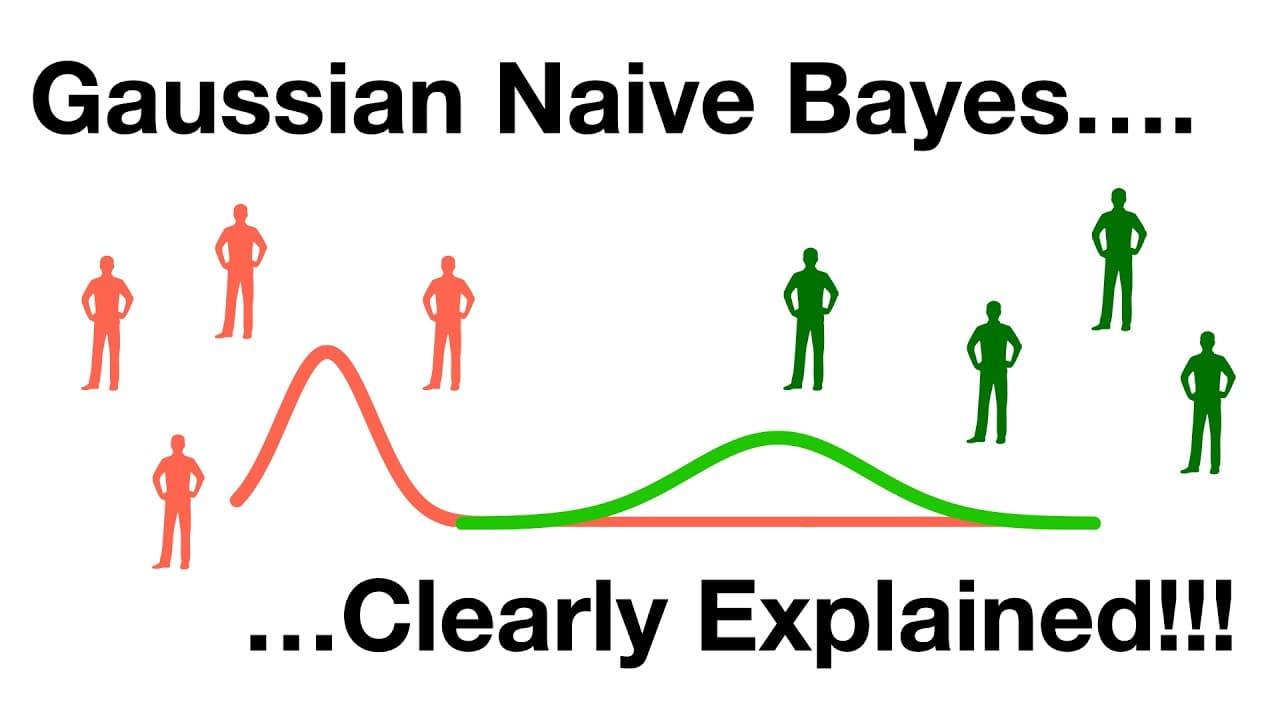
Gaussian Naive Bayes is a classification algorithm that uses Gaussian distributions to model data. By calculating prior probabilities and likelihoods, it predicts categories based on features such as popcorn, soda, and candy consumption. Utilizing logarithmic functions prevents numerical underflow, ensuring accurate computations during the classification process.
Transcript
quest hello i'm josh starmer and welcome to stat quest today we're going to talk about gaussian naive bayes and it's going to be clearly explained note this stack quest assumes that you are already familiar with the main ideas behind multinomial naive bayes if not check out the quest the link is in the description below this stack quest also assume... Read More
Key Insights
- 😒 Gaussian Naive Bayes uses Gaussian distributions to model data for classification.
- 💯 Prior probabilities and likelihoods are crucial in calculating class scores.
- 🦻 The log function prevents numerical underflow and aids in computation.
- 🍬 The choice of features like candy impacts classification decisions.
- 😵 Cross-validation helps optimize feature selection for better predictions.
- 🦮 Support StatQuest by purchasing study guides or contributing to Patreon.
- ❓ Gaussian Naive Bayes simplifies classification using probabilistic principles.
Install to Summarize YouTube Videos and Get Transcripts
Explore YouTube Video Summarizer or Get YouTube Transcript Extractor
Questions & Answers
Q: How does Gaussian Naive Bayes utilize prior probabilities?
Gaussian Naive Bayes uses initial guesses, called prior probabilities, to predict a new data point's classification. These probabilities are based on training data statistics.
Q: Why is the log function used in Gaussian Naive Bayes?
The log function is used to prevent underflow issues when dealing with very small probabilities in calculations. It transforms multiplications into summations for easier computation.
Q: How does Gaussian Naive Bayes handle feature likelihoods?
Gaussian Naive Bayes calculates the likelihood of a data point given a class (love or not love Troll 2) for each feature (popcorn, soda pop, candy) using Gaussian distributions.
Q: Why is cross-validation important in Gaussian Naive Bayes?
Cross-validation helps determine which features are most influential in making accurate classifications, guiding the selection of meaningful features like candy over popcorn or soda pop.
Summary & Key Takeaways
-
Gaussian Naive Bayes predicts based on Gaussian distributions.
-
Involves prior probabilities, likelihoods, and log functions.
-
Utilizes features like popcorn, soda pop, and candy for classification.
Read in Other Languages (beta)
Share This Summary 📚
Summarize YouTube Videos and Get Video Transcripts with 1-Click
Try YouTube Summary with ChatGPT & Claude or YouTube Transcript Generator
Explore More Summaries from StatQuest with Josh Starmer 📚

Summarize YouTube Videos and Get Video Transcripts with 1-Click
Try YouTube Summary with ChatGPT & Claude or YouTube Transcript Generator