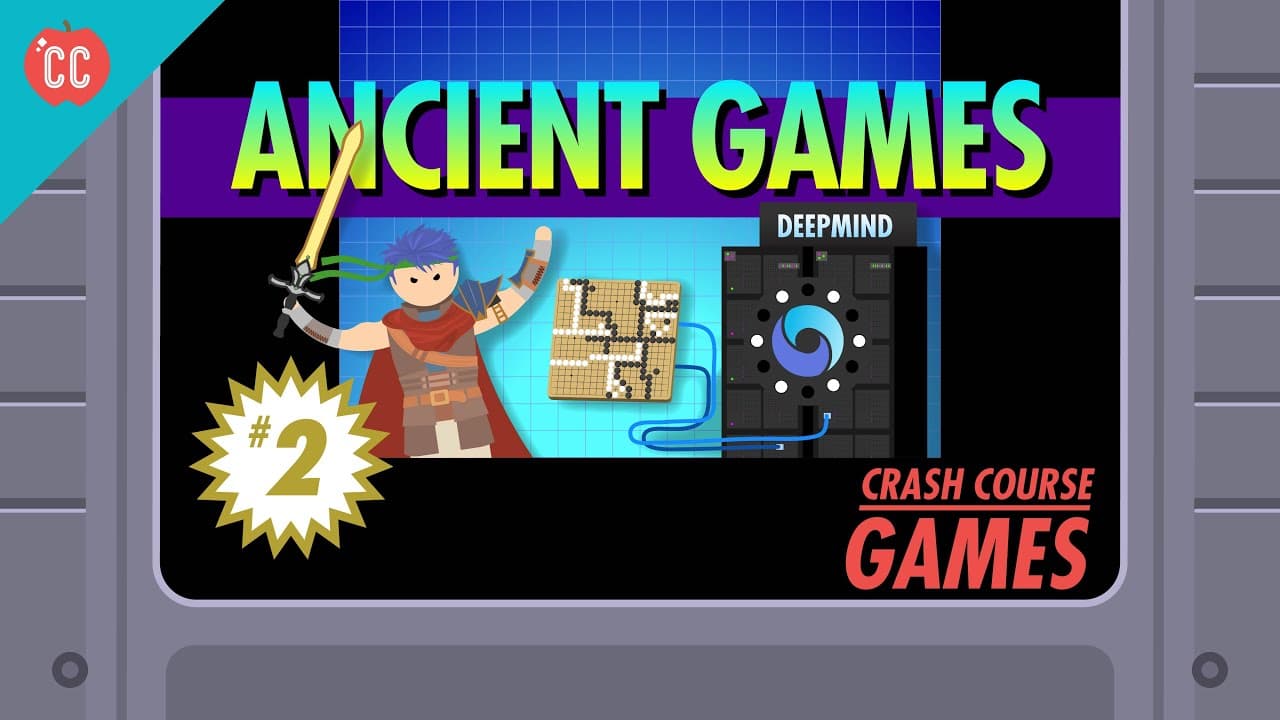
Ancient Games: Crash Course Games #2
TL;DR
Ancient games shaped modern board and video games.
Transcript
Hi I'm Andre Meadows and this is Crash Course Games. You've got games in your house right? You know the ones you play on family game night. Games like Monopoly, Life, or modern ones like Ticket to Ride or Settlers of Catan. Do you have a drawer, filled with dice? Or maybe even have one rolling around in your pocket right now? Dice in there. Well be... Read More
Key Insights
- Games have been part of human civilization for over 5,500 years, evolving from simple dice and board games to complex modern games.
- Dice, initially made from bones and knuckles, symbolize randomness and were used in ancient cultures for both games and divination.
- Senet, an ancient Egyptian game, evolved from a secular pastime to a mystical game predicting the player's afterlife fortune.
- Go, originating in China around 4,000 years ago, remains a complex game with more possible moves than chess, showcasing its enduring appeal.
- Patolli, popular among Meso-American cultures, involved betting and was associated with the Aztec god Xochipilli, highlighting the integration of games with cultural practices.
- Mancala, an ancient game type, has persisted in various forms across cultures, demonstrating the timelessness of its mechanics.
- Snakes and Ladders, originating in India, was used to teach moral lessons, illustrating the educational potential of games.
- Archaeological discoveries continue to reveal unknown ancient games, emphasizing the ongoing quest to understand historical gaming practices.
Install to Summarize YouTube Videos and Get Transcripts
Explore YouTube Video Summarizer or Get YouTube Transcript Extractor
Questions & Answers
Q: What is the significance of dice in ancient games?
Dice in ancient games symbolized chance and randomness, reflecting the unpredictability of life. They were crafted from bones and other materials and used in both games and divination practices. Ancient cultures believed dice could communicate with higher powers, influencing decisions and predicting events.
Q: How did the game of Senet evolve over time?
Senet began as a secular game in ancient Egypt, enjoyed for leisure and social interaction. Over time, it gained mystical significance, believed to predict a player's afterlife fortune. This evolution illustrates the integration of gaming with spiritual beliefs, transforming Senet into a tool for divine communication.
Q: Why is Go considered a significant ancient game?
Go, originating in China over 4,000 years ago, is significant for its complexity and enduring popularity. It involves strategic placement of stones on a grid to control the board. With more possible moves than chess, Go challenges players’ strategic thinking, maintaining its status as a revered intellectual pursuit.
Q: What role did Patolli play in Meso-American cultures?
Patolli was a popular game among Meso-American cultures, notably the Aztecs, where it involved betting and was linked to the god Xochipilli. It served as both entertainment and a ritualistic activity, reflecting the cultural integration of gaming with religious and social practices, highlighting its importance in daily life.
Q: How has Mancala persisted through history?
Mancala, dating back to at least the 4th century, remains popular due to its simple yet engaging mechanics. It involves moving counters along a track, a concept that has been adapted into various forms worldwide. Its persistence demonstrates the game's ability to transcend cultural and temporal boundaries.
Q: What moral lessons were taught through Snakes and Ladders?
Snakes and Ladders, originating in India, was used to impart moral lessons. Ladders represented virtues leading to spiritual elevation, while snakes symbolized sins leading to downfall. This educational aspect aimed to instill ethical values in players, demonstrating the potential of games as moral teaching tools.
Q: What do recent archaeological discoveries reveal about ancient games?
Recent archaeological discoveries, such as the Royal Game of Ur and Liubo, reveal the diversity and complexity of ancient games. These findings provide insights into historical leisure activities and cultural practices, highlighting the significance of games in ancient societies and their influence on modern gaming.
Q: How do ancient games connect us to history and each other?
Ancient games connect us to history by preserving cultural practices and gaming mechanics that have influenced modern games. They foster connections across generations and cultures, demonstrating the universal human desire for entertainment, strategy, and social interaction, bridging historical and contemporary gaming experiences.
Summary & Key Takeaways
-
Games have been integral to human culture for thousands of years, evolving from ancient dice and board games to today's diverse gaming landscape. These games not only provided entertainment but also served mystical and educational purposes, influencing modern gaming mechanics and cultural connections.
-
Ancient games like Senet, Go, and Patolli reflect the deep-rooted human fascination with chance, strategy, and social interaction. These games often carried cultural significance, with some predicting afterlife fortunes or teaching moral lessons, highlighting their multifaceted roles in society.
-
The persistence of games like Mancala and Snakes and Ladders across centuries underscores the universal appeal of gaming mechanics. Archaeological findings continue to uncover ancient games, enriching our understanding of historical leisure activities and their impact on contemporary gaming.
Read in Other Languages (beta)
Share This Summary 📚
Summarize YouTube Videos and Get Video Transcripts with 1-Click
Try YouTube Summary with ChatGPT & Claude or YouTube Transcript Generator
Explore More Summaries from CrashCourse 📚





Summarize YouTube Videos and Get Video Transcripts with 1-Click
Try YouTube Summary with ChatGPT & Claude or YouTube Transcript Generator