Lecture 10.2 - Convergence of Graph Filters in the node Domain
TL;DR
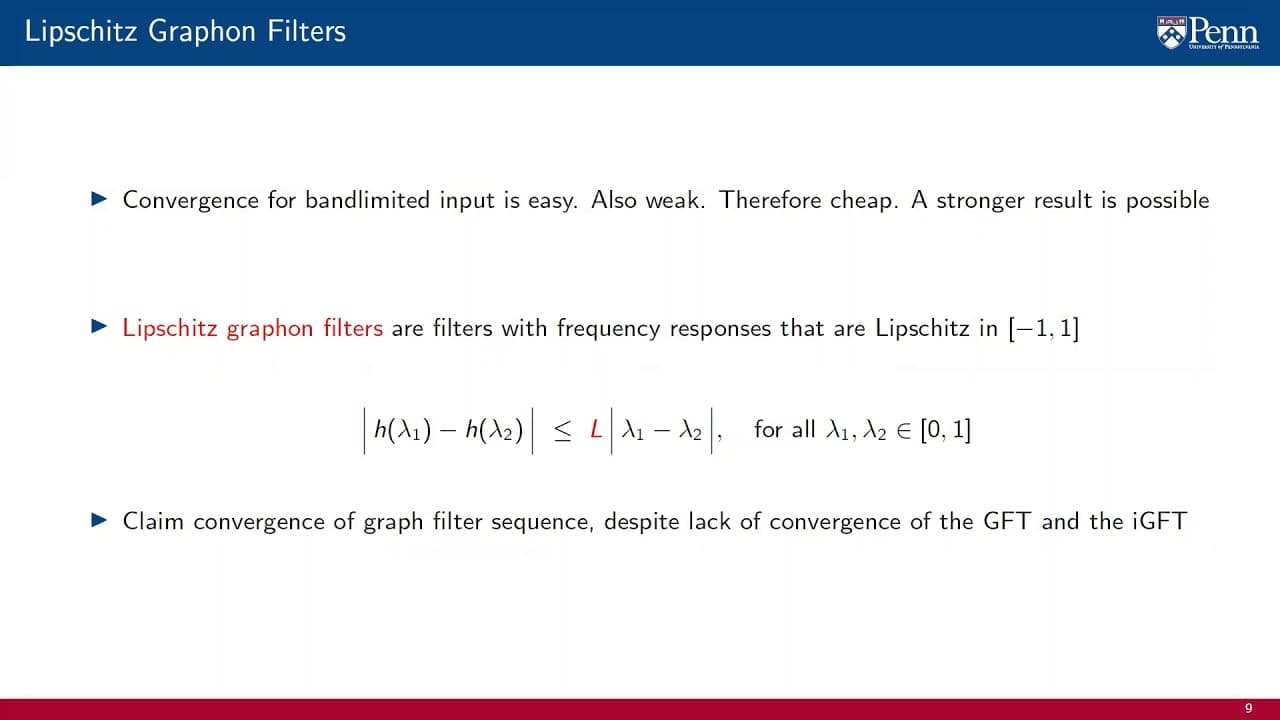
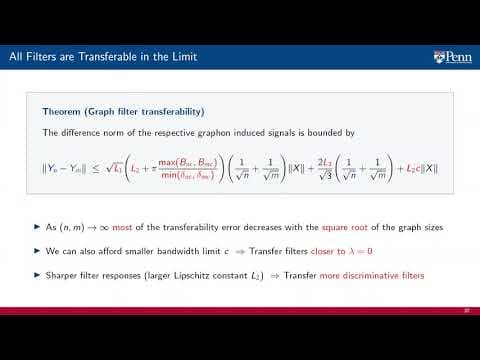
Graph filters converge to graphon filters with Lipschitz continuity.
Transcript
as we did in the previous section we consider convergent sequences of graphs along with associated sequences of graph filters we showed that if the graph sequence is converged towards a graph the graph filter sequence converges towards the graph filter but our statements are now in the node domain not in the spectral domain this convergence result ... Read More
Key Insights
- The lecture discusses the convergence of graph filters in the node domain, emphasizing the need for band-limited graphon signals for convergence.
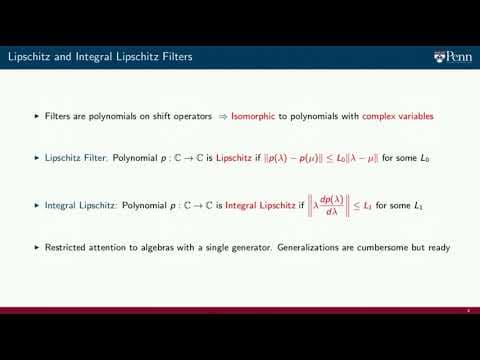
- A new approach involves using Lipschitz continuous filters to achieve convergence for any graphon signal, overcoming limitations of band-limited signals.
- The theorem's proof is complex and available in the course notes, highlighting the mathematical rigor involved in establishing convergence.
- The convergence of graph filters is contrasted with their discriminability, noting that achieving both simultaneously is challenging.
- The use of Lipschitz continuity in filters ensures that eigenvalues close to zero do not disrupt convergence, addressing a key challenge.
- The lecture points out that graph neural networks may offer solutions to the inherent challenges in graph filter transferability and discriminability.
- The theorem's implications suggest that while filters can transfer well, they may lack discriminative power, and vice versa.
- The lecture sets the stage for further exploration of transference bounds for finite graph sequences, indicating ongoing research in the field.
Install to Summarize YouTube Videos and Get Transcripts
Explore YouTube Video Summarizer or Get YouTube Transcript Extractor
Questions & Answers
Q: What is the main focus of the lecture?
The main focus of the lecture is the convergence of graph filters in the node domain. It discusses how sequences of graph filters converge towards graphon filters for convergent graph signal sequences. The lecture also explores the limitations and challenges associated with achieving convergence, particularly when dealing with band-limited graphon signals.
Q: How do Lipschitz continuous filters address convergence challenges?
Lipschitz continuous filters address convergence challenges by ensuring that the frequency response of the filters does not change too quickly. This continuity allows for convergence even when eigenvalues are close to zero, which is a common issue in graph filter convergence. By using Lipschitz continuity, the lecture demonstrates a stronger result that applies to any graphon signal, not just band-limited ones.
Q: What are the implications of the theorem discussed in the lecture?
The implications of the theorem suggest a trade-off between transferability and discriminability of graph filters. While filters that converge quickly are good for transferability, they may lack discriminative power. Conversely, discriminative filters may not transfer well. This inherent challenge necessitates exploring new methods, such as graph neural networks, to address these limitations.
Q: Why is the convergence of graph filters challenging?
The convergence of graph filters is challenging due to the accumulation of eigenvalues at zero, causing complications with eigenvector convergence. This makes it difficult to claim uniform convergence. Additionally, achieving both transferability and discriminability in graph filters is inherently contradictory, as filters that are good at one may not be effective at the other.
Q: How does the lecture propose to overcome the limitations of band-limited signals?
The lecture proposes to overcome the limitations of band-limited signals by using Lipschitz continuous filters. These filters provide a stronger result, allowing convergence for any graphon signal, not just those that are band-limited. This approach resolves some of the challenges associated with the convergence of graph filters in the node domain.
Q: What role do graph neural networks play in the lecture's discussion?
Graph neural networks are suggested as a potential solution to the challenges of transferability and discriminability in graph filters. The lecture indicates that while traditional graph filters face inherent limitations, graph neural networks may offer a way to achieve both effective transferability and discriminability, thus addressing the shortcomings of existing methods.
Q: What is the significance of the Lipschitz continuity hypothesis?
The Lipschitz continuity hypothesis is significant because it ensures that the frequency response of graph filters does not change too rapidly, which is crucial for achieving convergence. This hypothesis allows the lecture to claim convergence even when eigenvalues are close to zero, a common problem in graph filter convergence. It provides a robust framework for analyzing filter behavior.
Q: What future research directions does the lecture suggest?
The lecture suggests future research directions in exploring transference bounds for finite graph sequences. This indicates ongoing efforts to refine the understanding of graph filter convergence and address the limitations of current theorems. The lecture also hints at further exploration of graph neural networks as a means to overcome the challenges of transferability and discriminability in graph filters.
Summary & Key Takeaways
-
The lecture explores the convergence of graph filters in the node domain, requiring band-limited graphon signals for convergence. It introduces Lipschitz continuous filters as a solution to achieve convergence for any graphon signal, overcoming previous limitations.
-
The proof of the convergence theorem is detailed and available in the course notes. The lecture discusses the inherent trade-off between transferability and discriminability in graph filters, highlighting the challenges in achieving both.
-
Lipschitz continuity ensures that eigenvalues close to zero do not hinder convergence, addressing a critical issue. The lecture suggests that graph neural networks may resolve challenges in graph filter transferability and discriminability, with further research on transference bounds.
Read in Other Languages (beta)
Share This Summary 📚
Summarize YouTube Videos and Get Video Transcripts with 1-Click
Try YouTube Summary with ChatGPT & Claude or YouTube Transcript Generator
Explore More Summaries from Alelab Alelab 📚
Summarize YouTube Videos and Get Video Transcripts with 1-Click
Try YouTube Summary with ChatGPT & Claude or YouTube Transcript Generator