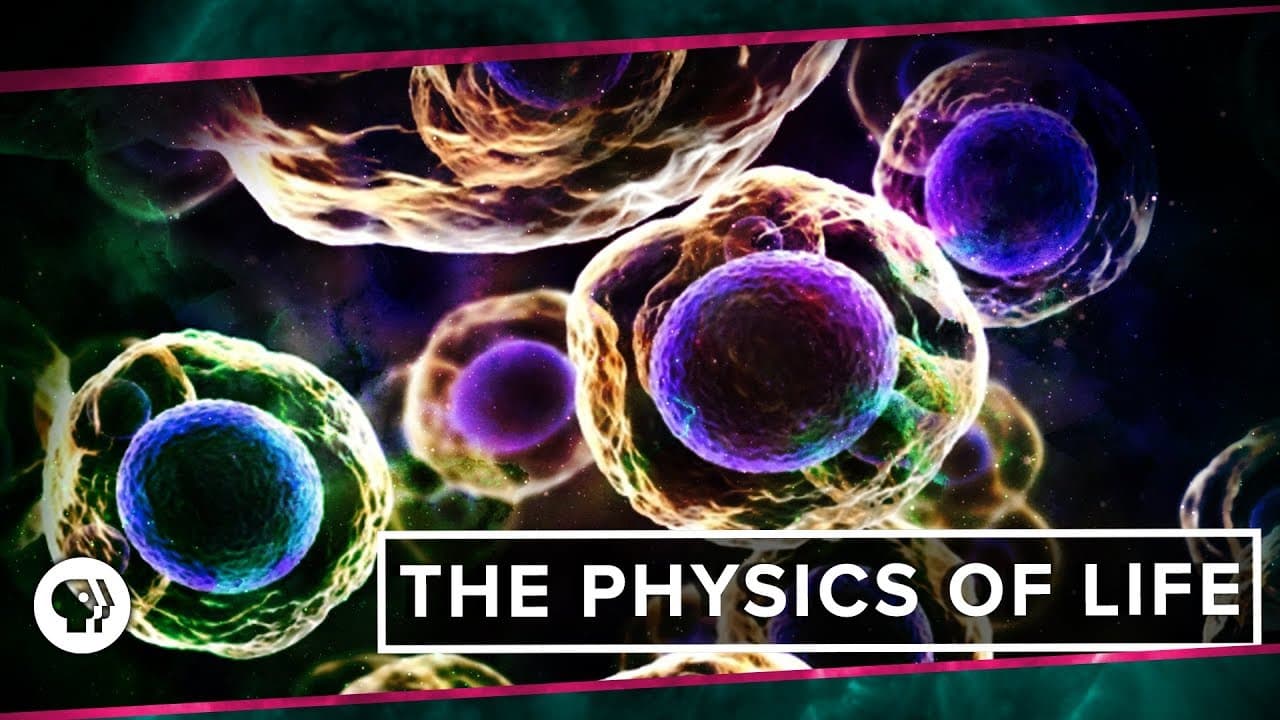
The Physics of Life (ft. It's Okay to be Smart & PBS Eons!)
TL;DR
Life's complexity arises from physics and entropy interactions.
Transcript
[MUSIC PLAYING] Our universe is prone to increasing disorder and chaos. So how did it generate the extreme complexity we see in life? Actually, the laws of physics themselves may demand it. [MUSIC PLAYING] How did life begin? We can seek the answer in the chemistry of the early Earth or in the biology of the first cell. In fact, our friends at PBS ... Read More
Key Insights
- The universe naturally tends toward disorder, yet life represents a striking example of complexity and low entropy, defying this trend through intricate molecular machinery.
- Life's complexity increases over time, as evidenced by the fossil record, showing a clear trend from simple to complex organisms over billions of years.
- Although life seems to defy the second law of thermodynamics, it does not violate it because life is not a closed system; it receives energy from the sun.
- Life reduces its internal entropy by increasing the entropy of its surroundings, a concept first noted by Ludwig Boltzmann and further explored by Erwin Schrodinger.
- Energy gradients are crucial for life, as they provide the necessary flow of energy that life feeds on, which can help explain the origin of life.
- The origin of life might have occurred in environments with persistent energy gradients, such as tidal pools or hydrothermal vents, where complexity can increase indefinitely.
- Jeremy England's research suggests that self-replicating systems, like life, are excellent at dissipating energy and maximizing entropy, supporting the thermodynamic basis of life.
- Life and self-replication may be natural processes in the universe's thermodynamic drive to dissipate energy, acting as eddies of order within the larger flow toward disorder.
Install to Summarize YouTube Videos and Get Transcripts
Explore YouTube Video Summarizer or Get YouTube Transcript Extractor
Questions & Answers
Q: How does life maintain low entropy despite the universe's tendency toward disorder?
Life maintains low entropy through its complex molecular structures, which are highly specific and non-random. This complexity increases over time, as evidenced by the fossil record. Life is not a closed system; it receives energy from the sun, allowing it to reduce internal entropy by increasing the entropy of its surroundings.
Q: What role do energy gradients play in the origin of life?
Energy gradients are crucial for life because they provide the necessary flow of energy that life feeds on. These gradients allow complexity to increase indefinitely, aiding in the understanding of life's origin. Life may have originated in environments with persistent energy gradients, such as tidal pools or hydrothermal vents.
Q: How does the concept of entropy relate to the complexity of life?
Entropy measures the disorder or randomness of a system. While the universe tends toward higher entropy, life exhibits low entropy due to its complex and specific molecular structures. Life reduces its internal entropy by increasing the entropy of its surroundings, aligning with the second law of thermodynamics.
Q: What insights did Boltzmann and Schrodinger provide about life and entropy?
Ludwig Boltzmann described life as a struggle against entropy, or for negative entropy. Erwin Schrodinger expanded on this idea, describing life as a process feeding on negative entropy. Life absorbs order and ejects disorder into its surroundings, aligning with the principles of thermodynamics.
Q: How does Jeremy England's research support the thermodynamic basis of life?
Jeremy England's research suggests that self-replicating systems, like life, are excellent at dissipating energy and maximizing entropy. He demonstrated mathematically that these systems are efficient energy dissipators, supporting the idea that life's complexity and self-replication are natural processes within the universe's thermodynamic drive.
Q: Why are environments with energy gradients important for life's origin?
Environments with energy gradients are important for life's origin because they provide the necessary conditions for complexity to increase. These gradients allow energy to flow, supporting the formation of increasingly complex molecules, which is crucial for the development of life from simple molecular structures.
Q: What is the significance of the fossil record in understanding life's complexity?
The fossil record provides evidence of evolution, showing a clear trend from simple to complex organisms over billions of years. This trend demonstrates that life's complexity increases over time, supporting the idea that life defies the universe's tendency toward disorder by maintaining low entropy through intricate molecular machinery.
Q: How does life act as an 'eddy of order' in the universe?
Life acts as an 'eddy of order' by maintaining low internal entropy while increasing the entropy of its surroundings. This concept aligns with the second law of thermodynamics, as life contributes to the universe's overall trend toward disorder, serving as a temporary fluctuation of order within the larger flow toward maximum entropy.
Summary & Key Takeaways
-
Life defies the universe's tendency toward disorder by maintaining low internal entropy through complex molecular structures. This complexity increases over time, as seen in the fossil record, yet life does not violate the second law of thermodynamics because it is not a closed system, receiving energy from the sun.
-
Life reduces its internal entropy by increasing the entropy of its surroundings, a concept explored by Boltzmann and Schrodinger. Energy gradients are crucial for life, providing the necessary flow of energy that fuels life's processes, aiding in understanding life's origin.
-
The origin of life may have occurred in environments with persistent energy gradients, allowing complexity to increase indefinitely. Jeremy England's research supports the thermodynamic basis of life, suggesting self-replicating systems are efficient energy dissipators, acting as eddies of order in the universe's flow toward disorder.
Read in Other Languages (beta)
Share This Summary 📚
Summarize YouTube Videos and Get Video Transcripts with 1-Click
Try YouTube Summary with ChatGPT & Claude or YouTube Transcript Generator
Explore More Summaries from PBS Space Time 📚
Summarize YouTube Videos and Get Video Transcripts with 1-Click
Try YouTube Summary with ChatGPT & Claude or YouTube Transcript Generator