How To Solve Linear Equations With Fractions
TL;DR
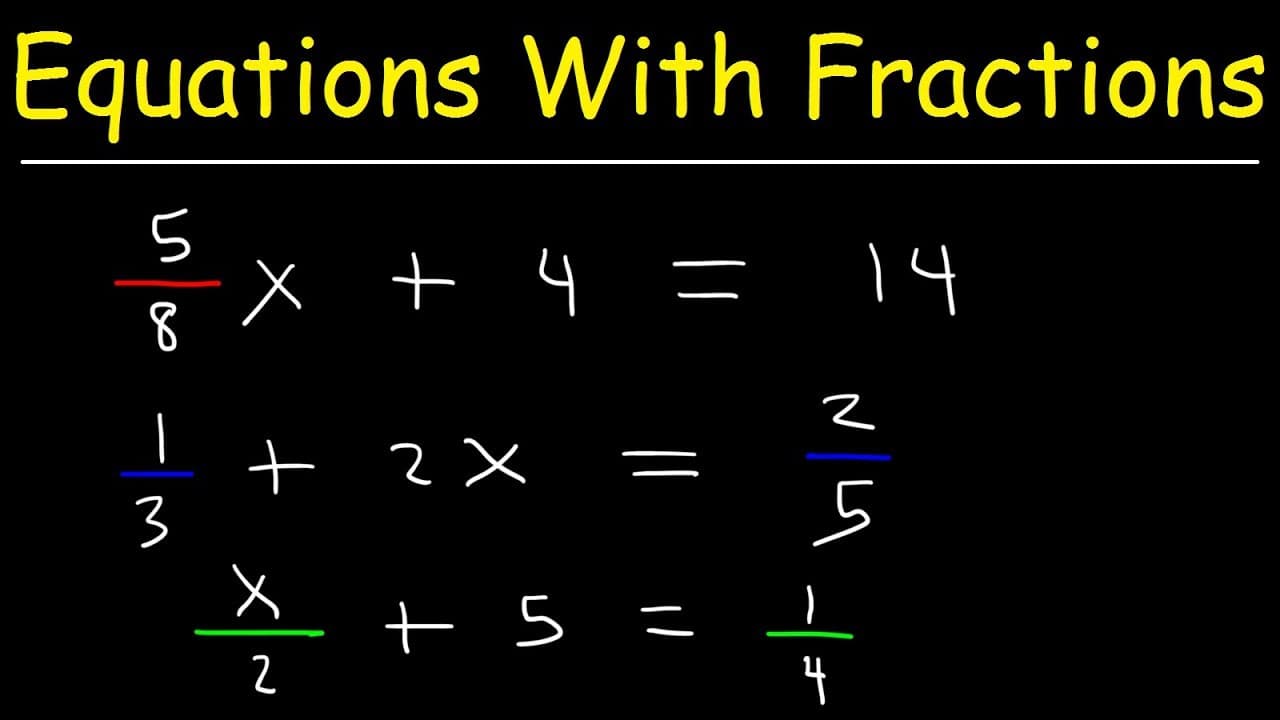
Learn how to solve equations containing fractions by multiplying both sides by a common denominator and simplifying.
Transcript
now what would you do if you need to solve an equation that has fractions so what would you do to solve this one so here's what we can do let's multiply both sides by three that will get rid of the three on the bottom if we do that these will cancel and so we're going to have on the left is 2x on the right 8 times 3 is 24 and now all we need to do ... Read More
Key Insights
- 🙃 Multiplying both sides by the reciprocal of a fraction or by the common denominator eliminates the fractions in the equation.
- 🤝 Dividing first and then multiplying can simplify calculations, especially when dealing with larger numbers.
- 🙃 To clear away all fractions in an equation with two fractions, multiply both sides by the common denominator.
Install to Summarize YouTube Videos and Get Transcripts
Explore YouTube Video Summarizer or Get YouTube Transcript Extractor
Questions & Answers
Q: What is the first step to solve an equation with fractions?
The first step is to multiply both sides of the equation by the reciprocal of the fraction or by the common denominator to eliminate the fractions.
Q: Why is it better to divide first and then multiply when dealing with larger numbers?
Dividing first and then multiplying helps simplify the calculations and avoid dealing with large numbers in the multiplication step.
Q: How do you clear away all fractions if the equation contains two fractions?
Multiply both sides of the equation by the common denominator of the two fractions, which can be determined by multiplying the denominators together.
Q: Can any common denominator be used to eliminate fractions in an equation?
Yes, any common denominator can be used, but it's ideal to use the least common denominator for simplicity.
Summary & Key Takeaways
-
To solve equations with fractions, multiply both sides by the reciprocal of the fraction or by the common denominator to eliminate the fractions.
-
When dealing with larger numbers, it's better to divide first and then multiply.
-
If the equation contains two fractions, multiply both sides by the common denominator of the two fractions to clear away all fractions.
Read in Other Languages (beta)
Share This Summary 📚
Summarize YouTube Videos and Get Video Transcripts with 1-Click
Try YouTube Summary with ChatGPT & Claude or YouTube Transcript Generator
Explore More Summaries from The Organic Chemistry Tutor 📚



Summarize YouTube Videos and Get Video Transcripts with 1-Click
Try YouTube Summary with ChatGPT & Claude or YouTube Transcript Generator