The Real Science of the EHT Black Hole
TL;DR
The first image of a black hole reveals groundbreaking scientific insights.
Transcript
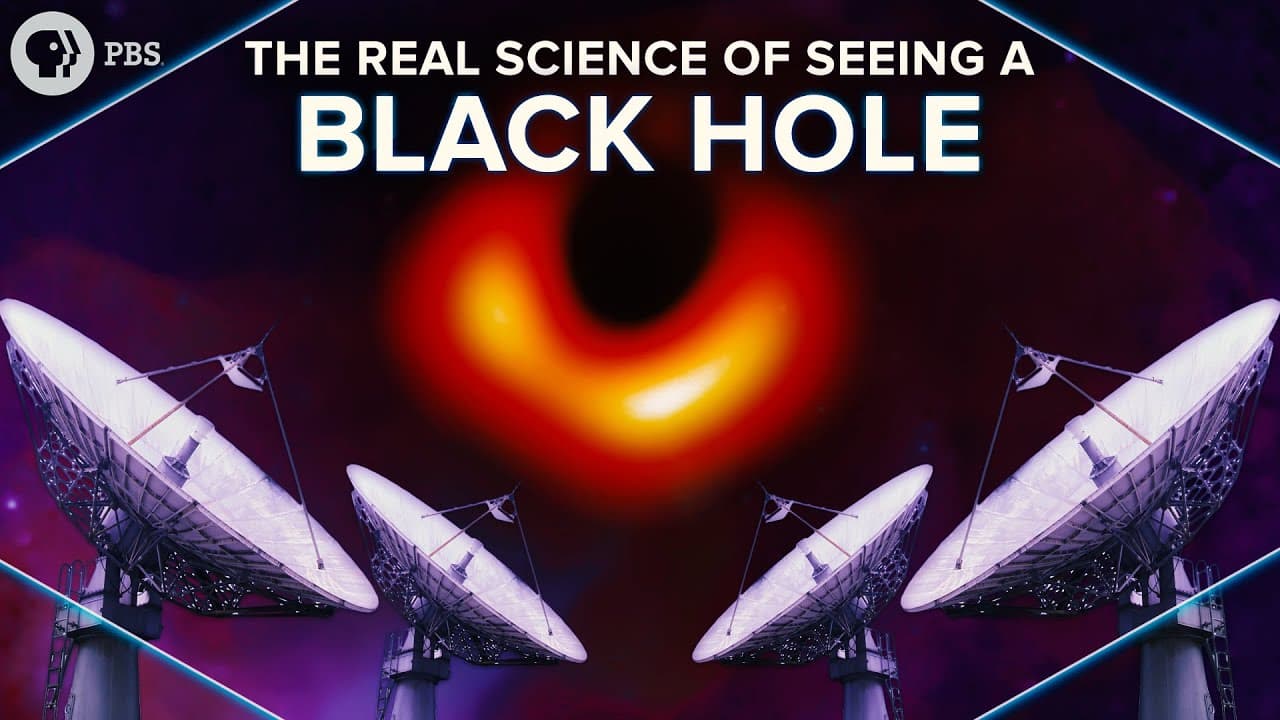
Thanks to CuriosityStream for supporting PBS Digital Studios. How do you take a picture of a black hole and what have we learned from seeing one for the very first time? By now I expect you’ve seen this picture many times. Our first ever actual bona fide photo of a black hole, made by the Event Horizon Telescope and revealed to the world in a press... Read More
Key Insights
- The Event Horizon Telescope (EHT) captured the first image of a black hole, located in the M87 galaxy, using a network of radio telescopes across the globe.
- Interferometry, a technique combining light from multiple telescopes, was crucial in achieving the high resolution needed to capture the black hole image.
- The black hole in M87 has a mass over six billion times that of the Sun, with an event horizon larger than our solar system.
- The image reveals a bright ring, the photon sphere, where light orbits the black hole due to its immense gravitational pull.
- The asymmetry in the ring is caused by relativistic beaming, where light is amplified when moving in the same direction as the emitted light.
- The EHT's observations confirm predictions made by Einstein’s general theory of relativity, showcasing the black hole's expected appearance.
- The black hole is spinning nearly at maximum speed, influencing the rotation direction of the surrounding plasma vortex.
- The EHT's success highlights the power of global scientific collaboration and advanced technology in exploring deep space phenomena.
Install to Summarize YouTube Videos and Get Transcripts
Explore YouTube Video Summarizer or Get YouTube Transcript Extractor
Questions & Answers
Q: How was the image of the black hole captured?
The image was captured using the Event Horizon Telescope, a global network of radio telescopes that employs interferometry. This technique combines light from multiple telescopes to achieve high resolution, allowing the EHT to resolve the black hole in the M87 galaxy, located 53 million light years away.
Q: What is the significance of the photon sphere in the black hole image?
The photon sphere is significant because it represents the region where light can orbit the black hole due to its immense gravitational pull. The bright ring seen in the image is the photon sphere, which provides valuable information about the black hole's mass, spin, and the surrounding environment.
Q: What role did interferometry play in capturing the black hole image?
Interferometry was crucial in capturing the black hole image as it allows the combination of light from multiple telescopes to improve resolution. This technique enabled the EHT to achieve the necessary resolution to observe the black hole's event horizon, equivalent to resolving a grain of sand from thousands of kilometers away.
Q: How does the image confirm Einstein's theory of general relativity?
The image confirms Einstein's theory of general relativity by matching the predicted appearance of a black hole. The observed photon sphere and the behavior of light around the black hole align with the theoretical predictions, demonstrating the accuracy of Einstein's equations in describing such extreme cosmic phenomena.
Q: What challenges did scientists face in capturing the black hole image?
Scientists faced several challenges, including the need for high resolution to capture the distant black hole and the requirement to synchronize telescopes across the globe. The EHT overcame these challenges using advanced interferometry techniques and precise atomic clocks to align observations from multiple radio observatories.
Q: What does the asymmetry in the black hole image indicate?
The asymmetry in the black hole image indicates relativistic beaming, where light is amplified when moving in the same direction as the emitted light. This effect occurs due to the high-speed rotation of the plasma around the black hole, providing insights into the black hole's spin and the dynamics of surrounding matter.
Q: How does the EHT contribute to our understanding of black holes?
The EHT contributes to our understanding by providing the first direct image of a black hole, confirming theoretical predictions and offering new insights into the behavior of matter and light in extreme gravitational fields. It demonstrates the feasibility of observing black holes and the power of international scientific collaboration.
Q: What future advancements can be expected from the EHT?
Future advancements from the EHT may include capturing clearer images of black holes, observing other black holes, and improving our understanding of their properties. As more telescopes join the network and technology advances, the EHT's capabilities will expand, potentially revealing new phenomena in black hole physics.
Summary & Key Takeaways
-
The Event Horizon Telescope successfully captured the first image of a black hole, located in the M87 galaxy, using a global network of radio telescopes. This achievement required the application of interferometry, a technique that combines light from multiple telescopes to improve resolution.
-
The black hole in M87 is a supermassive entity with a mass over six billion times that of the Sun. Its image reveals a bright ring, known as the photon sphere, where light orbits the black hole due to its strong gravitational field.
-
The captured image confirms Einstein’s predictions from general relativity, showing the black hole's expected appearance. The EHT's findings underscore the importance of scientific collaboration and technology in advancing our understanding of the universe.
Read in Other Languages (beta)
Share This Summary 📚
Summarize YouTube Videos and Get Video Transcripts with 1-Click
Try YouTube Summary with ChatGPT & Claude or YouTube Transcript Generator
Explore More Summaries from PBS Space Time 📚






Summarize YouTube Videos and Get Video Transcripts with 1-Click
Try YouTube Summary with ChatGPT & Claude or YouTube Transcript Generator