Thin-layer chromatography (TLC) | Intermolecular forces and properties | AP Chemistry | Khan Academy
TL;DR
Thin Layer Chromatography is a technique used to separate substances in a mixture based on their polarity and analyze their retention factors.
Transcript
- [Instructor] So let's say that I have a vial of some mystery liquid right over here, and I want to start figuring out what's going on there. And the first step is to think about, is it just one substance or is it a mixture of multiple substances? And the focus of this video is a technique to separate out the substances to understand at least how ... Read More
Key Insights
- 🤔 Thin layer chromatography is commonly used to separate substances in a mixture based on their polarity.
- ❓ The choice of stationary phase and solvent determines the effectiveness of the separation.
- 🤢 The retention factor (Rf value) is a measure of how far a substance has traveled and provides information about its polarity.
- 🐻❄️ Higher Rf values indicate less polar substances, while lower Rf values indicate more polar substances.
- 🤔 Thin layer chromatography is widely used in various fields, including chemistry, forensic science, and pharmaceutical analysis.
- 🤔 Different variations of chromatography, such as paper chromatography, operate on similar principles to thin layer chromatography.
- 🤔 The technique of thin layer chromatography allows for the visualization and identification of different substances in a mixture.
Install to Summarize YouTube Videos and Get Transcripts
Explore YouTube Video Summarizer or Get YouTube Transcript Extractor
Questions & Answers
Q: What is the purpose of thin layer chromatography?
The purpose of thin layer chromatography is to separate substances in a mixture and determine their polarity by analyzing their retention factors.
Q: What is the difference between the stationary phase and the mobile phase in thin layer chromatography?
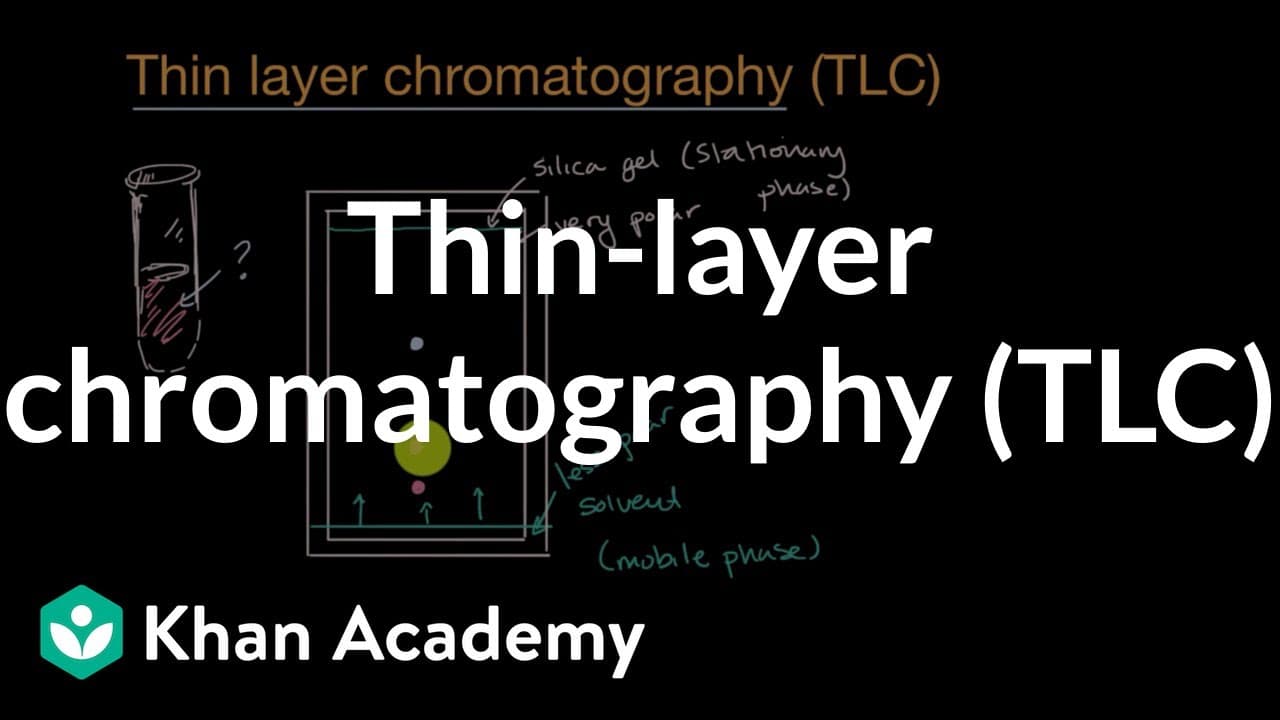
The stationary phase in thin layer chromatography refers to the solid polar substance, such as silica gel, that does not move. The mobile phase is the less polar solvent that moves through the stationary phase and carries the components of the mixture.
Q: How is the retention factor calculated in thin layer chromatography?
The retention factor (Rf value) is calculated by dividing the distance traveled by the solute (substance) by the distance traveled by the solvent from the origin. The Rf value gives an indication of the substance's polarity, with higher Rf values indicating less polar substances.
Q: Why is it important to use a polar stationary phase and a less polar solvent in thin layer chromatography?
The use of a polar stationary phase, such as silica gel, and a less polar solvent allows for the separation of substances based on their polarity. More polar substances are attracted to the stationary phase and do not travel as far, while less polar substances travel further with the solvent.
Summary & Key Takeaways
-
Thin Layer Chromatography is a technique used to separate substances in a mixture by using a solid polar substance, such as silica gel, and a less polar solvent.
-
The stationary phase, the silica gel, does not move, while the mobile phase, the solvent, moves through it and picks up the components of the mixture.
-
The retention factor is a measure of how far a substance has traveled relative to the solvent, and it depends on the substance's polarity.
Read in Other Languages (beta)
Share This Summary 📚
Summarize YouTube Videos and Get Video Transcripts with 1-Click
Try YouTube Summary with ChatGPT & Claude or YouTube Transcript Generator
Explore More Summaries from Khan Academy 📚






Summarize YouTube Videos and Get Video Transcripts with 1-Click
Try YouTube Summary with ChatGPT & Claude or YouTube Transcript Generator