AI Powered Data Analysis & Visualization with Julius AI
TL;DR
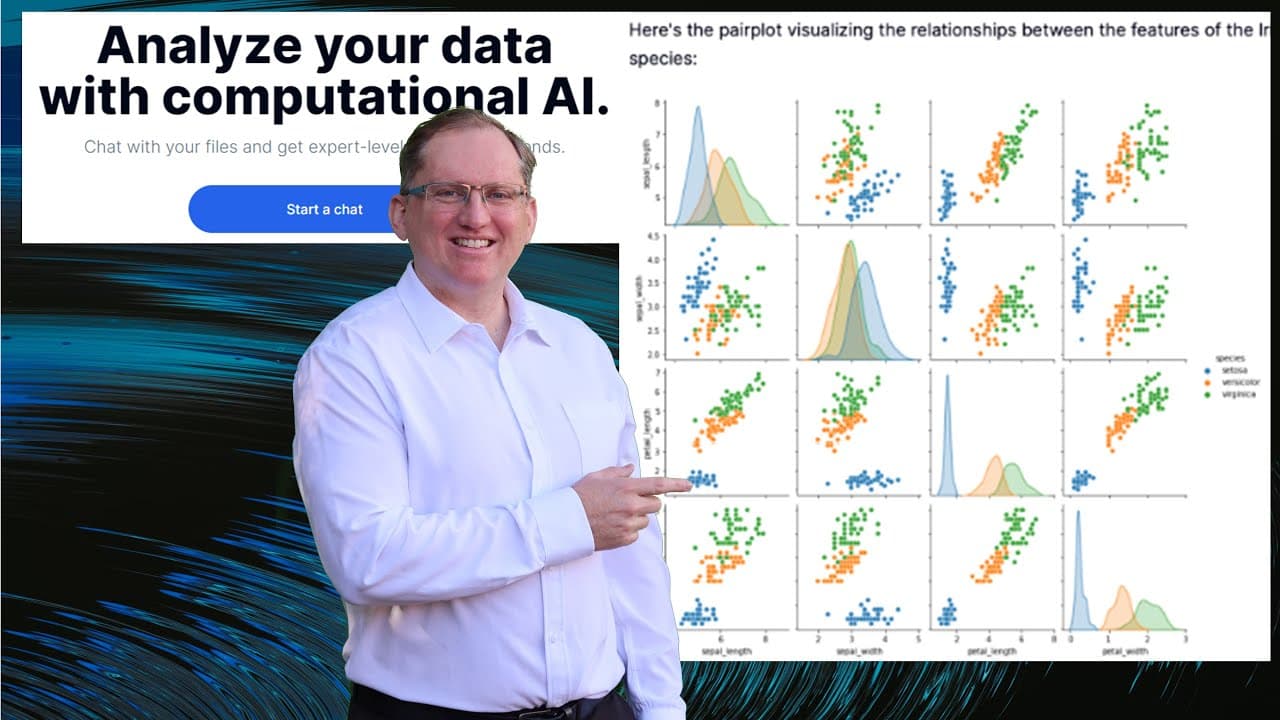
Julius AI shows promise for statistical analysis and graph generation compared to traditional language models.
Transcript
hi friends welcome back to the channel today we're looking at Julius AI so this is an AI that is supposed to be able to do stats and graphs and Analysis for you we've seen some very mixed and to some degree poor results out of the likes of cat GPT in Gemini and Bard with this they are large language models so we shouldn't necessarily be expecting t... Read More
Key Insights
- 🛄 Julius AI specializes in statistical analysis, aiming to outperform traditional AI models in mathematical tasks.
- 👻 The interface is user-friendly, allowing easy uploading of data files for analysis.
- 👨💻 It efficiently calculates statistical measures while generating associated Python code for transparency and reproducibility.
- 🎵 The AI provides visualizations in its analyses, although some presentation issues were noted in output tables.
- 🛀 Regression analysis and interaction effects were addressed reasonably well, showing its analytical depth.
- 🍻 Clustering analysis was executed competently, with interpretations that linked findings to relevant sports contexts.
- 👤 Users can access Julius AI with varying tiers, providing a degree of functionality without upfront costs.
Install to Summarize YouTube Videos and Get Transcripts
Explore YouTube Video Summarizer or Get YouTube Transcript Extractor
Questions & Answers
Q: What distinguishes Julius AI from other AI models like ChatGPT and Bard?
Julius AI is tailored specifically for statistical functions, which enhances its ability to perform mathematical analyses and create graphical representations. Unlike general language models, which may struggle with complex mathematical tasks, Julius is built to handle a variety of statistical inquiries more effectively, providing users with the relevant methodology alongside the answers.
Q: How does Julius AI perform when given a normal distribution problem?
In testing the normal distribution probability problem, Julius AI successfully identified the correct approach by calculating the z-score and referencing the normal table. It not only provided the correct value but also generated Python code for the calculation, demonstrating its competence in solving statistical questions accurately.
Q: Can Julius AI handle data sets efficiently?
Yes, Julius AI can readily process data sets by allowing users to drag and drop CSV files into the chat. This functionality enables swift data analysis, such as plotting relationships (e.g., height versus weight of athletes) and generating insights related to different variables like gender and sports, showcasing its capability in handling practical data analytics.
Q: What are the limitations observed during testing with Julius AI?
While Julius AI performed well in many aspects, some limitations were noted, particularly in its output presentation. For instance, the formatting of certain statistical tables became messy, and when generating reports or summaries, it sometimes failed to include necessary visualizations or interpretative text that would enhance understanding.
Q: How effective is Julius AI at conducting regression analysis?
Julius AI showed a good grasp of regression analysis, initially performing correctly and then attempting to run post-hoc tests and summary statistics. However, the interface encountered issues when presenting results, which indicated a need for improvement in data visualization and formatting to ensure clarity in reporting statistical findings.
Q: How does Julius AI treat categorical variables in analysis?
Julius AI recognizes categorical variables, such as gender and sport, and incorporates them effectively in analyses like two-way ANOVA. In tests, it demonstrated an understanding of their significance and the potential interaction effects, showcasing its competence in handling multiple variables while providing relevant suggestions for further analysis.
Q: What type of clustering analysis does Julius AI support?
Julius AI supports clustering analysis through methods like the silhouette score and K-means clustering. During testing, it effectively interpreted clusters related to athlete characteristics, demonstrating an ability to summarize cluster traits and relate findings back to practical implications in the context of sports.
Q: What feedback or improvements could enhance Julius AI's performance?
Future improvements for Julius AI could focus on enhancing the clarity and formatting of statistical outputs as well as enriching its interpretative capabilities in reports. Adding comprehensive visual aids, clearer interaction with user queries regarding varying statistical techniques, and refining its handling of high-dimensional datasets could further increase its usability and effectiveness.
Summary & Key Takeaways
-
Julius AI is designed specifically for statistical analysis and graph generation, aiming to improve results over general language models like ChatGPT and Bard.
-
In testing, Julius produced accurate methodologies for normal distribution problems, generating correct values and coding in Python effectively.
-
Despite some minor presentation issues, Julius showcases potential in performing various statistical analyses, including regression and clustering, with reasonable efficiency.
Read in Other Languages (beta)
Share This Summary 📚
Summarize YouTube Videos and Get Video Transcripts with 1-Click
Try YouTube Summary with ChatGPT & Claude or YouTube Transcript Generator
Explore More Summaries from Dr Lyndon Walker 📚




Summarize YouTube Videos and Get Video Transcripts with 1-Click
Try YouTube Summary with ChatGPT & Claude or YouTube Transcript Generator