How to Calculate Cohen's D for Effect Size Measurement
TL;DR
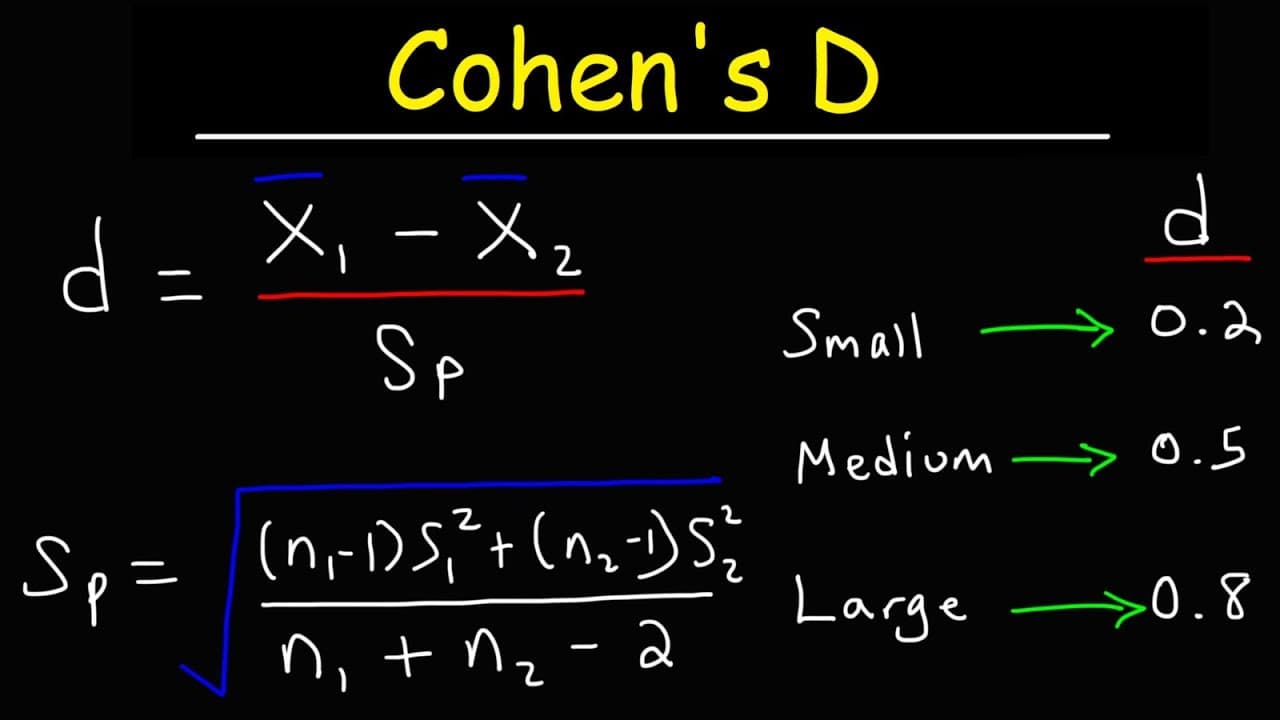
To calculate Cohen's d, subtract the mean of one sample from the other and divide by the pooled standard deviation. A d value of 0.2 indicates a small effect, 0.5 indicates a medium effect, and 0.8 or higher indicates a large effect. Use one formula for equal sample sizes and another for significantly different sizes.
Transcript
in this video we're going to talk about how to calculate cohen's d and determine if the size of the effect is small medium or large but let's talk about what cohen's d means or what it tells us a d value of one tells us that the difference between the two sample means is equal to one standard deviation a d value of two means that the difference of ... Read More
Key Insights
- 😄 Cohen's d is a useful statistic for measuring effect size in research studies.
- ◾ Different d values represent small, medium, and large effect sizes.
- ⚾ The formula for calculating the pooled standard deviation varies based on the sample sizes.
- 😚 The simpler formula for the pooled standard deviation is applicable when the sample sizes are close to each other.
- 😄 Calculating cohen's d helps determine the significance and practical importance of study findings.
- 🖐️ Sample sizes play a significant role in the accuracy of the calculated effect size.
- 😄 The d value provides a standardized measure of the difference between two sample means.
Install to Summarize YouTube Videos and Get Transcripts
Explore YouTube Video Summarizer or Get YouTube Transcript Extractor
Questions & Answers
Q: What does Cohen's d measure?
Cohen's d measures the difference between two sample means in terms of standard deviations. It helps determine the effect size of a study.
Q: How do you determine the effect size based on the calculated d value?
If the d value is around 0.2, the effect size is considered small. A d value close to 0.5 indicates a medium effect, and a d value of 0.8 or higher suggests a large effect.
Q: What is the formula for calculating the pooled standard deviation?
The formula for calculating the pooled standard deviation is: (n1-1)(s1^2) + (n2-1)(s2^2) / (n1 + n2 - 2). It takes into account the sample sizes and standard deviations of both groups.
Q: When should you use the simpler formula for calculating the pooled standard deviation?
The simpler formula, which is just the square root of (s1^2 + s2^2)/2, should be used when the sample sizes are similar or equal. It saves time and provides a good estimate.
Summary & Key Takeaways
-
Cohen's d measures the difference between two sample means in terms of standard deviations.
-
A d value of 0.2 indicates a small effect, 0.5 indicates a medium effect, and 0.8 or higher indicates a large effect.
-
Two formulas can be used to calculate the pooled standard deviation, depending on the sample sizes.
Read in Other Languages (beta)
Share This Summary 📚
Summarize YouTube Videos and Get Video Transcripts with 1-Click
Try YouTube Summary with ChatGPT & Claude or YouTube Transcript Generator
Explore More Summaries from The Organic Chemistry Tutor 📚



Summarize YouTube Videos and Get Video Transcripts with 1-Click
Try YouTube Summary with ChatGPT & Claude or YouTube Transcript Generator