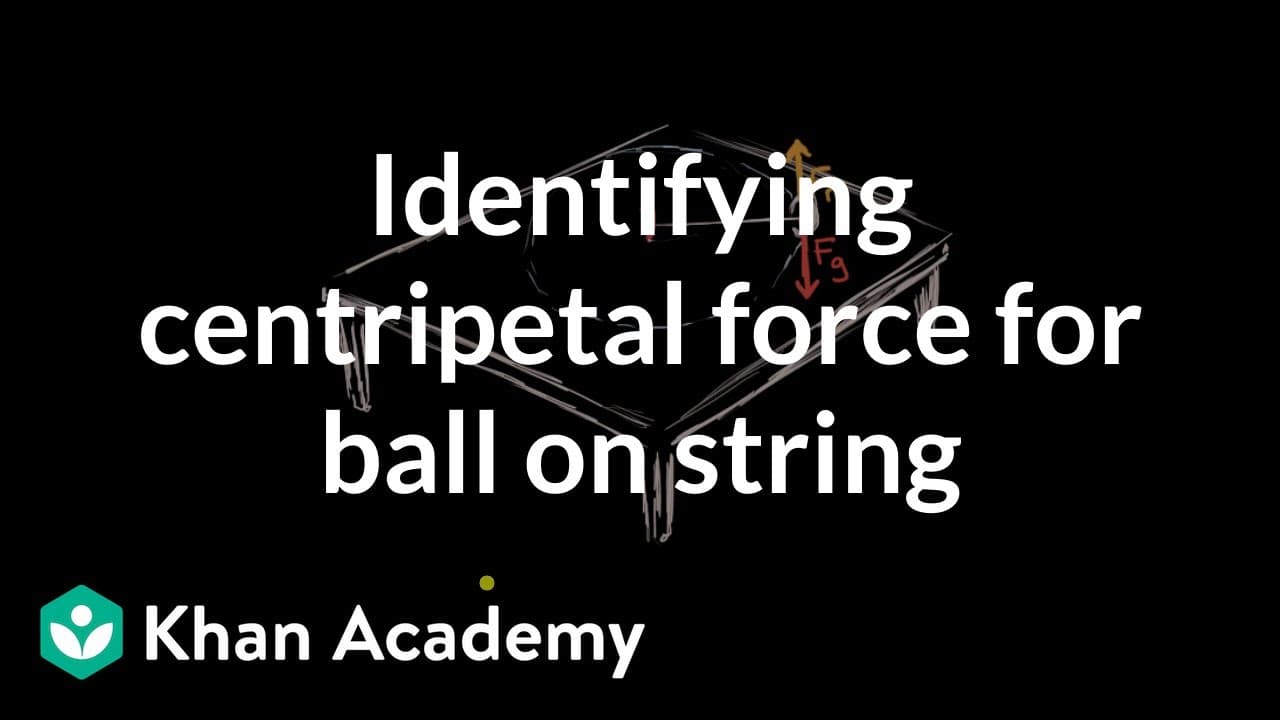
Identifying centripetal force for ball on string | AP Physics 1 | Khan Academy
TL;DR
Learn about centripetal force and how it keeps objects in uniform circular motion.
Transcript
- [Tutor] What we're going to do in this video is try to look at as many scenarios as we can, where an object is exhibiting uniform circular motion, it's traveling around in a circle at a constant speed and what we wanna do is think about why is it staying on the circle, what centripetal force is keeping the object from just going off in a straight... Read More
Key Insights
- 🫥 Centripetal force is necessary to keep an object in uniform circular motion and prevent it from moving in a straight line.
- ℹ️ Tension in a string is a common source of centripetal force in scenarios involving circular motion.
- 🧑🏭 The magnitude of the tension force is equal to the magnitude of the centripetal force in situations where the tension is acting as the centripetal force.
Install to Summarize YouTube Videos and Get Transcripts
Explore YouTube Video Summarizer or Get YouTube Transcript Extractor
Questions & Answers
Q: What is centripetal force?
Centripetal force is the force that acts towards the center of a circle, keeping an object in uniform circular motion. It is required to counteract the tendency of the object to move in a straight line.
Q: How does tension in a string provide centripetal force?
In scenarios like the wheel and pendulum examples, tension in a string acts as the centripetal force. The string pulls inward on the object, preventing it from moving off in a straight line and keeping it in circular motion.
Q: Can centripetal force exist without gravity?
Yes, centripetal force can exist without gravity. In situations where gravity is not a factor, other forces, such as tension or electromagnetic forces, can provide the necessary centripetal force to keep an object in uniform circular motion.
Q: What happens if there is no centripetal force acting on an object in circular motion?
If there is no centripetal force acting on an object, it would continue moving in a straight line tangent to the circle. The object would leave the circular path and not maintain uniform circular motion.
Summary & Key Takeaways
-
The video discusses scenarios where an object is moving in a circle at a constant speed and explores the forces that keep it on the circle.
-
In the first scenario, a wheel attached to a string is moving in a circle, with the tension force in the string acting as the centripetal force.
-
In the second scenario, a pendulum on a string is swinging in a circular motion. The tension force in the string provides the centripetal force while counteracting gravity.
Read in Other Languages (beta)
Share This Summary 📚
Summarize YouTube Videos and Get Video Transcripts with 1-Click
Try YouTube Summary with ChatGPT & Claude or YouTube Transcript Generator
Explore More Summaries from Khan Academy 📚






Summarize YouTube Videos and Get Video Transcripts with 1-Click
Try YouTube Summary with ChatGPT & Claude or YouTube Transcript Generator