The Trebuchet Challenge | Space Time
TL;DR
Explores energy principles through the mechanics of a trebuchet.
Transcript
[JINGLE PLAYING] Energy is a powerful tool for predicting the behavior of our universe, from quantum to cosmological scales. It's also pretty good for siege warfare. Let's see how. [ELECTRONIC MUSIC] In a recent episode, we talked about one of the most powerful and misunderstood concepts in all of physics. We asked, what is energy? The term has bee... Read More
Key Insights
- Energy, though intangible, is a crucial concept in physics, clearly defined for precise calculations, unlike its vague use in metaphysical contexts.
- Kinetic and potential energy are pivotal in understanding motion, conserved across systems due to the conservative nature of fundamental forces.
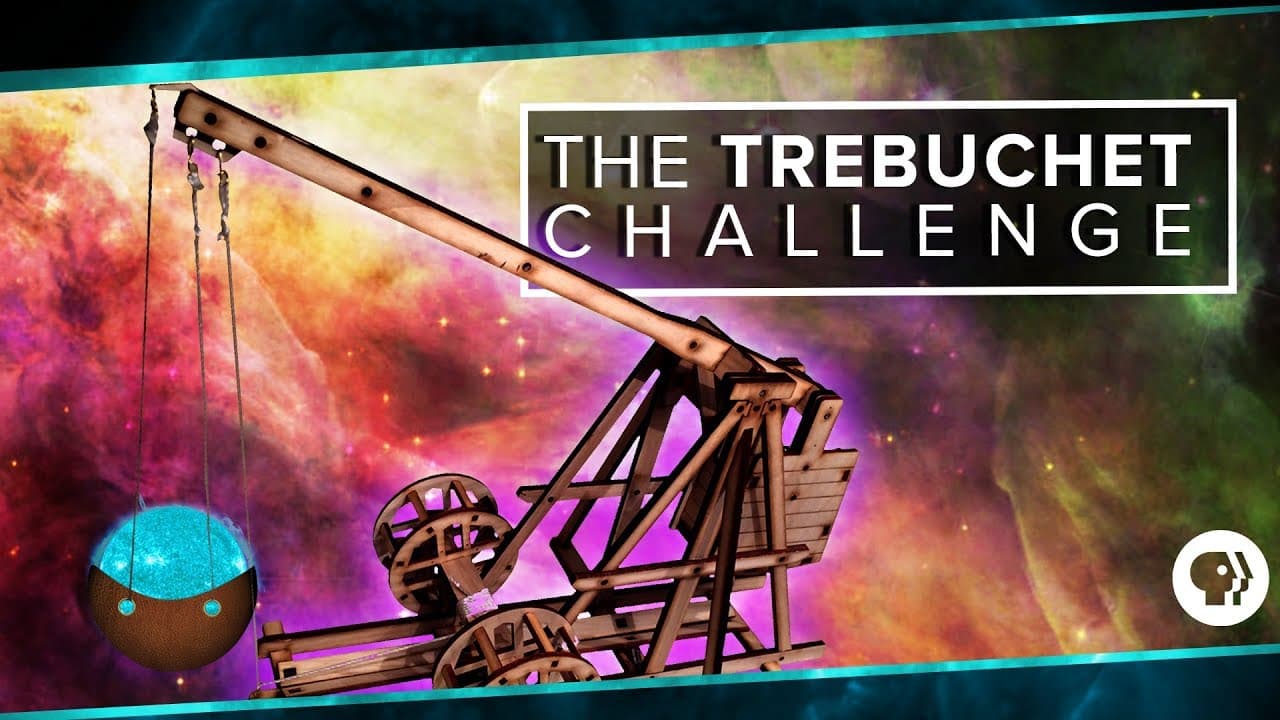
- The trebuchet, a medieval siege engine, exemplifies efficient conversion of potential energy into kinetic energy, using a lever mechanism.
- The trebuchet's design allows a counterweight to swing a projectile with high speed, demonstrating principles of energy conservation.
- Calculating the trebuchet's projectile speed can be simplified using energy conservation laws, bypassing complex force vector analyses.
- Assumptions in the trebuchet model include no energy loss to friction or air resistance, and negligible lever arm mass compared to the counterweight.
- The video poses a challenge to viewers to calculate projectile speed, emphasizing energy's role in simplifying complex physical calculations.
- Energy conservation insights highlight fundamental symmetries in nature, with practical applications in various fields, including siege warfare.
Install to Summarize YouTube Videos and Get Transcripts
Explore YouTube Video Summarizer or Get YouTube Transcript Extractor
Questions & Answers
Q: What is the main focus of the video?
The main focus of the video is to explore the concept of energy in physics, specifically how it can be applied to understand and calculate the mechanics of a trebuchet, a medieval siege engine. The video highlights the efficiency of energy conversion in trebuchets and challenges viewers to apply energy conservation principles to solve related problems.
Q: How does the trebuchet demonstrate energy conservation?
The trebuchet demonstrates energy conservation by efficiently converting the potential energy of a heavy counterweight into the kinetic energy of a projectile. The lever mechanism allows the counterweight to swing a projectile at high speed, showing how energy can be transferred and conserved within a system, despite its components' different masses and paths.
Q: What assumptions are made in the trebuchet model?
The trebuchet model assumes no energy loss due to friction or air resistance, and that the mass of the lever arm is negligible compared to the counterweight and projectile. These simplifications allow for a clearer analysis of energy conservation principles, focusing on the start and end points of the counterweight and projectile to determine their energies.
Q: Why is energy considered a powerful tool in physics calculations?
Energy is considered a powerful tool in physics calculations because it provides a clear, quantifiable measure that remains conserved across systems. This allows for the simplification of complex problems, such as the mechanics of a trebuchet, by focusing on energy transfer and conservation rather than intricate force vector analyses, making calculations more manageable and insightful.
Q: What challenge does the video pose to viewers?
The video challenges viewers to calculate the speed of a trebuchet's projectile using energy conservation principles. Viewers are encouraged to apply the concepts discussed, such as potential and kinetic energy, to determine the projectile's speed based on the masses and start and end locations of the counterweight and projectile, demonstrating the practical application of energy in problem-solving.
Q: How does the video relate energy to fundamental symmetries of nature?
The video relates energy to fundamental symmetries of nature by highlighting how the conservation of kinetic and potential energy reflects underlying symmetrical properties in physical systems. This insight into nature's symmetries is crucial for understanding the consistent behavior of physical laws across different scales and scenarios, such as the operation of a trebuchet.
Q: What is the significance of the trebuchet in the context of the video?
In the context of the video, the trebuchet serves as a practical example of how energy principles can be applied to real-world scenarios. It illustrates the efficient conversion of potential to kinetic energy and provides a platform for viewers to engage with energy conservation calculations, reinforcing the video's educational focus on physics and mechanics.
Q: What educational approach does the video take?
The video takes an educational approach by combining theoretical discussions of energy with practical applications, such as the mechanics of a trebuchet. It encourages active learning through viewer challenges and problem-solving exercises, aiming to deepen understanding of energy conservation and its relevance in both historical and modern contexts.
Summary & Key Takeaways
-
The video discusses the concept of energy in physics, contrasting its precise definition with its vague metaphysical use, and explores its application in trebuchets.
-
A trebuchet efficiently converts potential energy into kinetic energy through a lever mechanism, exemplifying energy conservation principles in practical scenarios.
-
Viewers are challenged to calculate the speed of a trebuchet's projectile using energy conservation laws, showcasing the power of energy in simplifying complex calculations.
Read in Other Languages (beta)
Share This Summary 📚
Summarize YouTube Videos and Get Video Transcripts with 1-Click
Try YouTube Summary with ChatGPT & Claude or YouTube Transcript Generator
Explore More Summaries from PBS Space Time 📚



Summarize YouTube Videos and Get Video Transcripts with 1-Click
Try YouTube Summary with ChatGPT & Claude or YouTube Transcript Generator