What Is Thermal Stress and How Is It Calculated?
TL;DR
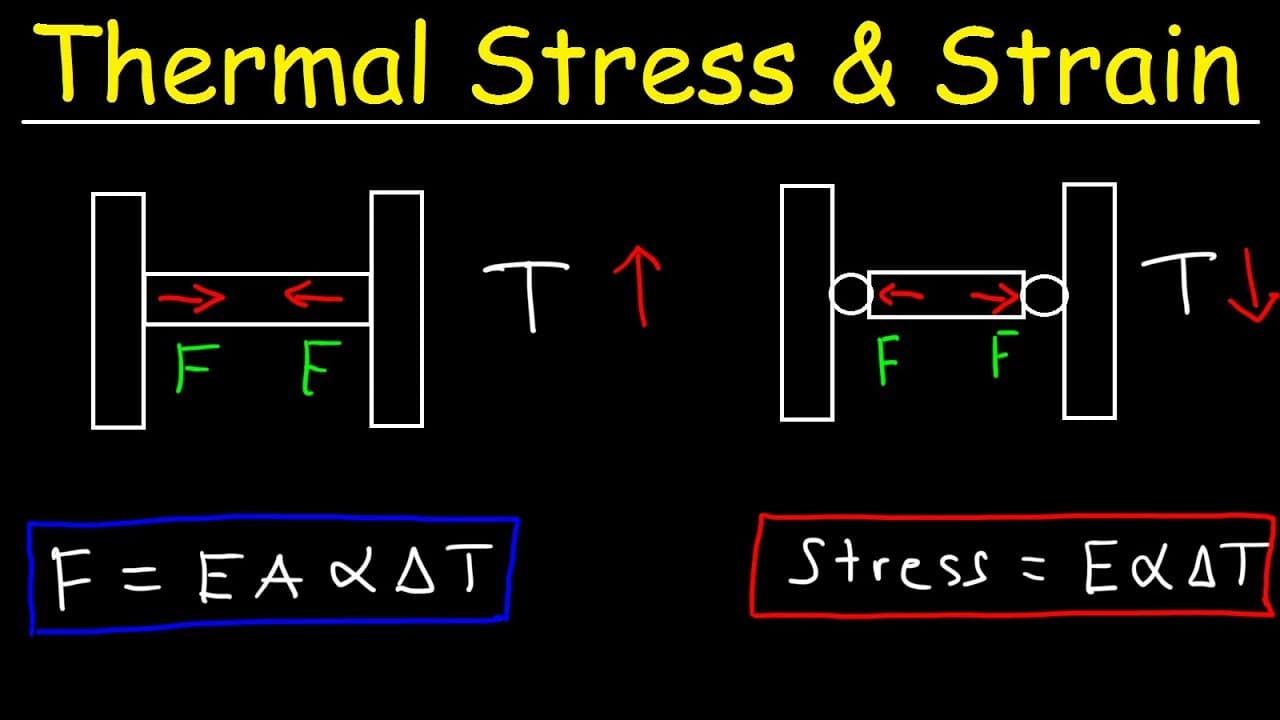
Thermal stress occurs when materials expand or contract due to temperature changes while being restrained, resulting in compressive or tensile forces. It can be calculated using the elastic modulus, coefficient of linear expansion, and change in temperature. For example, the compressive force on a steel rod can be calculated by combining these factors to determine the stress experienced by the material.
Transcript
in this video we're going to focus on thermal stress and strain so let's start with the first problem a steel circular rod with a radius of 10 centimeters is placed between two vertical supports at 15 degrees celsius what compressive force is exerted by the vertical supports if the temperature increases to 40 celsius so let's say that's the first v... Read More
Key Insights
- 💱 Thermal stress occurs when materials expand or contract due to changes in temperature and are restrained by external forces.
- 🚦 The compressive force exerted by vertical supports on a steel rod can be calculated using the elastic modulus, area, coefficient of linear expansion, and change in temperature.
- 🤢 The tensile force exerted by clamps on an aluminum bar can be determined using the elastic modulus, coefficient of linear expansion, and change in temperature.
Install to Summarize YouTube Videos and Get Transcripts
Explore YouTube Video Summarizer or Get YouTube Transcript Extractor
Questions & Answers
Q: How does thermal stress affect a steel rod placed between two vertical supports?
When the temperature increases, the steel rod expands, but the vertical supports exert a compressive force to prevent this expansion, resulting in thermal stress.
Q: How is the compressive force exerted by the vertical supports calculated?
The compressive force can be calculated using the equation: compressive force = elastic modulus × area × coefficient of linear expansion × change in temperature.
Q: What happens to an aluminum bar when the temperature decreases?
The aluminum bar contracts, but because it is clamped between two supports, it experiences a tensile force that stretches it back to its original length, causing thermal stress.
Q: How can the thermal stress on the aluminum bar be calculated?
The thermal stress can be calculated using the equation: thermal stress = elastic modulus × coefficient of linear expansion × change in temperature.
Summary & Key Takeaways
-
In the first scenario, a steel rod between two vertical supports experiences compressive force when the temperature increases, preventing it from expanding.
-
In the second scenario, an aluminum bar clamped between two supports experiences tensile force when the temperature decreases, stretching it back to its original length.
-
The maximum temperature a concrete block can reach without fracturing can be calculated based on its ultimate compressive strength, elastic modulus, and coefficient of linear expansion.
Read in Other Languages (beta)
Share This Summary 📚
Summarize YouTube Videos and Get Video Transcripts with 1-Click
Try YouTube Summary with ChatGPT & Claude or YouTube Transcript Generator
Explore More Summaries from The Organic Chemistry Tutor 📚

Summarize YouTube Videos and Get Video Transcripts with 1-Click
Try YouTube Summary with ChatGPT & Claude or YouTube Transcript Generator