Newton's 2nd Law (8 of 21) Calculate Acceleration w/o Friction; Inclined Plane, One Mass
TL;DR
Determine acceleration on a frictionless inclined plane with Newton's second law.
Transcript
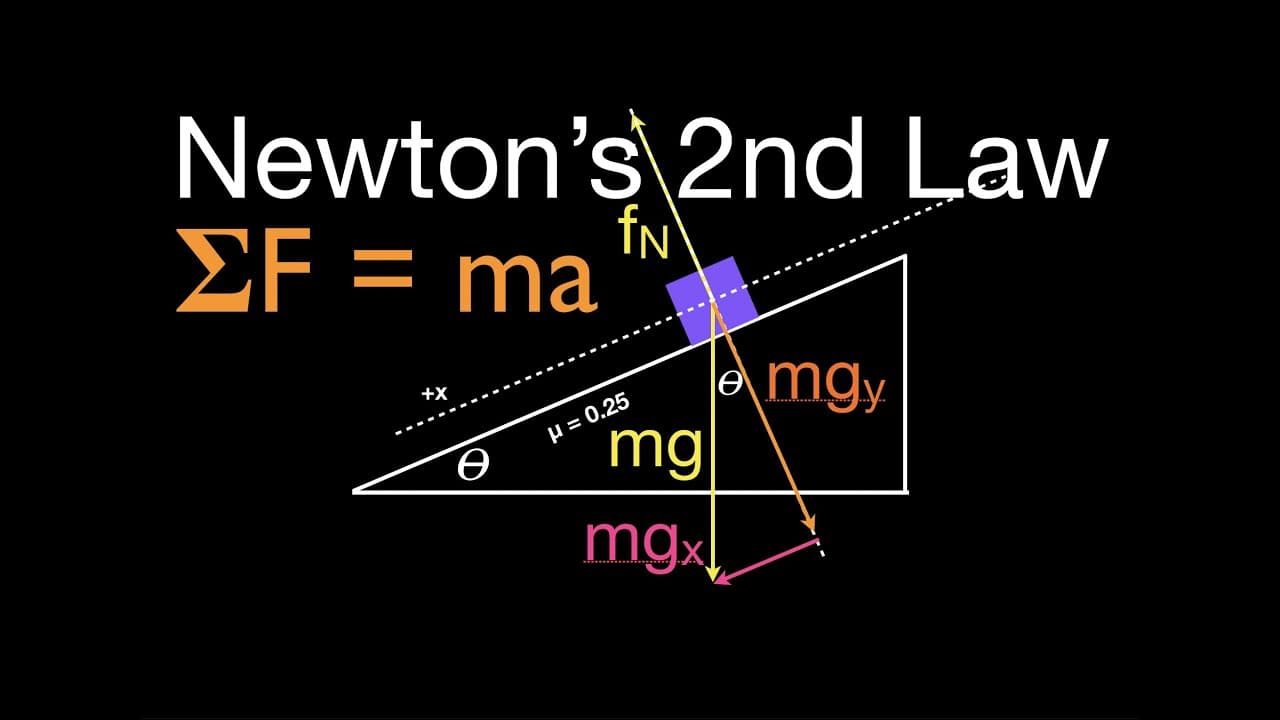
via we are going to go over how to determine the acceleration of an object that is sliding down an inclined plane and there is no friction between the object and the inclined plane here is the purple object here is the inclined plane there is no I fiction between this object and the inclined plane okay this is the question we want to know what is t... Read More
Key Insights
- ✈️ Frictionless inclined planes result in no opposing forces to the object's motion.
- 🧑🏭 Gravity and normal forces are the primary forces acting on an object on an inclined plane.
- ☺️ The X component of gravity contributes to the acceleration of the object down the incline.
- 💆 Acceleration on an inclined plane is determined by the angle of inclination, not the object's mass.
- 👨💼 Trigonometric functions like sine and cosine can help calculate force components on an inclined plane.
- 👮♂️ Newton's second law, F=ma, is used to find the acceleration on an inclined plane.
- 💆 The acceleration on an inclined plane is unaffected by the mass of the object.
Install to Summarize YouTube Videos and Get Transcripts
Explore YouTube Video Summarizer or Get YouTube Transcript Extractor
Questions & Answers
Q: How do you determine the acceleration of an object on a frictionless inclined plane?
To find the acceleration, use Newton's second law by summing up forces in the X direction and dividing by the mass of the object. The acceleration depends on the angle of the inclined plane, not the mass.
Q: What are the key forces acting on an object on an inclined plane?
The main forces are gravity acting downwards and the normal force acting upwards perpendicular to the inclined plane. The X component of gravity causes the object to accelerate down the incline.
Q: Why does the acceleration on an inclined plane not depend on the mass of the object?
The acceleration on an inclined plane is independent of mass because it only relies on the angle of the incline. Mass does not play a role in determining the acceleration in this scenario.
Q: How can trigonometry be used to calculate the components of the gravitational force?
By using sine and cosine functions, the Y and X components of the gravitational force can be determined based on the angle of the incline. Sine relates to the opposite side, while cosine relates to the adjacent side in a right triangle.
Summary & Key Takeaways
-
Calculate acceleration on a frictionless inclined plane without friction.
-
Use Newton's second law to find the acceleration in the X direction.
-
The mass of the object does not affect the acceleration on the inclined plane.
Read in Other Languages (beta)
Share This Summary 📚
Summarize YouTube Videos and Get Video Transcripts with 1-Click
Try YouTube Summary with ChatGPT & Claude or YouTube Transcript Generator
Explore More Summaries from Step by Step Science 📚

Summarize YouTube Videos and Get Video Transcripts with 1-Click
Try YouTube Summary with ChatGPT & Claude or YouTube Transcript Generator