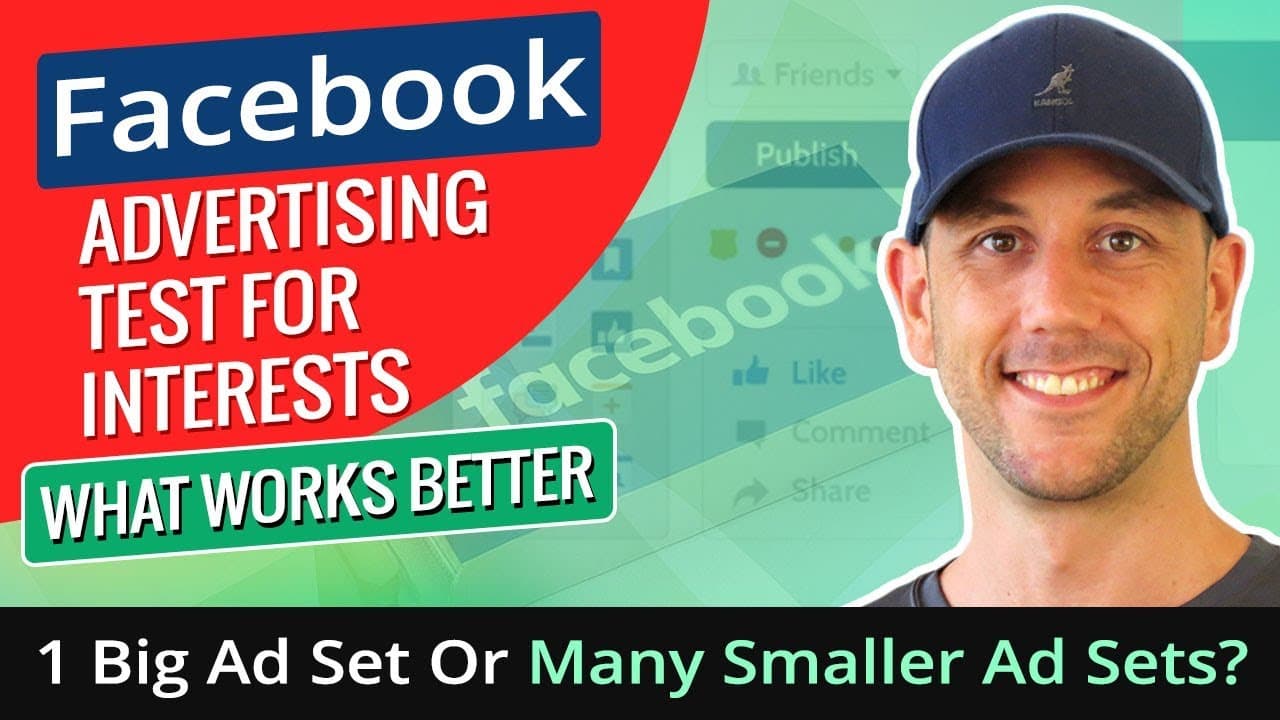
Facebook Advertising Test For Interests - What Works Better, 1 Big Ad Set Or Many Smaller Ad Sets?
TL;DR
Testing reveals smaller ad sets yield better Facebook ad results.
Transcript
miles here miles Becker calm and in this video I'm gonna share with you the results of some tests that I just concluded about Facebook advertising specifically at the ad set level I wanted to answer the question what's the better way to approach multiple interests at the ad set level is it better to group them all together into one ad set and incre... Read More
Key Insights
- Testing different ad set strategies in Facebook advertising can reveal significant differences in cost efficiency and lead acquisition.
- Grouping multiple interests into one ad set resulted in higher costs per lead, approximately $3, compared to separating interests.
- Separating interests into individual ad sets at $5 per day significantly reduced the cost per lead to around 55 cents.
- The machine learning system in Facebook ads performs better with more data at the ad set level, influencing ad set strategy.
- Facebook's ad spending behavior can vary significantly based on how ad sets are structured, impacting overall budget efficiency.
- Understanding customer lifetime value and average cost per lead is crucial for making informed advertising decisions.
- The $5 per day ad set strategy allows for more controlled spending and better optimization of lead acquisition costs.
- Continuous testing and adaptation of Facebook ad strategies are essential for maintaining profitability and effective ad spend.
Install to Summarize YouTube Videos and Get Transcripts
Explore YouTube Video Summarizer or Get YouTube Transcript Extractor
Questions & Answers
Q: What was the purpose of the Facebook advertising test?
The purpose of the Facebook advertising test was to determine the most cost-effective strategy for managing ad sets. The test compared grouping multiple interests into one ad set against separating them into smaller, individual ad sets. The goal was to identify which approach resulted in better cost per lead and overall advertising efficiency.
Q: What were the results of grouping interests into one ad set?
Grouping multiple interests into one ad set resulted in a higher cost per lead, approximately $3. This approach was significantly less efficient compared to separating the interests into individual ad sets. The higher cost per lead indicated that the machine learning system did not perform optimally when handling multiple interests within a single ad set.
Q: How did separating interests into individual ad sets affect the results?
Separating interests into individual ad sets with a $5 daily budget drastically reduced the cost per lead to around 55 cents. This approach allowed for more precise targeting and optimization, leveraging Facebook's machine learning system more effectively. The lower cost per lead made this strategy more viable and profitable for the advertiser.
Q: Why is understanding customer lifetime value important in Facebook advertising?
Understanding customer lifetime value is crucial because it informs how much an advertiser can afford to spend on acquiring a lead. By knowing the average revenue generated per customer over time, advertisers can set appropriate budgets and expectations for their campaigns, ensuring they remain profitable or at least break even in the long run.
Q: What role does Facebook's machine learning system play in ad set performance?
Facebook's machine learning system plays a significant role in ad set performance by optimizing ad delivery based on data. When more data is available at the ad set level, the system can make better decisions, potentially improving results. The test showed that smaller, more focused ad sets allowed the system to perform more effectively, reducing costs.
Q: How does the $5 per day ad set strategy work?
The $5 per day ad set strategy involves creating multiple ad sets, each focused on a single interest, with a daily budget of $5. This approach allows advertisers to test and optimize each interest individually, leading to more precise targeting and potentially lower costs per lead. It provides more control over spending and facilitates better performance analysis.
Q: What insights were gained about Facebook's ad spending behavior?
The test revealed that Facebook's ad spending behavior can vary significantly based on ad set structure. Grouping interests into a single ad set led to higher spending without proportional results, while separating them allowed for more controlled and efficient use of the budget. This suggests that Facebook's system may spend more aggressively when interests are grouped together.
Q: Why is continuous testing important in Facebook advertising?
Continuous testing is important in Facebook advertising because it allows advertisers to adapt to changing conditions and optimize their strategies for better results. By regularly testing different approaches, advertisers can identify what works best for their specific goals and audience, ensuring they remain competitive and cost-effective in their ad campaigns.
Summary & Key Takeaways
-
The video discusses a test comparing two Facebook ad strategies: grouping interests in one ad set versus separating them into smaller ad sets. The latter approach proved more cost-effective, significantly reducing the cost per lead.
-
By separating interests into individual ad sets with a $5 daily budget, the cost per lead dropped from $3 to 55 cents, demonstrating the importance of testing and optimizing ad strategies for better results.
-
The speaker emphasizes the importance of understanding customer lifetime value and average cost per lead, suggesting that knowing these metrics can guide more effective advertising decisions on Facebook.
Read in Other Languages (beta)
Share This Summary 📚
Summarize YouTube Videos and Get Video Transcripts with 1-Click
Try YouTube Summary with ChatGPT & Claude or YouTube Transcript Generator
Explore More Summaries from Miles Beckler 📚




Summarize YouTube Videos and Get Video Transcripts with 1-Click
Try YouTube Summary with ChatGPT & Claude or YouTube Transcript Generator