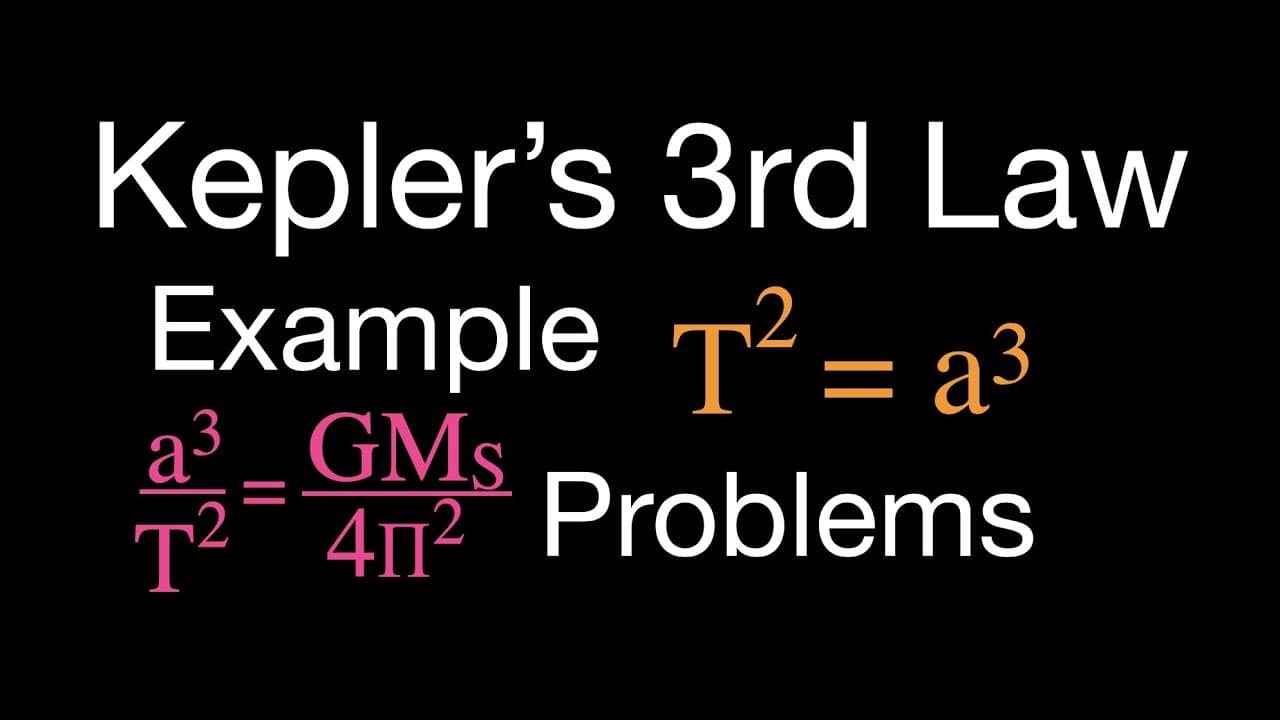
Gravitation: Kepler’s Laws of Planetary Motion, Example Problems
TL;DR
Solving six fascinating example problems using Kepler's third law for planetary motion.
Transcript
in today's video we are going to go over six different very interesting example problems for kepler's third law of planetary motion now before we get started please don't forget to subscribe to my channel step by step science get all my excellent physics chemistry and math videos when i look at my youtube analytics i see that more than 90 of people... Read More
Key Insights
- 👮 Kepler's third law relates the orbital period and semi-major axis of planets in an elegant mathematical relationship.
- 👮 Applications of Kepler's third law extend beyond planets to moons orbiting them in the solar system.
- 🤩 Kepler's constant provides a key value for calculations related to planetary motion across different celestial bodies.
- 👻 Understanding Kepler's third law allows for precise calculations of orbital parameters for various astronomical objects.
- 👮 Real data from the solar system can be utilized to solve practical problems involving Kepler's third law.
- 👮 Knowledge of Kepler's laws is fundamental to understanding the dynamics of planetary motion in our solar system.
- 🦾 Kepler's law of planetary motion forms the basis for modern celestial mechanics and astrodynamics.
Install to Summarize YouTube Videos and Get Transcripts
Explore YouTube Video Summarizer or Get YouTube Transcript Extractor
Questions & Answers
Q: What does Kepler's third law state?
Kepler's third law states that the square of a planet's orbital period is proportional to the cube of the length of its semi-major axis.
Q: How can Kepler's third law be used to calculate orbital periods?
By utilizing the relation t^2 = a^3, one can determine the time a planet takes to orbit the sun based on its semi-major axis.
Q: What is the significance of Kepler's constant in the calculations?
Kepler's constant serves as a universal value that remains consistent across different celestial bodies, aiding in the calculations of orbital parameters.
Q: How does Kepler's third law apply to determining the mass of celestial bodies?
By rearranging the formula, one can derive the mass of a central object like the sun or Jupiter based on the semi-major axis and orbital period of its orbiting bodies.
Summary & Key Takeaways
-
Six example problems showcasing the application of Kepler's third law for planetary motion.
-
Demonstrates how to calculate orbital periods, masses, and distances using Kepler's laws.
-
Utilizes real data for planets and moons in the solar system to solve for various parameters.
Read in Other Languages (beta)
Share This Summary 📚
Summarize YouTube Videos and Get Video Transcripts with 1-Click
Try YouTube Summary with ChatGPT & Claude or YouTube Transcript Generator
Explore More Summaries from Step by Step Science 📚
Summarize YouTube Videos and Get Video Transcripts with 1-Click
Try YouTube Summary with ChatGPT & Claude or YouTube Transcript Generator