ICT - Trading Plan Development 5
TL;DR
Explores intermediate term trading strategies using macroeconomic indicators and market analysis.
Transcript
okay folks we are looking at the intermediate term trading plan example and then what we're going to cover them in this module is going to be just an example like it's states here there's gonna be certain aspects of this particular example of a plan where I can suggest that you could use other tools or applications and where... Read More
Key Insights
- Intermediate term trading requires patience and understanding of higher timeframe market structures, unlike short-term trading strategies like scalping or intraday trading.
- The trading plan focuses on using the daily chart to identify intermediate term price swings, with trades lasting several weeks to months.
- Bullish conditions are identified by seasonal tendencies, interest rate movements, and weakening of the US dollar, while bearish conditions involve risk-off scenarios and strengthening of the US dollar.
- The plan emphasizes the importance of monitoring interest rates, Treasury notes, and the Commitment of Traders (COT) report to anticipate market movements.
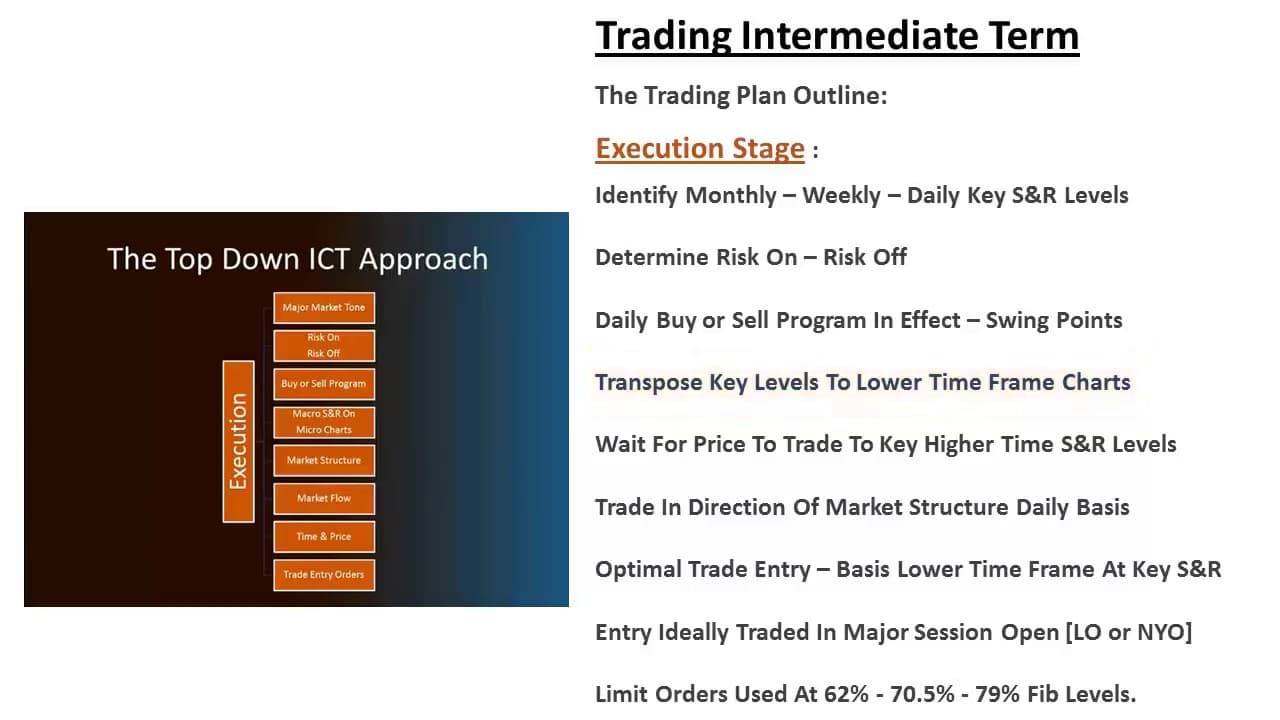
- Key support and resistance levels on monthly, weekly, and daily charts are crucial for setting up trades and identifying potential market signals.
- The execution stage involves determining risk scenarios, using optimal trade entry patterns, and transposing higher timeframe levels to lower timeframes for precise entry points.
- The trading plan includes using Fibonacci retracement and extension levels for entry and profit-taking, with strict risk management by capping risk at 2% per trade.
- Understanding macroeconomic indicators and market correlations, such as stock indices and currency pair divergences, is essential for anticipating market shifts and executing successful trades.
Install to Summarize YouTube Videos and Get Transcripts
Explore YouTube Video Summarizer or Get YouTube Transcript Extractor
Questions & Answers
Q: What is the primary focus of the intermediate term trading plan?
The primary focus of the intermediate term trading plan is to trade intermediate term price swings found on the daily chart. The plan is designed to identify and capitalize on market movements that last several weeks to months, emphasizing the importance of patience and understanding of higher timeframe market structures.
Q: How does the plan suggest identifying bullish market conditions?
The plan suggests identifying bullish market conditions by looking for seasonal tendencies, monitoring interest rates for potential increases, and observing a weakening of the US dollar. It also involves analyzing Treasury notes and the Commitment of Traders report for signs of market sentiment shifts and potential buying opportunities.
Q: What role do key support and resistance levels play in the trading plan?
Key support and resistance levels are crucial in the trading plan as they serve as catalysts for identifying potential market signals and setting up trades. The plan emphasizes the need to identify these levels on monthly, weekly, and daily charts to facilitate informed trading decisions and enhance the likelihood of successful trades.
Q: What is the significance of the Commitment of Traders (COT) report in the plan?
The Commitment of Traders (COT) report plays a significant role in the plan by providing insights into the positions of commercial traders. The plan uses the COT report to gauge market sentiment and anticipate potential market movements, such as identifying when commercials are net long or net short, which can indicate bullish or bearish conditions.
Q: How does the plan incorporate Fibonacci retracement and extension levels?
The plan incorporates Fibonacci retracement and extension levels as tools for determining entry and profit-taking points. It suggests using these levels to identify optimal trade entry points and to set targets for taking profits, ensuring trades are executed with precision and in alignment with the market structure on the daily chart.
Q: What is the approach to risk management in the trading plan?
The trading plan emphasizes strict risk management by capping the maximum risk at 2% per trade. It includes strategies for reducing risk after taking losses and stresses the importance of preserving equity. The plan also advises moving stop-loss orders to break-even after securing initial profits, creating a risk-free scenario for the remainder of the trade.
Q: How does the plan suggest using macroeconomic indicators for trading?
The plan suggests using macroeconomic indicators, such as interest rates, Treasury notes, and the US dollar index, to anticipate market shifts and inform trading decisions. It highlights the importance of understanding market correlations and divergences, such as those between stock indices and currency pairs, to identify potential trading opportunities.
Q: What is the importance of patience in the intermediate term trading plan?
Patience is crucial in the intermediate term trading plan as it involves waiting for trades to set up and unfold over several weeks to months. The plan emphasizes that most traders may lack the patience required at the early stages of their development, but mastering this aspect is essential for successfully executing the strategies outlined in the plan.
Summary & Key Takeaways
-
The content provides a detailed overview of an intermediate term trading plan, emphasizing the need for patience and understanding of higher timeframe market structures. It explains how to use daily charts to identify price swings lasting weeks to months.
-
The trading plan outlines strategies for identifying bullish and bearish market conditions using macroeconomic indicators like interest rates, Treasury notes, and the Commitment of Traders report. It highlights the importance of key support and resistance levels.
-
Execution involves determining risk scenarios, using optimal trade entry patterns, and applying strict risk management. The plan stresses the importance of macroeconomic indicators and market correlations for successful trading.
Read in Other Languages (beta)
Share This Summary 📚
Summarize YouTube Videos and Get Video Transcripts with 1-Click
Try YouTube Summary with ChatGPT & Claude or YouTube Transcript Generator
Explore More Summaries from The Inner Circle Trader 📚



Summarize YouTube Videos and Get Video Transcripts with 1-Click
Try YouTube Summary with ChatGPT & Claude or YouTube Transcript Generator